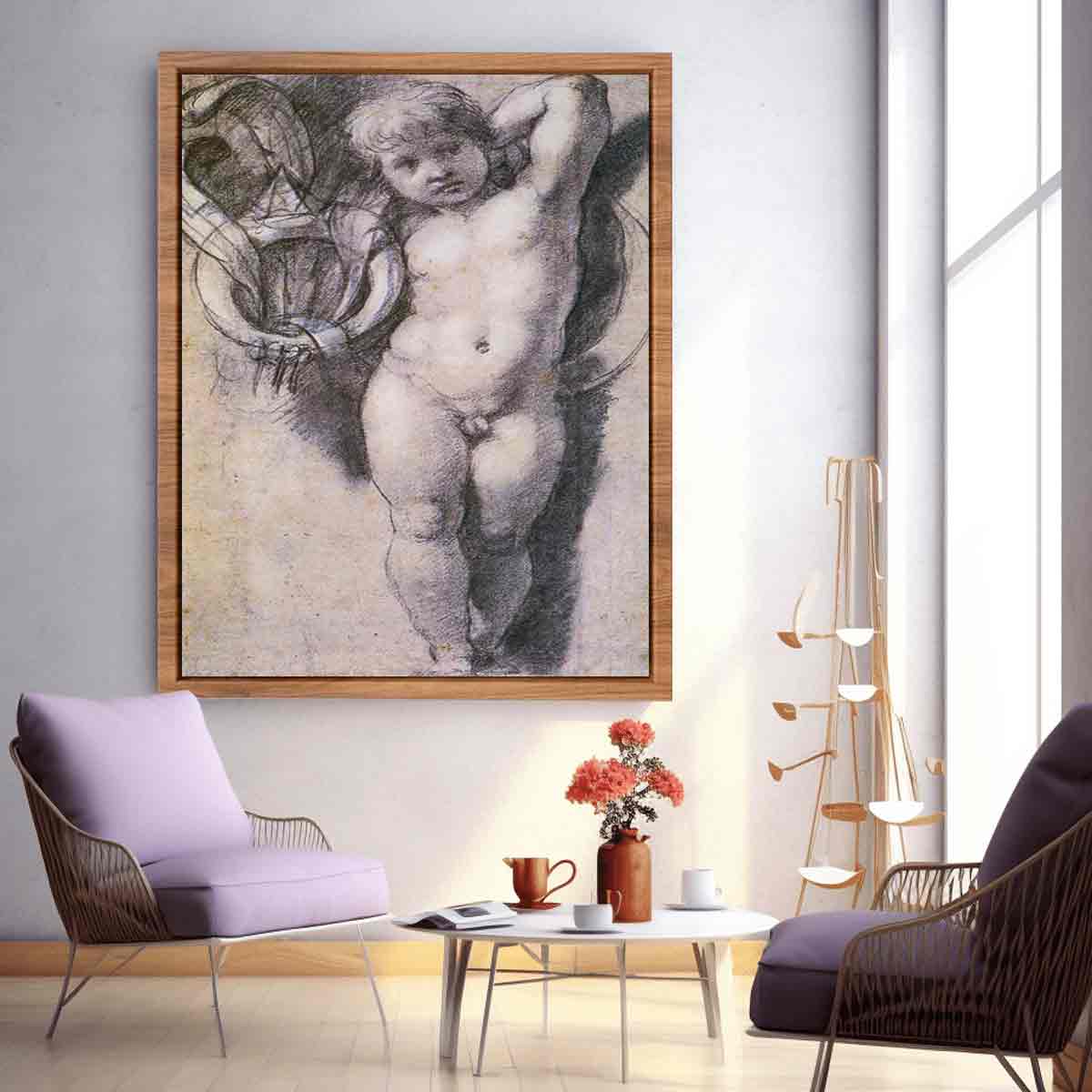
Putto with Medici Symbols by Raphael: A Refined Renaissance Drawing
Raphael’s Putto with Medici Symbols reveals a quieter side of the artist’s genius. Rather than a monumental fresco or celebrated altarpiece, this work is an intimate figure study associated with Raphael’s mature Roman period. Dated to 1514 and executed in black chalk heightened with white, the drawing is connected with the world of Renaissance design and Medici symbolism. The original is associated with the Teylers Museum in Haarlem. For collectors, this makes it an unusually sophisticated choice: it combines the classical putto, Renaissance anatomy, drawing technique and the political symbolism of the Medici family in a single sheet.
The Putto as a Renaissance Motif
Putti were among the most versatile figures in Renaissance decorative art. Derived partly from classical imagery, they could appear in religious scenes, architectural ornament, allegories and celebratory programs. Raphael was particularly accomplished at giving these youthful figures natural movement. In Putto with Medici Symbols, the nude body becomes a vehicle for exploring proportion, balance and gesture. The figure is decorative but not superficial. Raphael uses the child-like form to demonstrate his understanding of anatomy while also incorporating symbolic imagery connected with one of Renaissance Italy’s most influential families.
Medici Power in Raphael’s Rome
The Medici connection adds historical significance. Giovanni de’ Medici became Pope Leo X in 1513, only a year before the drawing’s date. Raphael worked extensively under Leo X, and Medici identity was therefore closely tied to the cultural and political world in which the artist operated. Symbols associated with the family could communicate patronage, dynastic identity and authority. The putto offers an elegant way to integrate those symbols into a classical visual language rather than presenting them as dry heraldic information.
Black Chalk and White Light
The technique is one of the drawing’s most attractive features. Black chalk establishes the principal contours and tonal structure, while white highlighting can bring selected areas of the body forward. This method gives the figure a sculptural presence. Light appears to move across the anatomical forms, making the body feel three-dimensional even though the image remains fundamentally linear. A high-quality reproduction can preserve this monochromatic sophistication and is particularly suited to interiors that favor restrained palettes, classical furniture, libraries or contemporary gallery walls.
A Window into Raphael’s Working Process
Renaissance drawings are valuable because they expose stages of artistic thinking that finished paintings often conceal. Raphael produced studies for figures, gestures, compositions and decorative elements as part of a highly organized creative process. Putto with Medici Symbols allows viewers to encounter that process directly. The drawing has the intimacy of a working sheet but the refinement of a finished work on paper. For a collector, this can be more revealing than a conventional reproduction of a famous painting because it shows Raphael thinking through the body, pose and symbolic details.
Why It Works Beautifully as Wall Art
The limited palette makes the work remarkably versatile. A fine art print can preserve the appearance of an Old Master drawing, while canvas can enlarge the putto and emphasize its sculptural qualities. Framing is especially appropriate because Renaissance drawings are traditionally encountered as carefully presented works on paper. A hand-painted interpretation can offer a different experience for buyers who prefer a tactile surface. The image is equally at home in a library, study, bedroom, gallery wall or sophisticated living space.
The Historical Appeal of the Medici Symbolism
Displaying this artwork also introduces a connection with the broader history of Florence, Rome and Renaissance patronage. The Medici family helped shape European art through generations of support for painters, sculptors, architects and intellectuals. Under Leo X, Medici identity entered the papal environment in which Raphael was one of the dominant artists. The putto therefore sits at an intersection of art, politics and patronage. That historical layer makes the drawing particularly attractive to serious collectors.
Choose a Distinctive Raphael Reproduction
Putto with Medici Symbols is an excellent option for anyone who wants Raphael wall art that feels less predictable than the artist’s most famous Madonnas and frescoes. It offers the elegance of Renaissance drawing, the study of the nude figure, the decorative charm of a putto and the historical resonance of Medici symbolism. Whether selected as a fine art print, canvas, framed reproduction or hand-painted interpretation, it can bring the intellectual refinement of Raphael’s Roman period into a contemporary collection. Its intimate scale and monochrome character also make it unusually easy to integrate with other artworks while retaining a distinctive identity of its own.
Raphael’s Intimate Side
Compared with Raphael’s vast Vatican frescoes, this drawing feels private and concentrated. That intimacy is part of its value. The viewer can see the artist’s attention moving across the figure rather than simply reading a completed narrative. The Medici symbols add a second layer, connecting the graceful putto with the world of patronage and power. For a collector, the result is an artwork that can be discussed from several directions: drawing technique, anatomy, classical decoration, Renaissance politics and Medici history.
Why Collectors Look Beyond Raphael’s Famous Paintings
Raphael’s most recognizable works are often large religious paintings, but his drawings reveal the breadth of his practice. Putto with Medici Symbols offers a different experience because its scale and monochrome medium invite close attention. The viewer can follow the contours of the body, observe the white highlights and consider the relationship between the figure and the Medici imagery. This is ideal for collectors who want art that feels scholarly and intimate. The work can also complement larger Raphael paintings in a collection, providing a quieter counterpoint to monumental compositions. Its connection with the Medici world gives it an additional historical story, making the piece suitable for buyers interested in Renaissance patronage as well as drawing.