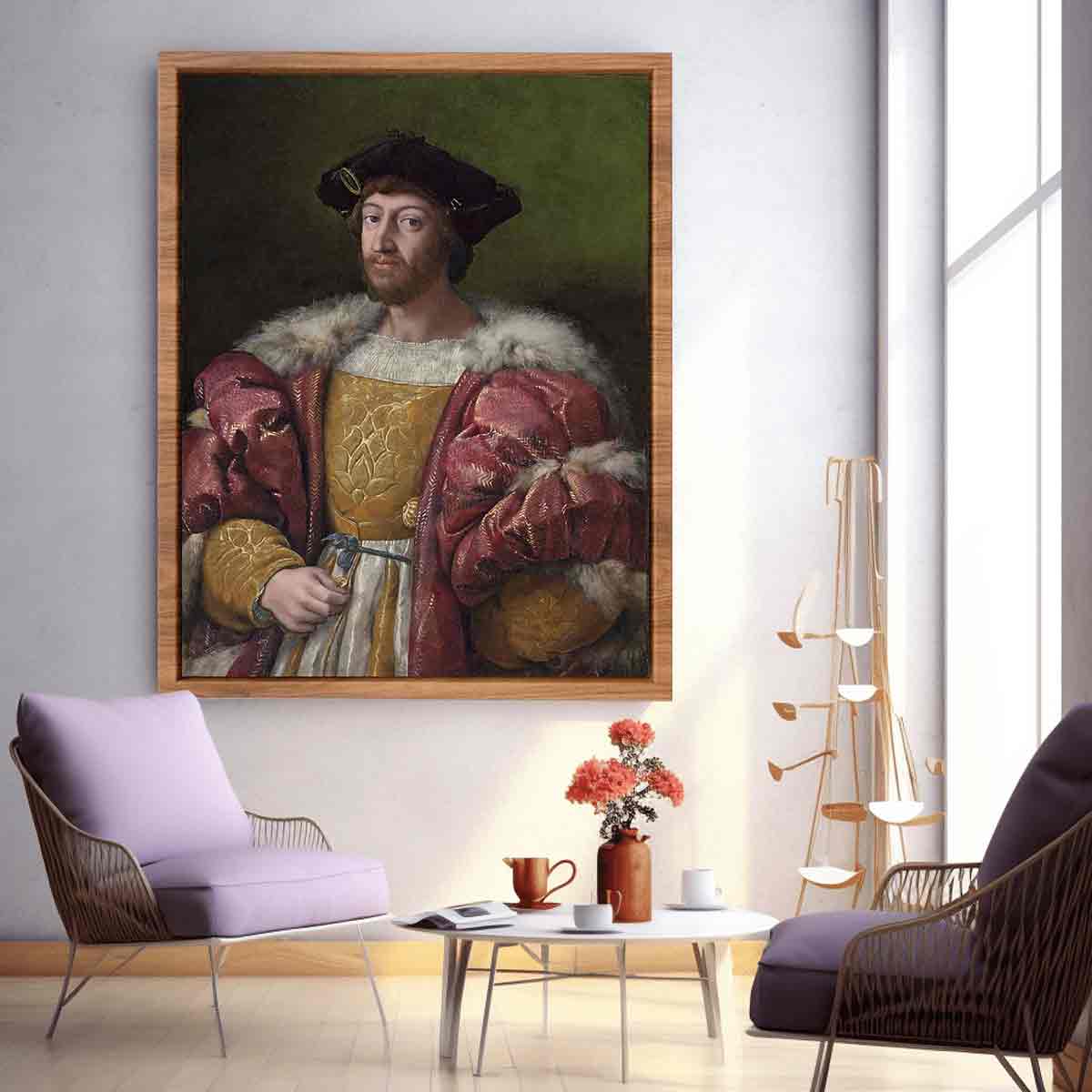
Portrait of Lorenzo di Medici, Duke of Urbino By Raphael
-23%
Portrait of Lorenzo di Medici, Duke of Urbino By Raphael

Portrait of Lorenzo di Medici, Duke of Urbino By Raphael

Regular price $129.00 Sale price $99.00

Go kalles this summer with this vintage navy and white striped v-neck t-shirt from the Nike. Perfect for pairing with denim and white kicks for a stylish kalles vibe.

1. Select Type: Museum Canvas
2. Select Finish Option: Rolled Canvas
3. Select Size: 60cm X 90cm [24" x 36"]
Add to Wishlist
Add to Compare
Artist: Raphael
SKU: FA-RAP-217-S1
Portrait of Lorenzo di Medici, Duke of Urbino By Raphael

Portrait of Lorenzo di Medici, Duke of Urbino By Raphael

Print & Painting Options

One Famous Painting. Four Beautiful Ways to Own It.

Choose the finish that best matches the way you want to experience this masterpiece. Alpha Art Gallery offers Museum-Quality Canvas Prints, Fine Art Paper Prints, Satin Photo Paper Prints and 100% Hand-Painted Oil Paintings—each with its own surface, character and visual effect.

Premium Fine-Art Materials
Professional Pigment Printing
Ready-to-Hang Options
Real Hand-Painted Oils

Which option should you choose? Museum Canvas is ideal when you want texture and wall presence. Fine Art Paper gives a refined matte museum-print look. Satin Photo Paper offers richer colour with a subtle semi-gloss sheen. If you want a genuine painting rather than a print, choose our 100% Hand-Painted Oil Painting.

Most Popular

Museum-Quality Canvas Print

A premium textured reproduction that gives famous paintings the depth, scale and presence traditionally associated with canvas.

  • Premium approximately 400–450 GSM polycotton artist canvas*
  • Professional pigment printing for rich colour and fine detail
  • Natural canvas texture adds visual depth
  • Low-glare surface ideal for artwork display
  • Excellent choice for classical and famous painting reproductions
  • Available rolled, stretched or floating framed
Best for: art lovers who want a substantial, textured fine-art reproduction with strong gallery-style wall presence.
Rolled Canvas Same premium canvas, ready for your own local framer.
Stretched Canvas Professionally stretched and supplied ready to hang.
Floating Frame A premium contemporary presentation with an elegant shadow gap.
Why choose Museum Canvas? +

Famous paintings often contain subtle colour relationships, visible texture and compositional depth. A quality canvas reproduction provides a substantial surface that helps the image feel more like a piece of wall art than a conventional paper print. Stretched canvases use timber stretcher bars, while floating framed canvases place the stretched artwork inside an outer frame with an approximately 5 mm visual gap.

Refined Matte Finish

Fine Art Paper Print

A sophisticated fine-art reproduction with an elegant velvet-matte appearance and excellent detail.

  • Premium archival-grade fine-art paper*
  • Professional pigment printing
  • Soft velvet-matte appearance
  • Excellent tonal transitions and fine-detail reproduction
  • Low reflection compared with glossy surfaces
  • Especially beautiful when professionally framed
Best for: classical masterpieces, drawings, detailed paintings and customers who prefer an elegant museum-print presentation.
Why choose Fine Art Paper? +

Fine Art Paper is designed for viewers who value subtle detail and a restrained surface. The matte presentation helps minimize distracting reflections while preserving delicate lines, tonal shifts and colour relationships. It is an excellent choice for framed reproductions of well-known paintings and works on paper.

About framed Fine Art Prints +

Framed paper prints are presented in sleek wood frames with a contemporary slim profile and protective shatter-resistant plexiglass. Available frame choices vary by product and size. Framed options are supplied ready to hang.

Vibrant Semi-Gloss

Satin Photo Paper Print

A smooth, vivid reproduction with crisp detail and a subtle semi-gloss surface that gives colour and contrast extra impact.

  • Premium photographic print surface*
  • Elegant satin / semi-gloss appearance
  • Sharp image reproduction
  • Rich colour and strong contrast
  • More luminous than matte Fine Art Paper
  • Less reflective than traditional high-gloss photo paper
Best for: colourful masterpieces, modern art and customers who enjoy stronger colour with a subtle polished sheen.
Fine Art Paper or Satin Photo Paper? +

Choose Fine Art Paper for a soft matte museum-print appearance with minimal reflection. Choose Satin Photo Paper when you prefer stronger colour, crisp contrast and a gentle semi-gloss finish. Neither is universally better—the right choice depends on the artwork and your preferred visual style.

Collector's Choice

100% Hand-Painted Oil Painting

For customers who want a real painting rather than a print, this masterpiece is individually recreated by a skilled artist using real oil paint on canvas.

  • 100% hand-painted by a skilled artist
  • Real oil paint applied directly to canvas
  • Genuine brushstrokes and physical paint texture
  • Individually recreated rather than mechanically printed
  • No artificial printed brushstroke effect
  • Custom sizes and commissioned paintings available
Best for: collectors and art lovers who want the closest experience to owning a traditionally painted version of the masterpiece.
A Painting, Not a Print. Every hand-painted oil reproduction is created with real paint and genuine artist-applied brushwork. Subtle differences in brushwork and paint application are part of the character of an individually made painting.
Canvas Print vs Hand-Painted Oil Painting +

A canvas print reproduces the artwork using professional printing technology on textured canvas. A hand-painted oil painting is physically recreated by an artist using real oil paint, resulting in genuine brushstrokes, paint texture and handmade variation.

Compare the Four Artwork Formats

The main difference is the surface and how the artwork is created. The first three options are professionally printed reproductions. The oil painting option is individually painted by hand.

Artwork Type Surface Appearance Best Feature Best For
Museum Canvas Textured artist canvas Rich & gallery-style Texture & wall presence Classic famous painting reproductions
Fine Art Paper Velvet-matte fine-art paper Elegant & refined Fine detail Traditional framed presentation
Satin Photo Paper Smooth semi-gloss paper Vibrant & luminous Colour impact Colour-rich and modern artworks
Hand-Painted Oil Real oil paint on canvas Textured & painterly Genuine brushwork Collectors wanting a real painting

Still Not Sure Which One to Choose?

Most Popular Museum Canvas
Most Refined Fine Art Paper
Most Vibrant Satin Photo Paper
Most Authentic Hand-Painted Oil

Prefer Your Artwork Ready to Hang?

Choose a Stretched Canvas, Floating Framed Canvas or Framed Paper Print for a professionally finished presentation designed to go straight onto your wall.

Prefer to use your own framer? Choose Rolled Canvas.

Quick Buying Questions

Which format looks most like a traditional painting?

A 100% Hand-Painted Oil Painting provides the closest experience to a traditionally painted artwork because real oil paint is applied by hand. Among printed options, Museum Canvas provides the most painterly surface because of its visible canvas texture.

What is the difference between Canvas and Fine Art Paper?

Canvas has a textured woven surface and can be stretched or floating framed, giving the artwork more physical depth. Fine Art Paper has a smoother matte surface that emphasizes delicate detail and traditional framed presentation.

Which option is best for famous painting reproductions?

Museum Canvas is an excellent all-round option for famous paintings because it combines texture, visual presence and flexible framing choices. Fine Art Paper is ideal when subtle detail and a matte museum-print appearance are more important.

Which option has the strongest colour?

Satin Photo Paper generally provides the most vivid, polished colour appearance because its semi-gloss surface enhances contrast and luminosity.

*Exact paper, canvas, framing materials and specifications may vary by product, size or production location. Where a specific product page lists a different specification, that product-specific information takes precedence.

Portrait of Lorenzo di Medici, Duke of Urbino by Raphael

Raphael's Portrait of Lorenzo di Medici, Duke of Urbino is an exceptional example of Renaissance portraiture in which personal likeness, princely fashion and political identity become inseparable. Painted in 1518, the portrait presents Lorenzo de' Medici (1492–1519), Duke of Urbino and ruler of Florence, in a sophisticated three-quarter-length composition. He is shown in luxurious clothing, with a dark hat, rich red fabric, fur trim and a small gold box. The result is an image of aristocratic authority that remains remarkably compelling for modern collectors.

For buyers searching for Raphael portrait prints, Medici family wall art, Italian Renaissance canvas paintings or hand-painted Old Master reproductions, this work offers a distinctive subject. It is not a generic nobleman's portrait. Lorenzo was a member of the powerful Medici dynasty and nephew of Pope Leo X, and the painting was connected with his marriage negotiations with Madeleine de La Tour d'Auvergne. The portrait consequently carries both personal and dynastic meaning.

Lorenzo de' Medici as a Renaissance Prince

Lorenzo de' Medici was born in 1492, the grandson of Lorenzo the Magnificent and a member of the ruling Medici family of Florence. His political career unfolded during a period when the Medici were deeply involved in both Florentine government and papal affairs. His uncle, Giovanni de' Medici, became Pope Leo X, and Lorenzo's position as Duke of Urbino formed part of the family's wider ambitions.

Raphael's portrait therefore had a purpose beyond recording facial appearance. It presented Lorenzo as a sophisticated ruler whose clothing, posture and accessories communicated wealth and rank. The sitter's position within the composition makes him the unmistakable focus, while the absence of distracting narrative details allows the viewer to concentrate on his identity.

Christie's records the painting as a three-quarter-length portrait of Lorenzo holding a gold box, measuring approximately 97 by 79 cm and painted in oil on canvas. Its provenance begins with Lorenzo himself in Florence in 1518 and later passes through Medici collections before the work entered subsequent European and American collecting history.

The Portrait and Lorenzo's Marriage to Madeleine de La Tour d'Auvergne

The circumstances surrounding the portrait add a fascinating diplomatic dimension. Lorenzo was engaged to Madeleine de La Tour d'Auvergne, a relative of the French king. Contemporary correspondence records the exchange of portraits because the duke and his prospective bride had not yet met. Raphael's image was therefore part of a process in which likeness could travel between courts and establish the identity of an aristocratic stranger.

This makes the portrait particularly interesting for collectors of Renaissance portraiture. The painting is not merely a beautiful image of a young man; it belongs to the practical world of dynastic marriage, international politics and elite communication. Portraits could stand in for physical presence when political and family relationships were being negotiated across long distances.

The subject's clothing reinforces this international context. Lorenzo is presented in fashionable court dress rather than in simple Florentine attire. His appearance communicates his participation in the broader culture of European princely fashion.

Raphael's Three-Quarter Portrait Format

The three-quarter-length format gives Raphael enough space to describe Lorenzo's clothing and accessories while maintaining a close relationship with the viewer. The face remains highly prominent, but the body and garments are substantial enough to communicate social rank.

This was an effective solution for Renaissance court portraiture. A head-and-shoulders image could emphasize likeness, but a larger format allowed status to be shown through fabric, fur, jewelry, pose and objects. Raphael uses all of these elements without allowing them to overpower the sitter.

The composition has a sculptural quality. Lorenzo's body occupies the foreground with a controlled turn, while his face directs attention outward. The result feels formal but not stiff. He appears conscious of being represented, yet his expression retains a degree of individuality.

Fur, Crimson Fabric and Renaissance Luxury

The costume is one of the portrait's most memorable features. Lorenzo wears a richly colored garment edged with fur, topped by a dark hat. These materials immediately communicate wealth. In Renaissance Europe, clothing was a visual language of social position, and luxury fabrics and furs were particularly powerful indicators of rank.

Raphael's treatment of the costume is also important artistically. The darker hat frames the head, the red garment establishes warmth and depth, and the fur introduces a contrasting texture. These surfaces create a visual hierarchy that ultimately leads the eye back to Lorenzo's face.

As wall art, this makes the painting especially effective. The combination of dark, red and pale textures produces a strong silhouette that remains readable when the artwork is displayed at a substantial size. A canvas reproduction can emphasize these contrasts and give the portrait a commanding presence in a library, office, study or formal living room.

The Gold Box as a Detail of Status

Lorenzo holds a small gold box, an accessory that adds refinement to the portrait while helping Raphael solve the placement of the sitter's hands. Such objects could function as visual indicators of luxury, but they also gave aristocratic portraiture a sense of lived reality.

The gold object is deliberately modest in scale. It does not compete with Lorenzo's face, yet it rewards close observation. Its presence suggests the level of attention given to personal possessions in elite Renaissance culture, when small objects could be expensive, fashionable and socially meaningful.

For collectors, these details become more noticeable when a reproduction is displayed at a larger size. A high-quality print or canvas allows the viewer to move beyond the immediate impression of the portrait and discover the smaller visual signals that construct Lorenzo's identity.

The Face Behind the Princely Image

Despite the elaborate costume, Raphael does not allow Lorenzo to disappear behind his status. The face remains the psychological center of the work. His expression is controlled and his gaze establishes a direct relationship with the viewer.

This is one of Raphael's greatest strengths as a portrait painter. He could create an image that communicates rank without turning the sitter into an impersonal symbol. The viewer encounters a recognizable individual as well as a duke.

The result is particularly attractive to modern buyers because it bridges decorative and historical art. The painting can function as a sophisticated portrait on the wall while also inviting questions about the Medici family, Renaissance politics and the culture of sixteenth-century courts.

The Medici Dynasty and the Politics of Image

The Medici were among the most influential patrons and political families of Renaissance Italy. Their association with Florence, banking, scholarship and the arts made their portraits part of a much larger cultural system. Lorenzo's image belonged to this dynastic environment.

His relationship with Pope Leo X strengthened the political significance of the portrait. The papal court and Florentine politics were closely connected, and Lorenzo's position was shaped by the family's efforts to maintain influence. Raphael's portrait consequently helped turn a political figure into a carefully constructed visual identity.

This history makes the work a compelling choice for collectors who want Renaissance art with a strong narrative. The painting can be displayed as Medici wall art, Italian portraiture or a representation of Renaissance princely culture.

A Painting with an Unusual Attribution History

The modern history of the portrait is unusually interesting. The work was recognized as a Raphael in earlier collecting records, later became the subject of attribution debate and was subsequently defended as an authentic work by Raphael. Konrad Oberhuber's 1971 study played a major role in restoring the painting's reputation as a significant Raphael portrait.

The Royal Collection Trust identifies its own photographic record as a photograph of the painting attributed to Raphael and notes that the original was in a private collection. Christie's documentation gives a detailed provenance and describes the painting as Raphael's work. This history demonstrates how attribution can evolve as scholars reconsider technique, provenance, copies and workshop practice.

For collectors, the story adds another layer of interest. Renaissance masterpieces often have complex histories, and this portrait is a particularly good example of how scholarship can change the understanding of a work over time.

Private Collection History and the Journey of the Image

The original portrait passed through Medici ownership and later European collections before reaching the New York dealer Ira Spanierman. Christie's offered it in London in July 2007, where it attracted exceptional attention as one of the rare Raphael paintings still in private hands at that time.

The Royal Collection Trust also records photographs of the original and of a version thought to be a copy, demonstrating how Raphael's composition existed in more than one visual form. This reproductive history is especially relevant for modern buyers because it shows that the image has long been valued beyond the physical original.

A contemporary reproduction continues that tradition. A fine art print, framed portrait, canvas or hand-painted interpretation can bring the composition into a private environment while allowing the original to remain in its protected collection context.

Why Lorenzo's Portrait Works as Luxury Wall Art

The portrait has a strong decorative presence. Lorenzo's figure fills the composition, while the rich costume provides color, texture and visual weight. The dark hat establishes a strong upper silhouette and the fur creates a tactile contrast against the clothing.

These characteristics make the painting particularly effective in a study, library, executive office, formal sitting room or interior inspired by European history. A traditional frame can reinforce its Old Master character, while a canvas reproduction can give the portrait a more substantial contemporary presence.

For collectors of Italian Renaissance portraits, the subject also works well as part of a larger gallery wall. It can be paired with images of other Medici figures, Renaissance rulers, popes, aristocrats or artists to create a visual history of power and representation.

Raphael's Late Portraiture

The portrait dates to 1518, only two years before Raphael's death. By this stage, he had become one of the dominant artists of Renaissance Rome. His portraiture had developed a remarkable ability to combine physical observation with social identity.

The Lorenzo portrait belongs to that mature period. The figure has the confidence of a monumental design, yet the face remains closely observed. The costume communicates political rank without turning the painting into a collection of accessories. Every element serves the sitter.

This maturity makes the work a valuable addition to a Raphael collection. It shows the artist outside the devotional imagery for which he is most famous and demonstrates his skill at representing powerful individuals.

A Distinctive Choice for Collectors of Medici Art

Buyers familiar with Renaissance art often recognize the Medici name immediately, but Lorenzo's portrait is less frequently encountered than images of Lorenzo the Magnificent or later Medici rulers. That relative rarity gives the work a distinctive appeal.

It can serve as a focal point for a collection devoted to Florence, Medici history, Renaissance politics or Italian portraiture. It also stands independently as a beautifully composed portrait of a young ruler whose life was deeply entangled with the political history of Italy and France.

Bring Raphael's Medici Portrait Into Your Collection

A reproduction of Portrait of Lorenzo di Medici, Duke of Urbino offers an opportunity to display one of Raphael's most sophisticated Renaissance portraits. Lorenzo's direct presence, sumptuous costume, gold box and connection to the Medici dynasty create a subject that is visually powerful and historically rich.

Whether chosen as a fine art print, canvas portrait, framed Renaissance reproduction or hand-painted Old Master interpretation, the work can bring the atmosphere of sixteenth-century Florence and Rome into a contemporary interior. It is especially suited to collectors who want a portrait that communicates both personal character and political stature.

Raphael's achievement lies in the balance. Lorenzo is unmistakably a duke, but he is also presented as a young man with an individual face and controlled expression. The luxury surrounding him supports rather than overwhelms his presence. That combination of likeness, status, fashion and historical circumstance is what makes this Medici portrait an enduring choice for serious Renaissance art collections and distinctive wall decor.

Choose Your Artwork

One Masterpiece. Four Beautiful Ways to Own It.

Experience your favourite famous painting in the finish that suits your home and your taste. Choose from a Museum-Quality Canvas Print, Fine Art Paper Print, Satin Photo Paper Print or a genuine 100% Hand-Painted Oil Painting.

Premium Fine-Art Materials
Professional Pigment Printing
Ready-to-Hang Options
Real Hand-Painted Oils
Which finish is right for you?
Textured Museum Canvas
Elegant Matte Fine Art Paper
Vibrant Satin Photo Paper
Real Painting Hand-Painted Oil
Most Popular

Museum-Quality Canvas Print

Give a famous masterpiece the texture, depth and wall presence of premium artist canvas. Our Museum Canvas is an excellent all-round choice for classical paintings and statement art.

  • Premium approximately 400–450 GSM polycotton artist canvas*
  • Professional pigment printing
  • Rich colour and fine artwork detail
  • Natural woven canvas texture
  • Low-glare surface for comfortable viewing
  • Rolled, stretched and floating framed options
Best for: customers who want a substantial, textured reproduction with a premium gallery-style appearance.
Rolled Use your own local framer
Stretched Clean, ready-to-hang canvas
Floating Frame Premium gallery presentation
Why choose Museum Canvas?

Canvas gives a famous painting a tactile, substantial quality that conventional paper cannot reproduce. The woven surface adds subtle visual depth while the low-glare finish allows the composition and colour of the artwork to remain the focus.

Refined Matte Finish

Fine Art Paper Print

A refined museum-print presentation for customers who value fine detail, understated colour and a luxurious velvet-matte appearance.

  • Premium fine-art paper selected for art reproduction*
  • Professional pigment printing
  • Elegant velvet-matte appearance
  • Excellent fine-detail reproduction
  • Beautiful tonal transitions
  • Minimal distracting reflection
Best for: classical masterpieces, detailed artworks and elegant framed interiors.
Why choose Fine Art Paper?

Fine Art Paper emphasizes subtle detail instead of surface shine. Its matte presentation is particularly suited to traditional art reproductions, delicate tonal variation and sophisticated framed displays.

How are framed paper prints presented?

Framed options are professionally finished with a contemporary wood frame and protective shatter-resistant plexiglass. Available frame styles vary by size and artwork. Framed options arrive ready to hang.

Rich Colour

Satin Photo Paper Print

Smooth, crisp and vibrant. Satin Photo Paper brings additional luminosity and contrast to colourful famous paintings while retaining an elegant semi-gloss appearance.

  • Premium photographic print surface*
  • Smooth satin / semi-gloss finish
  • Crisp artwork detail
  • Rich colour and stronger contrast
  • More luminous than matte paper
  • Less reflective than traditional high gloss
Best for: colourful masterpieces and customers who want vibrant colour with a subtle sheen.
Fine Art Paper or Satin Photo Paper?

Choose Fine Art Paper for an understated matte museum-print look. Choose Satin Photo Paper for richer colour, stronger contrast and a smooth semi-gloss finish.

Collector's Choice

100% Hand-Painted Oil Painting

For customers who want a real painting rather than a print, our artists individually recreate the masterpiece using genuine oil paint on canvas.

  • 100% hand-painted by a skilled artist
  • Real oil paint applied directly to canvas
  • Genuine brushstrokes and physical paint texture
  • Individually created rather than mechanically printed
  • No artificial printed brushstroke effect
  • Custom sizes and commissions available
Best for: collectors and art lovers wanting the character and texture of a genuine handmade painting.
A Painting. Not a Print. Real paint, real brushwork and the subtle variations that belong to something individually created by an artist.
Canvas Print vs Hand-Painted Oil Painting

A canvas print uses professional printing technology to reproduce the artwork on canvas. A hand-painted oil painting is physically recreated by an artist using real oil paint, resulting in genuine brushwork, paint texture and handmade variation.

At a Glance

Compare Your Artwork Options

All four formats offer a different way to experience the same masterpiece. The main differences are the surface, visual finish and whether the artwork is printed or painted by hand.

Artwork Type Surface Appearance Why Choose It
Museum Canvas Textured artist canvas Rich & gallery-style Texture and strong wall presence
Fine Art Paper Matte fine-art paper Elegant & refined Fine detail and minimal reflection
Satin Photo Paper Smooth semi-gloss paper Vibrant & luminous Rich colour and contrast
Hand-Painted Oil Real oil paint on canvas Painterly & textured Genuine handmade brushwork

Still Deciding? Start Here.

Most Popular Museum Canvas
Most Refined Fine Art Paper
Most Vibrant Satin Photo Paper
Most Authentic Hand-Painted Oil

Want Your Artwork Ready to Hang?

Select Stretched Canvas, Floating Framed Canvas or a Framed Paper Print for a professionally finished presentation. Prefer your own local framer? Choose Rolled Canvas.

Buying Guide

Choosing the Right Art Reproduction

A few quick answers can make choosing your preferred finish much easier.

Which format looks most like a traditional painting?

A 100% Hand-Painted Oil Painting is the closest to a traditionally painted artwork because real oil paint is applied by an artist. Among printed formats, Museum Canvas offers the most painterly-looking textured surface.

What is the difference between a canvas print and a Fine Art Print?

A canvas print is reproduced on textured artist canvas and can be rolled, stretched or floating framed. A Fine Art Print is produced on a smooth matte paper surface, emphasizing detail and traditional framed presentation.

Fine Art Paper or Satin Photo Paper—which is better?

Neither is universally better. Fine Art Paper is ideal for a refined matte appearance with minimal reflection. Satin Photo Paper is better suited to customers who prefer richer colour, stronger contrast and a gentle semi-gloss sheen.

What is the difference between a canvas print and an oil painting?

A canvas print is created using professional printing technology. A hand-painted oil painting is created by an artist applying real oil paint to canvas, producing genuine brushstrokes, texture and handmade variation.

Which option is best for famous painting reproductions?

Museum Canvas is an excellent all-round choice for famous paintings because it combines texture, scale and flexible presentation options. Fine Art Paper is ideal when subtle detail and a matte museum-print appearance are the priority, while a Hand-Painted Oil Painting is best for customers wanting a genuine painted reproduction.

*Exact canvas, paper, frame profiles and production specifications can vary by product, size or production location. Product-specific specifications, where stated, take precedence.

Quality & Craftsmanship

Made to Honour the Artwork. Crafted to Look Beautiful for Years.

A great art reproduction depends on more than the image alone. Material quality, printing, surface preparation, stretching, framing and finishing all influence how the final artwork looks on your wall. At Alpha Art Gallery, each format is selected and prepared with the goal of preserving the character, colour and visual impact of the original masterpiece.

Premium Art Materials
Professional Pigment Printing
Gallery-Style Finishing
Real Hand-Painted Oils

Our approach is simple: use the right material for the artwork, reproduce it with care, and finish it so the result feels considered rather than mass-produced. Whether you choose Museum Canvas, Fine Art Paper, Satin Photo Paper or a 100% Hand-Painted Oil Painting, the aim is a finished piece worthy of prominent display.

Premium Canvas

400–450 GSM Museum-Quality Canvas*

Our premium polycotton artist canvas provides a substantial, textured surface designed for high-quality fine-art reproduction.

  • Approximately 400–450 GSM premium polycotton canvas*
  • Natural woven texture adds depth and character
  • Low-glare surface helps reduce distracting reflections
  • Suitable for rolled, stretched and floating framed presentation
  • Designed for detailed reproduction of famous paintings
Why it matters: heavier, well-prepared canvas offers better visual presence and a more substantial gallery feel than lightweight decorative canvas.
Fine-Art Reproduction

Professional Pigment Printing

Fine-art printing is about preserving subtle colour, tonal relationships and artwork detail—not simply producing a bright image.

  • Professional pigment-based printing workflows
  • Prepared for accurate artwork reproduction
  • Strong detail and tonal separation
  • Rich colour without unnecessary artificial enhancement
  • Suitable for canvas, fine-art paper and satin surfaces
Why it matters: source quality, colour preparation, ink, surface and print resolution all work together to determine the quality of a fine-art reproduction.
Gallery Presentation

Professional Stretching & Framing

A beautiful reproduction deserves a presentation that complements the artwork rather than overpowering it.

  • FSC-certified timber stretcher bars where specified
  • Professionally tensioned stretched canvas
  • Floating frame options for a premium shadow-gap effect
  • Sleek framed paper print options
  • Shatter-resistant plexiglass used on applicable framed prints
  • Ready-to-hang options available
Why it matters: correct stretching, alignment and framing help the artwork sit cleanly, securely and professionally on the wall.
Handmade Art

100% Hand-Painted Oil Paintings

Our oil painting reproductions are not textured prints. They are individually recreated by skilled artists using real oil paint on canvas.

  • 100% hand-painted by skilled artists
  • Real oil paint applied directly to canvas
  • Genuine artist-created brushstrokes
  • Physical paint texture and handmade variation
  • No artificial printed brushstroke effect
  • Custom sizing and commissioned artwork available
Why it matters: a genuine oil painting has physical paint, brush movement and subtle handmade variation that a printed reproduction cannot fully replicate.
Our Reproduction Process

From Masterpiece to Finished Artwork

High-quality wall art requires a chain of good decisions. Each stage affects the final result.

1
Artwork Preparation The source artwork is prepared for the selected format and print size with attention to composition, detail and tonal balance.
2
Material Selection Canvas, fine-art paper, satin paper or painting canvas is chosen according to the product option selected.
3
Printing or Painting Printed formats use professional reproduction methods, while oil paintings are recreated by hand using real paint.
4
Finishing & Presentation Depending on your selection, the artwork is rolled, stretched, framed or prepared for final delivery.

Why Quality Matters in Famous Painting Reproductions

Famous artworks often contain subtle tonal changes, complex colour relationships and small details that can be lost in low-quality reproductions. Better materials and careful preparation help preserve more of the artwork's visual character.

Detail Fine lines, textures and small visual elements remain clearer and more convincing.
Colour & Tone Thoughtful reproduction helps maintain the balance between highlights, shadows and colour relationships.
Wall Presence Premium materials and finishing give the artwork a more substantial, gallery-worthy appearance.
Quality Guide

Questions About Art Print Quality

Understanding materials and production makes it easier to choose the right reproduction for your space.

What makes a museum-quality canvas print?

A high-quality canvas print depends on several factors working together: a suitable artwork source, careful image preparation, professional pigment printing, a substantial canvas surface, accurate stretching and quality finishing. Canvas weight alone does not determine print quality, but a premium 400–450 GSM canvas can provide greater substance and wall presence than lightweight decorative canvas.

What is professional pigment printing?

Pigment printing uses pigment-based inks rather than conventional dye-based consumer printing. In fine-art reproduction, it is valued for strong detail, colour stability and suitability for premium art papers and canvas. The final quality also depends on the printer, media, source image and production workflow.

Are Alpha Art Gallery oil paintings really hand-painted?

Yes. Our hand-painted oil painting option is created by an artist using real oil paint on canvas. It is not a digitally printed canvas with artificial texture added on top. Genuine brushwork, physical paint texture and subtle handmade variation are part of the finished painting.

What is the difference between a fine-art print and a standard poster?

A fine-art print is produced using materials and printing methods selected for artwork reproduction, with greater attention to detail, tonal balance and presentation. Standard decorative posters are generally produced primarily for economical mass display rather than premium fine-art reproduction.

Does thicker canvas always mean better print quality?

No. Canvas weight is only one part of quality. The source artwork, printing method, ink, surface coating, colour preparation, stretching and finishing all affect the final result. A substantial premium canvas can improve durability and visual presence, but it must be combined with a good reproduction workflow.

What is the best format for a famous painting reproduction?

Museum Canvas is an excellent all-round option when you want texture and strong wall presence. Fine Art Paper is ideal for a refined matte presentation, Satin Photo Paper suits customers who prefer stronger colour and a subtle sheen, and a Hand-Painted Oil Painting is best when you want genuine paint and brushwork rather than a printed reproduction.

Made for Your Space

Choose the Finish That Makes the Artwork Yours

Select the artwork type, size and framing option that best suits your room. Choose Museum Canvas for texture, Fine Art Paper for matte refinement, Satin Photo Paper for richer colour, or a 100% Hand-Painted Oil Painting when you want a genuine painted reproduction with real brushwork.

*Exact canvas, paper, ink, frame profile and production specifications may vary by product, size or production location. Product-specific specifications, where stated, take precedence.

Recently viewed products