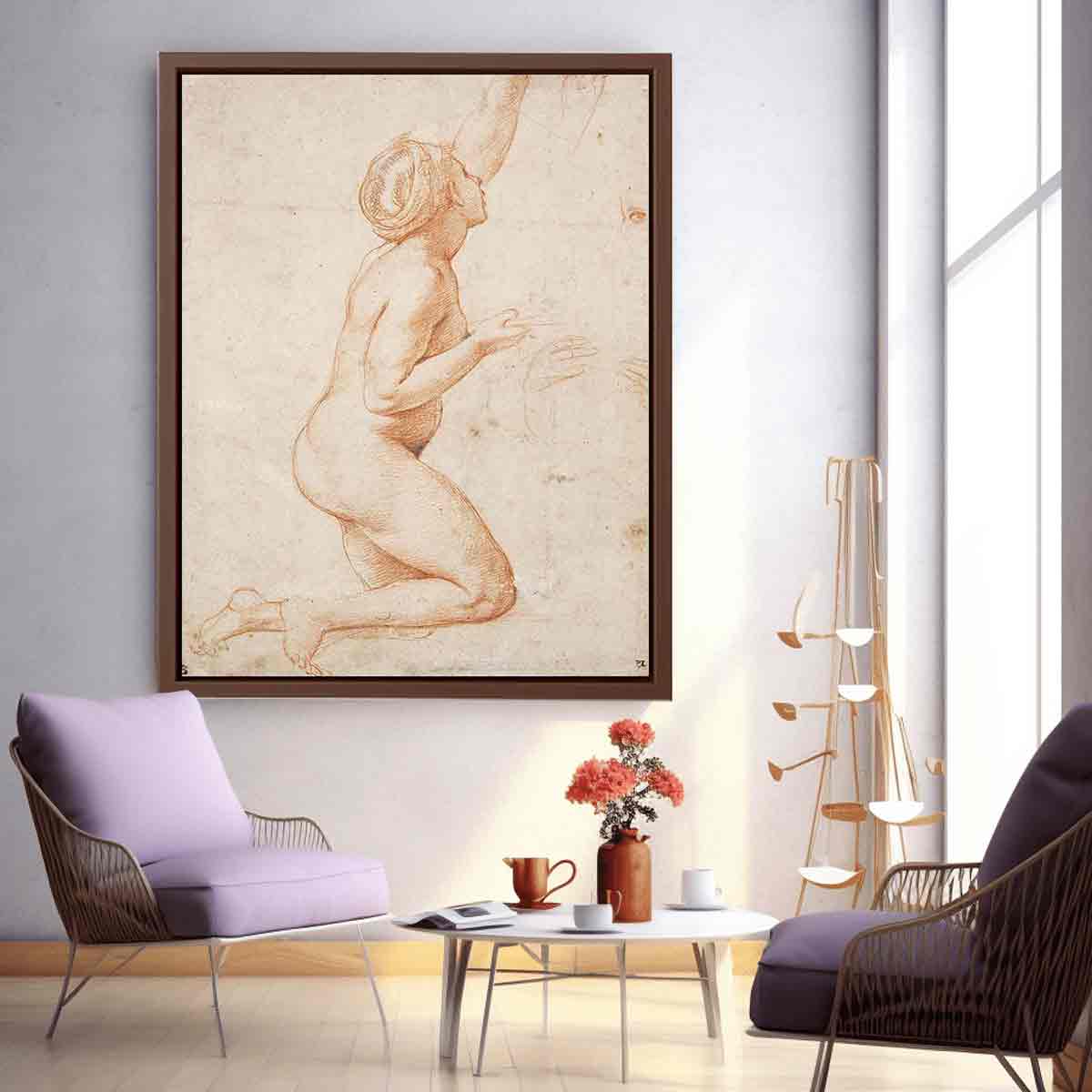
A Kneeling Nude Woman: Raphael's Study of the Female Figure
A Kneeling Nude Woman with her Left Arm Raised is an unusually revealing example of Raphael's work as a draftsman. Rather than presenting a finished narrative painting, the drawing concentrates on the human figure itself. The National Galleries of Scotland identifies the work as a study made around 1518 and describes it as a red-chalk drawing with touches of black chalk over stylus underdrawing. The drawing is connected with Raphael's plans for the frescoes of Cupid and Psyche at the villa of the wealthy banker Agostino Chigi beside the Tiber. This connection makes the sheet a valuable record of the preparatory thinking behind one of Raphael's Roman decorative projects.
The Significance of the Kneeling Pose
The kneeling position creates an especially interesting anatomical problem. The body must support its weight while remaining visually open and expressive. Raphael studies how the torso rises from the legs, how the shoulder turns and how the raised arm changes the balance of the whole figure. The pose also gives the body a graceful diagonal movement, preventing it from becoming a static front-facing study. Such drawings show why Renaissance artists relied on repeated observation and preparation before committing figures to monumental frescoes.
A New Approach to Female Life Drawing
The National Galleries of Scotland notes that Renaissance artists often used young male assistants as models for female figures, but that in Rome Raphael was among the first artists to use female models for life drawing. This detail is important because it places the sheet within a changing culture of artistic observation. The drawing is not simply an idealized invention; it reflects a more direct engagement with the female body as a subject of study. Raphael also took advantage of red chalk, a medium capable of producing descriptive outlines and subtle modelling.
Red Chalk and the Language of Line
The medium contributes greatly to the character of the drawing. Red chalk can describe contour with extraordinary sensitivity while also allowing the artist to suggest volume through layered strokes and changes in pressure. Raphael's use of the material demonstrates his ability to make line perform several functions at once: outline, shadow, anatomy, gesture and movement. The result is economical but not simplistic. A few carefully placed marks can establish the structure of a shoulder, the bend of a knee or the direction of an arm.
Connected to Cupid and Psyche
The study's connection to the planned Cupid and Psyche frescoes adds an important narrative dimension. In 1518 Raphael was working on the decoration of the Villa Farnesina for Agostino Chigi. The mythological program required numerous figures with complicated poses and movements. Preparatory drawings such as this one allowed Raphael to explore individual bodies before they became parts of the larger decorative scheme. The drawing therefore belongs to a wider process in which observation, mythology and monumental decoration came together.
Raphael as a Draftsman
Raphael is often remembered through polished paintings, but his drawings reveal the intellectual discipline underneath that finish. A study such as this makes the process visible. The viewer can see the artist asking practical questions about proportion, balance and movement. Because the image is not dominated by a completed background or elaborate costume, attention remains on the figure and the decisions that define it. This makes the drawing especially appealing to artists, students, collectors and anyone interested in Renaissance technique.
The Female Nude in Renaissance Art
The female nude occupied a complex position in Renaissance art, appearing in mythological, allegorical and decorative contexts while also serving as a subject for anatomical and compositional study. Raphael approached the figure with the idealizing discipline characteristic of his period. The body is observed, but it is also organized into a harmonious visual structure. The raised arm and kneeling posture create a rhythm that is as important as anatomical accuracy. The drawing therefore belongs to both the history of life drawing and the broader Renaissance search for ideal form.
Why the Study Works as Wall Art
Unlike a large mythological fresco, a figure study can bring a more intimate scale and scholarly atmosphere to an interior. Its linear quality makes it particularly suitable for a study, library, office, dressing room or gallery wall devoted to works on paper and Renaissance art. A high-quality print can preserve the delicate appearance of chalk marks, while a framed presentation can emphasize the work's status as a historical drawing. A canvas interpretation can give the study greater visual weight when displayed alongside larger paintings.
Raphael, Rome and Artistic Preparation
The drawing belongs to the Roman phase of Raphael's career, when his responsibilities had expanded dramatically. Rome offered access to major ancient monuments, sophisticated patrons and ambitious decorative commissions. The study demonstrates how Raphael's practice combined direct observation with the demands of large-scale projects. His ability to create individual studies and then transform them into coherent ensembles was essential to his success as a designer of monumental interiors.
Collecting a Raphael Figure Study Reproduction
For collectors who want something more intimate than a famous Raphael altarpiece, A Kneeling Nude Woman offers an excellent alternative. It connects the viewer directly with the artist's hand and with the preparatory process behind Renaissance decoration. The National Galleries of Scotland identifies the sheet as dating to about 1518 and records its place in the collection. A reproduction, fine art print, framed drawing or hand-painted interpretation can bring the character of Raphael's study practice into a contemporary collection while preserving its distinctive focus on line, anatomy and movement.
The Raised Arm and Visual Rhythm
The raised left arm is central to the study because it changes the rhythm of the entire body. The gesture pulls the eye upward and creates a diagonal that balances the lower mass of the kneeling figure. Raphael could therefore use a single anatomical adjustment to solve a compositional problem. This is precisely what makes preparatory drawings so revealing: they show how a pose can be designed for movement as well as observed from life.
The Relationship to Villa Farnesina
The connection with the Cupid and Psyche frescoes at Agostino Chigi's villa makes this sheet especially valuable for understanding Raphael's Roman decorative projects. The mythological cycle required figures that could inhabit a large architectural environment and remain legible from below. A small drawing on paper could therefore serve as the laboratory in which Raphael solved problems that would later become part of a much larger visual experience.
A Collector's View of Renaissance Draftsmanship
A reproduction of this drawing appeals to collectors who appreciate the evidence of artistic process. Instead of presenting an idealized finished scene, it shows the concentrated work of the draftsman. The paper, chalk, underdrawing and changes of emphasis all point toward an artist thinking through the body. That intimacy can make a framed figure study particularly effective in a room devoted to books, art, design or creative work.