


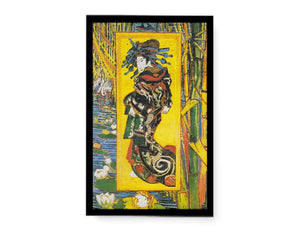
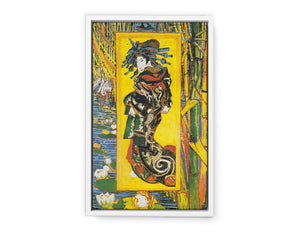
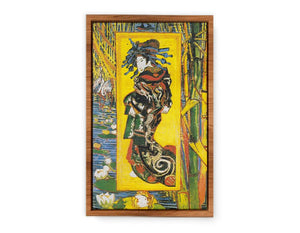
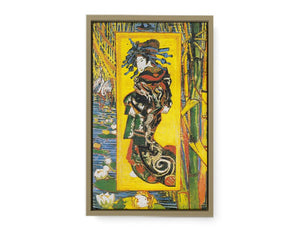
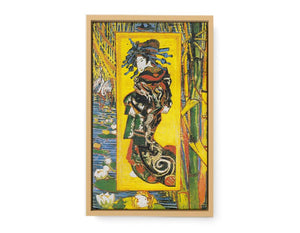
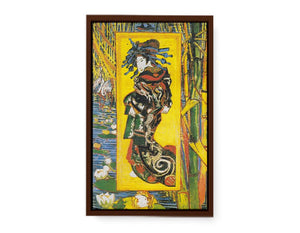
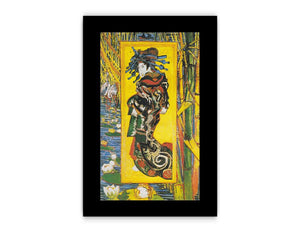
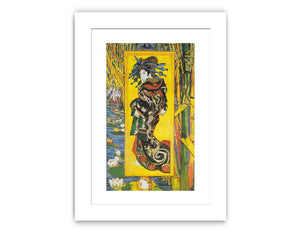
Courtesan After Eisen By Van Gogh
Go kalles this summer with this vintage navy and white striped v-neck t-shirt from the Nike. Perfect for pairing with denim and white kicks for a stylish kalles vibe.

Courtesan After Eisen By Van Gogh
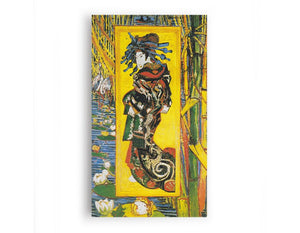
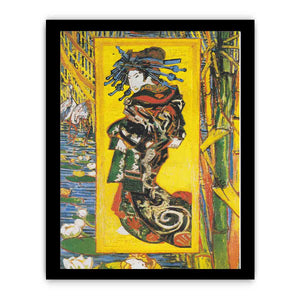
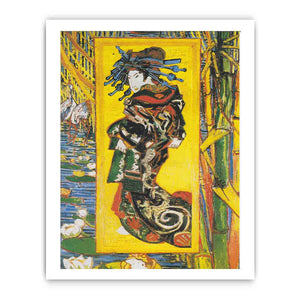
Courtesan After Eisen by Vincent van Gogh is one of the artist’s most important works inspired by Japanese ukiyo-e. Painted in Paris in October–November 1887, it enlarges a courtesan designed by Japanese artist Keisai Eisen and surrounds her with Van Gogh’s own vivid arrangement of bamboo, water lilies, cranes and frogs. Catalogued as F 373 / JH 1298, the historical painting is held by the Van Gogh Museum in Amsterdam. Alpha Art Gallery offers reproductions as canvas prints, fine art prints, framed prints and 100% hand-painted oil paintings.
About Courtesan After Eisen
Van Gogh created Courtesan (after Eisen) during his Paris period, when Japanese prints were exerting an enormous influence on his approach to colour, contour and composition. The painting is unusually tall and narrow, measuring approximately 100.7 × 60.7 cm.
The central woman was not invented by Van Gogh. He based her on an image by the Japanese ukiyo-e artist Keisai Eisen that had been reproduced on the cover of a special Japanese issue of the French magazine Paris Illustré.
Van Gogh used a grid to enlarge the figure. He then transformed the relatively small printed image into a large oil painting filled with emphatic outlines and brilliant colour.
Who Was Keisai Eisen?
Keisai Eisen was a Japanese artist particularly associated with images of fashionable women and courtesans. Van Gogh encountered Eisen’s design not through the original Japanese print itself but through its reproduction in a French illustrated publication.
This indirect route is important. Van Gogh’s image reflects nineteenth-century European engagement with Japanese visual culture—a phenomenon commonly described as Japonisme—rather than an attempt to recreate Japanese painting faithfully.
He absorbed selected visual ideas from prints and reworked them according to his own artistic priorities.
How Van Gogh Transformed Eisen’s Figure
The Van Gogh Museum explains that Van Gogh copied and enlarged the courtesan using a grid. He gave her a brightly coloured kimono and set her against a striking yellow field.
More importantly, he did not simply copy the original figure and stop. He created an entirely new decorative border around her using motifs drawn from other Japanese prints.
Bamboo rises through the surrounding scene. Water lilies appear below, while cranes, frogs and a small distant boat contribute additional imagery. The result combines several sources into a composition that never existed as one Japanese print.
The Frogs and Cranes Have an Additional Meaning
The Van Gogh Museum notes an unusual linguistic detail behind the surrounding animals. In nineteenth-century French slang, words for crane and frog could also refer to prostitutes.
Van Gogh’s inclusion of cranes and frogs therefore appears to function as a playful reference to the courtesan’s profession. This is one of the rare cases where apparently decorative details have a documented cultural association relevant to the central figure.
The symbols should nevertheless be understood within the specific nineteenth-century French context in which Van Gogh worked rather than treated as traditional Japanese symbolism.
Japonisme and Van Gogh
Japanese prints became a major source of inspiration for Van Gogh during his years in Paris. He collected them extensively and studied their flat areas of colour, bold outlines, unusual cropping and highly organized decorative surfaces.
He created several paintings directly after Japanese prints, including Flowering Plum Orchard (after Hiroshige) and Bridge in the Rain (after Hiroshige).
Courtesan After Eisen is especially ambitious because Van Gogh goes beyond straightforward translation. He combines the central figure with additional motifs to create an imagined Japanese environment of his own.
Why the Painting Looks So Different From Van Gogh’s Landscapes
Many viewers associate Van Gogh primarily with heavily brushed landscapes such as Wheat Field with Cypresses or The Starry Night. Courtesan After Eisen belongs to a different phase and uses a deliberately graphic approach.
The silhouette of the woman is strongly defined. Broad areas of vivid colour remain comparatively flat, and the composition depends heavily on contour. These characteristics show how Van Gogh was studying the visual language of printed images rather than relying only on European traditions of modelling volume through light and shadow.
Portrait or Japonisme Painting?
The work can reasonably be discovered through portrait and figurative categories because a single woman dominates the image. However, she was not a model who sat for Van Gogh, so it differs fundamentally from portraits such as his paintings of the Roulin family.
Japonisme and figurative art are therefore especially useful classifications. The painting is also part of Van Gogh’s broader Post-Impressionist development during the Paris period.
Why Courtesan After Eisen Matters
The painting provides unusually clear evidence of how Van Gogh learned through copying and transformation. Rather than concealing his source, he openly based the figure on Eisen while changing its scale, colour and context.
This process helped Van Gogh develop artistic ideas that would remain important after he left Paris. Strong outlines, flatter shapes and Japanese-inspired composition continued to influence the work he produced in Arles.
Visitors exploring other masterpieces from art history can use this painting to understand the international exchange of visual ideas that helped reshape European art in the late nineteenth century.
Historical Artwork Details
| Artist | Vincent van Gogh |
|---|---|
| Title | Courtesan (after Eisen) |
| Catalogue references | F 373 / JH 1298 |
| Date | October–November 1887 |
| Place created | Paris, France |
| Original medium | Oil on canvas |
| Dimensions | Approximately 100.7 × 60.7 cm |
| Source artist | Keisai Eisen |
| Style/context | Post-Impressionism and Japonisme |
| Current collection | Van Gogh Museum, Amsterdam |
The original historical painting is held by the Van Gogh Museum. Alpha Art Gallery offers reproductions and does not imply museum affiliation, authorization or endorsement.
Choose Your Courtesan After Eisen Reproduction
| Format | Presentation | Ideal For |
|---|---|---|
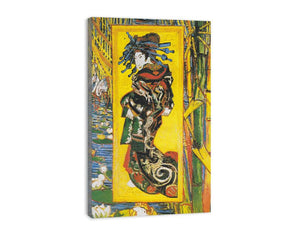
| Canvas Print | Bold vertical presentation emphasizing colour and graphic outline | Tall feature walls and statement art |
| Fine Art Print | Refined printed presentation suited to the print-inspired composition | Collectors interested in Van Gogh and Japanese art |
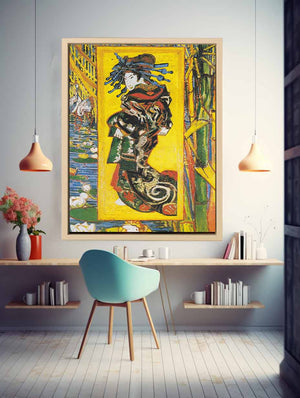
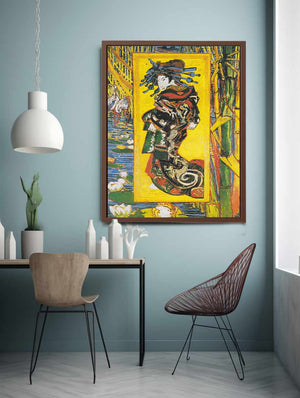
| Framed Print | Strong architectural border around the tall composition | Narrow walls, studies and formal interiors |
| Hand-Painted Oil Reproduction | Individually painted oil surface with real brushwork | Buyers wanting a handmade interpretation |
Museum-Quality Canvas Print
Alpha Art Gallery’s 400–450 GSM canvas prints suit the unusually tall proportions of this work. The format is useful where substantial vertical wall space is available but horizontal width is limited.
Fine Art and Framed Prints
A fine art print is particularly appropriate for a painting so closely connected with Japanese print culture. Framing can reinforce the composition’s strong border-like design and create a finished presentation for residential or professional interiors.
100% Hand-Painted Oil Reproduction
Alpha Art Gallery’s hand-painted oil reproductions are individually painted by professional artists on canvas, creating actual painted texture and subtle handmade variation.
Where Can I Buy Courtesan After Eisen?
Alpha Art Gallery offers the painting as canvas, fine art, framed and 100% hand-painted oil reproductions. Multiple sizes and available framing options make the work adaptable to different interiors, with free worldwide shipping included.
Frequently Asked Questions
Who painted Courtesan After Eisen?
Vincent van Gogh painted it in Paris in 1887, basing the central figure on a Japanese design by Keisai Eisen.
Did Van Gogh copy a Japanese print?
Yes, but he transformed it substantially. He enlarged Eisen’s figure using a grid and surrounded her with additional imagery borrowed from other Japanese prints.
Why are there frogs and cranes in the painting?
The Van Gogh Museum explains that French slang terms associated with frogs and cranes could refer to prostitutes, linking the animals humorously with the central courtesan.
Where is the original Courtesan After Eisen?
The historical original is in the Van Gogh Museum in Amsterdam.
How large is the original?
The original is approximately 100.7 × 60.7 cm, making it one of Van Gogh’s notably tall portrait-format compositions.
Can I buy it as a canvas print?
Yes. Alpha Art Gallery offers the work on substantial 400–450 GSM museum-quality canvas.
Is a hand-painted version available?
Yes. A 100% hand-painted oil-on-canvas reproduction can be individually painted by professional artists.
Does Alpha Art Gallery ship worldwide?
Yes. Free worldwide shipping is included with all orders.
Bring Van Gogh’s Japonisme Into Your Collection
Courtesan After Eisen combines Van Gogh’s fascination with Japanese prints, brilliant Paris-period colour and an exceptionally dramatic vertical composition. Choose a canvas, fine art, framed or hand-painted presentation in the scale that best suits your space.
| 1. Select Type |
Museum Canvas, Fine Art Paper, Hand-Painted Oil Painting, Satin Photo Paper |
|---|---|
| 2. Select Finish Option |
Rolled Canvas, Rolled- No Frame, Black Frame with Matt, White Frame with Matt, Black Frame No Matt, White Frame No Matt, Streched Canvas, Black Floating Frame, White Floating Frame, Brown Floating Frame, Rolled No Framed, Streched, Natural Floating Frame, Champagne Floating Frame, Gold Floating Frame |
| 3. Select Size |
60cm X 90cm [24" x 36"], 76cm X 114cm [30" x 45"], 82cm X 120cm [32" x 48"], 100cm X 150cm [40" x 60"], 22cm X 30cm [9" x 12"], 16.54 x 11.69"(A3), 25cm x 76cm [10" x 30"], 41cm x 61cm [16" x 24"], 20cm x 25Cm [8" x 10"], 30cm x 45Cm [12" x 18"], 35cm x 50Cm [14" x 20"], 45cm x 60 cm [18" x 24"], 35cm x 53Cm [14" x 21"], 66cm X 101cm[26" x 40"], 76cm x 116cm [30"x 46"], 50cm X 60cm [16" x 24"], 121cm X 182cm [48" x 72"], 135cm X 200cm [54" x 79"], 165cm x 205cm [65" x 81"], 183cm x 228cm [72" x 90"], 45cm x60cm [16" x 24'], 75cm X 100cm [30" x 40"], 121cm x 193cm [48" x 76"], 45cm x 60cm [16" x 24'], 50cm X 60cm 16" x 24"] |