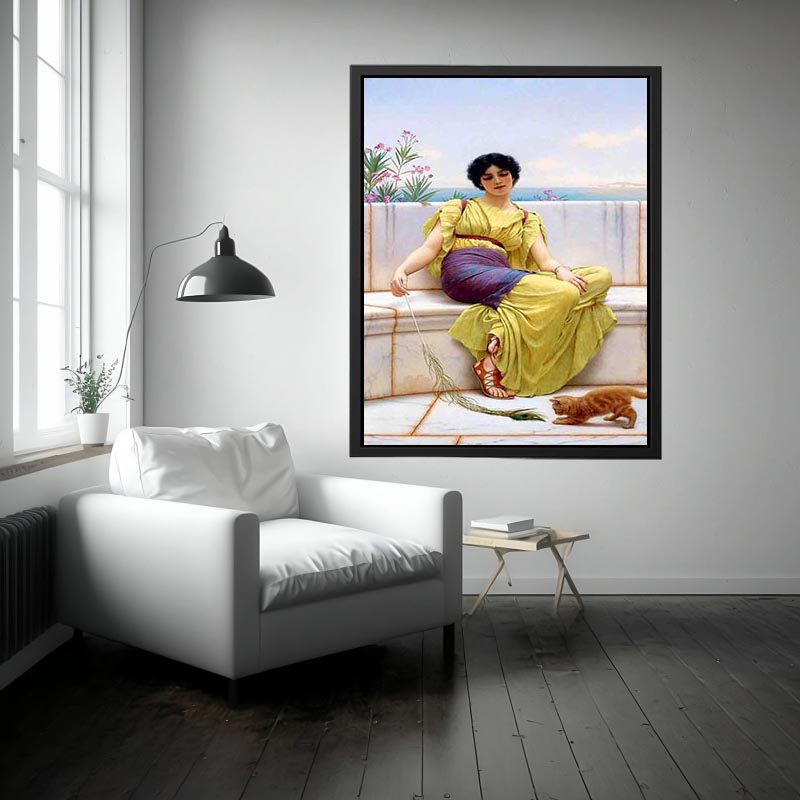
Idleness II Painting by John William Godward
Idleness II Painting by John William Godward is a distilled vision of stillness, sensual calm, and classical refinement, a painting in which time appears to pause in deference to beauty and repose. Created in the late nineteenth century, the work exemplifies Godward’s unwavering commitment to an idealized classical world—one shaped not by historical narrative or mythological drama, but by atmosphere, material harmony, and the quiet dignity of leisure. In Idleness II, the act of doing nothing is elevated into a philosophical and aesthetic state, rendered with exceptional precision and emotional restraint.
The artist behind this serene composition, John William Godward, was one of the most devoted heirs to the Victorian classical revival. Working in an era increasingly drawn toward modern experimentation, Godward remained steadfast in his pursuit of Greco-Roman ideals, marble purity, and contemplative beauty. His paintings do not argue for modernity or reject it; instead, they offer an alternative—an inward-looking world where harmony, surface, and mood hold enduring value. Idleness II stands as a quintessential expression of this vision.
The subject is deceptively simple. A young woman reclines or sits in languid repose, absorbed in her own quiet existence. There is no narrative action, no dramatic gesture, no mythological identification imposed upon her. Godward does not ask the viewer to interpret a story. He invites the viewer to share a state of being. The title itself, Idleness II, frames the painting not as moral critique but as aesthetic condition. Idleness here is not sloth; it is cultivated stillness.
Compositionally, the painting is structured with classical balance and clarity. The figure occupies a measured position within the pictorial space, neither dominating nor receding. Godward employs a restrained geometry, often anchoring the figure against architectural elements such as marble steps or walls. These structures provide stability and order, counterbalancing the softness of the human form. The composition encourages the eye to rest rather than wander, reinforcing the painting’s contemplative intent.
Perspective is shallow and controlled. Godward avoids deep spatial recession, preferring a compressed space that brings figure and surface into close dialogue. This flattening enhances intimacy and emphasizes material presence. The viewer is not invited into a vast world but held gently at the threshold of a private moment. Distance is minimized, yet privacy is preserved.
Light in Idleness II is soft, even, and caressing. It illuminates the figure without drama, revealing skin, fabric, and stone with equal clarity. There are no harsh shadows, no theatrical contrasts. Light functions here as a unifying force, dissolving hierarchy between elements and bathing the scene in a timeless glow. The effect is one of calm permanence rather than fleeting moment.
The color palette is refined and harmonious. Godward’s characteristic use of pale flesh tones, cool marbles, and muted drapery creates a chromatic balance that feels both luxurious and restrained. Subtle accents—perhaps in fabric or background detail—add warmth without disrupting equilibrium. Color is not expressive in isolation; it is orchestrated to support mood and texture.
Godward’s technique is meticulous and disciplined. Surfaces are rendered with astonishing smoothness, particularly the marble and flesh, which appear almost tactile in their precision. Brushwork is deliberately concealed, reinforcing the illusion of ideal form. This technical control is not decorative excess; it is integral to meaning. The perfection of surface mirrors the perfection of the state depicted—a world where effort is invisible and disturbance absent.
Symbolically, Idleness II resists allegorical overstatement. The figure is not labeled as muse, goddess, or mythic heroine. She exists simply as herself, embodying repose and introspection. In this refusal of narrative symbolism, Godward asserts that beauty and stillness are sufficient subjects in their own right. The painting becomes a meditation on presence rather than action, on interiority rather than event.
Psychologically, the work conveys detachment without coldness. The figure appears inwardly absorbed, neither engaging the viewer nor rejecting them. This emotional neutrality is deliberate. Godward creates a space where observation does not demand response. The painting allows the viewer to project personal experience—rest, contemplation, longing—onto the image, making its calm universally accessible.
Within Godward’s broader oeuvre, Idleness II represents the maturity of his aesthetic convictions. Throughout his career, he returned repeatedly to solitary female figures in classical settings, refining his approach with each iteration. This work demonstrates complete confidence in restraint. There is no excess, no experimentation for its own sake. Every element serves harmony.
Culturally, the painting reflects late Victorian and Edwardian fascination with classical antiquity as refuge from industrial modernity. Yet Godward’s work is not escapist fantasy alone. It is a disciplined articulation of values—order, beauty, and contemplation—that stand in quiet opposition to speed and noise. Idleness II offers not nostalgia, but an alternative tempo.
In contemporary interiors across the United States, the United Kingdom, Canada, Australia, and Europe, Idleness II integrates with exceptional elegance and versatility. In living rooms, it introduces calm and refined sensuality. In bedrooms and private studies, it fosters introspection and repose. In galleries and luxury residences, it anchors space with classical serenity, harmonizing seamlessly with traditional, modern, minimalist, and eclectic décor through its balanced palette and architectural clarity.
The painting remains meaningful today because it affirms the value of stillness. In an age dominated by productivity and constant motion, Idleness II proposes a different virtue: the dignity of rest, the richness of quiet awareness. Godward’s vision does not instruct or persuade. It offers presence—and trusts the viewer to recognize its worth.
Idleness II Painting by John William Godward endures as one of the most refined expressions of Neoclassical calm in British art. Through compositional balance, flawless surface, and emotional restraint, Godward transforms a moment of repose into a timeless meditation on beauty, leisure, and inner life. The painting does not demand attention. It rewards it.
Buy museum qulaity 400- 450 canvas prints, framed prints, and 100% oil paintings of Idleness II by John William Godward at Alpha Art Gallery, where world-famous masterpieces are recreated with museum-quality detail, refined craftsmanship, and premium materials.
FAQs
What does Idleness II depict?
It depicts a solitary woman in a state of quiet repose, emphasizing stillness rather than narrative action.
Is the painting symbolic or purely aesthetic?
It is primarily aesthetic, suggesting philosophical ideas through mood rather than explicit symbolism.
Why did Godward focus so often on classical settings?
He viewed classical antiquity as an ideal framework for harmony, beauty, and contemplation.
What role does marble play in the composition?
Marble provides structural calm and contrast to the softness of the human figure.
How does this painting differ from mythological works of the same period?
It avoids narrative and drama, focusing instead on interior state and surface harmony.
Why does the painting feel timeless?
Its restrained palette, idealized forms, and absence of modern markers remove it from specific era.
Why does Idleness II remain relevant today?
Its celebration of rest and inner calm resonates strongly in contemporary life.
Where does this artwork work best in interiors?
It is ideal for living rooms, bedrooms, studies, galleries, and spaces seeking elegance and tranquility.