The Night Watch Painting by Rembrandt Van Rijn
The Night Watch stands as one of the most revolutionary and intellectually ambitious works in the history of Western painting, representing a decisive moment not only in the career of Rembrandt Van Rijn but in the evolution of visual narrative itself. Completed in 1642, at the height of Rembrandt’s public prominence, the painting transforms what was traditionally a static civic portrait into a dynamic, psychologically charged drama. It is a work that redefines collective identity, authority, and movement, presenting civic life not as a posed declaration of status but as an unfolding human event.
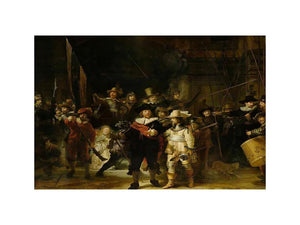
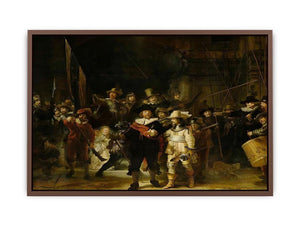
Formally titled The Company of Captain Frans Banning Cocq and Lieutenant Willem van Ruytenburch, the painting was commissioned as a group portrait of a civic militia company in Amsterdam. Such works were typically orderly, evenly lit, and hierarchically balanced, with each sitter clearly visible and afforded equal prominence. Rembrandt radically rejected this convention. Instead of presenting a frozen assembly, he imagined the moment of action itself: the instant when the company prepares to move, weapons raised, commands issued, and attention dispersed. The result is not a record of likeness alone, but a living scene infused with tension, hierarchy, and purpose.
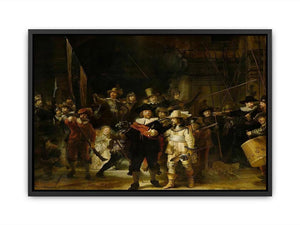
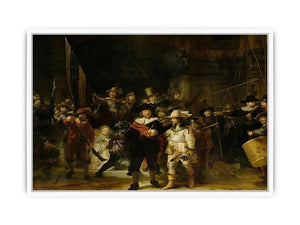
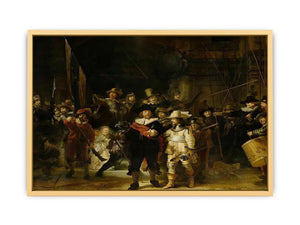
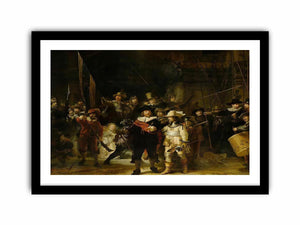
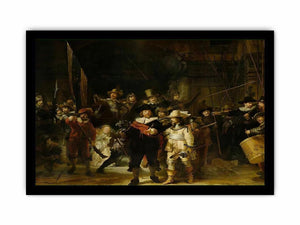
At the centre of the composition stands Captain Frans Banning Cocq, dressed in dark attire accented by a striking red sash, his commanding gesture directing the movement of the group. Beside him, Lieutenant Willem van Ruytenburch appears bathed in light, his pale costume and energetic posture amplifying the sense of forward momentum. Yet even these central figures do not dominate in isolation. Around them, militia members emerge from shadow, gesture, and partial illumination, forming a dense network of bodies, weapons, and glances that collectively animate the canvas.
Rembrandt’s compositional genius lies in his orchestration of controlled disorder. The scene appears spontaneous, even chaotic, yet every element is carefully calibrated. Diagonals drive the eye through the crowd, while overlapping figures create depth and compression. The viewer is drawn into the action, positioned not as an observer at a distance but as a participant caught within the surge of movement. This immersive quality was unprecedented in civic portraiture and remains one of the painting’s most arresting qualities.
Light plays a defining role in shaping both meaning and structure. Rembrandt’s mastery of chiaroscuro reaches extraordinary complexity here. Illumination does not fall evenly across the surface but moves selectively, revealing some faces and obscuring others. This shifting light reinforces hierarchy, directs attention, and introduces psychological tension. It also challenges the notion of equal representation, suggesting that visibility itself is contingent, dynamic, and earned rather than guaranteed.
The famous golden-lit girl who appears near the centre of the painting, often interpreted symbolically, adds another layer of complexity. She does not belong to the militia in a literal sense, yet her presence is unmistakably intentional. Carrying objects associated with the company’s emblem, she functions as an allegorical figure, embodying the spirit, identity, or moral purpose of the group. Her luminous presence contrasts sharply with the surrounding darkness, creating a moment of visual pause within the surge of action.
Colour in The Night Watch is rich but restrained. Deep blacks, browns, and muted earth tones dominate the composition, punctuated by flashes of red, gold, and white. These accents are never decorative; they serve structural and narrative functions, guiding the eye and reinforcing movement. Texture is equally expressive. Rembrandt’s handling of paint varies dramatically, from thick, tactile passages to smooth, almost translucent layers. This variation enhances the sense of physical presence and material reality.
Psychologically, the painting is remarkably complex. Each figure appears absorbed in a distinct role or response, from disciplined attention to distracted movement. There is no single emotional register. Instead, Rembrandt presents civic duty as a collective enterprise composed of individual motivations, levels of engagement, and degrees of authority. This refusal to idealise unity gives the work its enduring realism and moral depth.
Within Rembrandt Van Rijn’s career, The Night Watch marks both a pinnacle and a turning point. It represents the height of his public success and his boldest assertion of artistic independence. Yet its unconventional approach was not universally appreciated at the time. Some patrons were unsettled by their partial obscurity within the composition, and the painting’s departure from established norms may have contributed to Rembrandt’s later professional difficulties. In retrospect, however, these very qualities define its greatness.
Culturally, The Night Watch transcends its original function as a civic commission. It has come to symbolise the vitality, complexity, and ambition of the Dutch Golden Age, while also challenging simplistic narratives of collective identity. The painting suggests that leadership is active rather than symbolic, that community is dynamic rather than fixed, and that order emerges from movement rather than stillness.
For contemporary viewers across the United States, the United Kingdom, Canada, Australia, and Europe, the painting continues to resonate powerfully. Its themes of leadership, responsibility, and collective action remain deeply relevant in modern civic life. The work does not glorify power for its own sake; it examines how authority operates within a human framework, shaped by cooperation, tension, and unpredictability.
In interior spaces, The Night Watch commands attention through gravitas rather than ornament. In living rooms, it becomes an anchor of intellectual and cultural weight. In studies and offices, it reinforces ideas of leadership, accountability, and historical continuity. In galleries and luxury residences, it communicates a profound engagement with art history and the complexities of human organisation.
The painting integrates compellingly into both classical and modern interiors. In traditional settings, its historical authority and painterly depth resonate naturally. In minimalist or contemporary spaces, its dramatic contrasts and dense composition create a powerful counterpoint to architectural restraint, drawing the viewer inward rather than overwhelming the environment.
The enduring importance of The Night Watch lies in its refusal to simplify collective life into static symbolism. Rembrandt presents society as active, layered, and morally complex. He does not offer clarity without ambiguity, nor order without tension. This honesty allows the painting to remain alive, continually revealing new relationships and meanings to each generation of viewers.
To live with The Night Watch is to engage daily with one of the most intellectually demanding and visually compelling works ever created. It is a painting that rewards sustained attention, inviting viewers to reconsider notions of leadership, visibility, and collective responsibility. Through its dynamic composition, psychological depth, and revolutionary vision, Rembrandt Van Rijn created not merely a masterpiece of his time, but a work that continues to define what painting itself can achieve.
Buy museum qulaity 400- 450 canvas prints, framed prints, and 100% oil paintings of The Night Watch by Rembrandt Van Rijn at Alpha Art Gallery, where world-famous masterpieces are recreated with museum-quality detail, refined craftsmanship, and premium materials.
FAQS
What is the central meaning of The Night Watch?
The painting explores leadership, collective responsibility, and civic action, presenting society as dynamic rather than static.
Why is The Night Watch considered revolutionary?
It transformed traditional group portraiture into a dramatic narrative scene defined by movement, light, and psychological depth.
Why are some figures partially hidden in the painting?
Rembrandt rejected equal visibility in favour of realism, using light and shadow to reflect hierarchy and motion.
What does the illuminated girl symbolise?
She is widely interpreted as an allegorical figure representing the spirit or identity of the militia company.
Is The Night Watch suitable for modern interiors?
Yes. Its dramatic contrasts and intellectual depth make it a powerful focal point in both modern and traditional spaces.
What emotional impact does the painting have?
It conveys energy, authority, and tension, inviting prolonged reflection rather than immediate resolution.
Does The Night Watch have lasting cultural value?
As one of the most influential works in Western art, it holds enduring historical, artistic, and cultural significance.
Where is the best place to display this painting?
It is especially effective in living rooms, studies, offices, and gallery environments where its scale and complexity can be fully appreciated.