The Accolade Painting by Edmund Blair Leighton
The Accolade stands as one of Edmund Blair Leighton’s most enduring and culturally resonant works, a painting in which medieval ritual, romantic idealism, and disciplined academic craftsmanship are unified with striking clarity. Painted in 1901, at the height of Leighton’s artistic maturity, the work embodies the late Victorian fascination with chivalry—not as historical reconstruction alone, but as a moral and emotional ideal projected onto the past. More than a depiction of knighthood, The Accolade is a meditation on honour, duty, and the solemn transmission of responsibility, rendered with a composure that has secured its lasting place in the visual imagination.
Edmund Blair Leighton was among the foremost exponents of historical romanticism in late nineteenth- and early twentieth-century British art. Trained within the academic tradition and deeply committed to technical precision, Leighton specialised in scenes drawn from medieval legend, courtly life, and literary history. Yet his work transcended costume drama. He approached the past as a stage upon which timeless human values could be enacted with clarity and emotional discipline. In The Accolade, this philosophy reaches its most distilled expression.
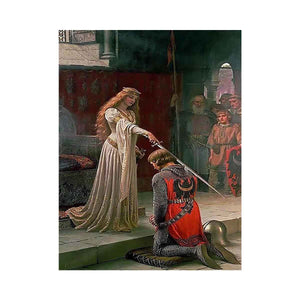
The composition presents a young knight kneeling before a queen or noblewoman who confers knighthood through the ceremonial touch of the sword. Leighton chooses the exact moment of investiture, when action pauses and meaning concentrates. The figures are arranged with deliberate symmetry, yet the scene avoids rigidity. The kneeling knight forms a vertical axis of humility and readiness, while the standing female figure embodies authority tempered by grace. Their relationship is not one of dominance, but of trust and solemn exchange.
The female figure is rendered with commanding serenity. Her posture is upright, composed, and controlled, her gesture precise rather than dramatic. Leighton avoids theatrical flourish, allowing authority to manifest through stillness. She does not appear triumphant or indulgent; instead, she appears acutely aware of the gravity of the act she performs. In this restraint lies the painting’s moral force. Power is exercised not through spectacle, but through measured responsibility.
The knight, in turn, is depicted at the threshold of transformation. His kneeling posture conveys humility, submission to duty, and conscious acceptance of obligation. Leighton does not idealise him through exaggerated heroism. His strength is latent rather than asserted. Armour gleams not as ornament, but as preparation. The knight’s stillness suggests concentration rather than anticipation, reinforcing the painting’s emphasis on inner resolve over outward glory.
Architectural elements play a crucial supporting role in the composition. Leighton situates the figures within a grand yet austere medieval interior, using stone columns, arches, and steps to frame the ceremony. The architecture is not decorative excess; it provides structure and permanence, reinforcing the idea that chivalric values are upheld by tradition and continuity. The setting feels ceremonial without becoming overwhelming, allowing human presence to remain central.
Light is handled with exceptional discipline. Leighton employs a controlled illumination that clarifies form and texture without dramatic contrast. Light falls evenly across figures and architecture, enhancing material richness while preserving compositional balance. Armour, fabric, and stone are rendered with clarity, yet none dominate the scene. This even lighting reinforces the painting’s tone of solemnity and order, aligning visual structure with moral theme.
Colour is restrained and purposeful. Leighton favours a palette of cool greys, silvery metal tones, deep reds, and muted earth colours. The restrained chromatic scheme avoids emotional manipulation, allowing meaning to emerge through form and gesture rather than saturation. Red, when present, carries symbolic weight, suggesting sacrifice, commitment, and authority without visual excess.
Leighton’s surface treatment reflects his academic training and technical assurance. Fabrics are rendered with precision, their folds and weight carefully observed. Armour is depicted with crisp clarity, catching light without becoming decorative spectacle. Stone surfaces possess solidity and age. Brushwork remains controlled and largely invisible, reinforcing the sense of timelessness and composure. Technique serves narrative and meaning rather than drawing attention to itself.
Symbolically, The Accolade operates with elegant economy. The sword functions as the central emblem of duty and moral responsibility rather than violence. The act of knighting is not framed as reward, but as obligation. Leighton presents chivalry not as romantic adventure, but as ethical burden willingly accepted. This interpretation distinguishes the painting from more sentimental medieval fantasies and grounds it in moral seriousness.
Emotionally, the painting is restrained yet profound. There is no exuberance, no overt triumph. Instead, the scene conveys gravity, awareness, and quiet resolve. The emotional power arises from anticipation held in check—the recognition that honour carries consequence. Leighton’s restraint allows the viewer to contemplate the weight of commitment rather than celebrate its outward form.
Within Leighton’s broader body of work, The Accolade represents a pinnacle of his historical romanticism. While he painted numerous scenes of courtly love and medieval narrative, this work achieves a rare balance between visual splendour and ethical clarity. It demonstrates his belief that the past could be used not to escape the present, but to reflect upon enduring human values.
The painting’s relevance today remains striking across the United States, the United Kingdom, Canada, Australia, and Europe. Contemporary audiences continue to respond to its vision of honour rooted in responsibility rather than dominance. In an age often sceptical of authority, The Accolade offers a model of leadership defined by restraint, ritual, and accountability.
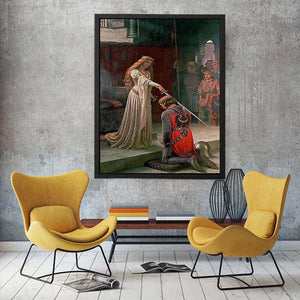
In interior settings, The Accolade introduces dignity, structure, and narrative depth. In living rooms, it becomes a focal point of reflection and conversation. In studies and offices, it reinforces ideals of duty, discipline, and ethical leadership. In galleries and luxury residences, it signals a refined engagement with historical art that values meaning as much as craftsmanship.
The painting integrates seamlessly into traditional, modern, minimalist, and eclectic décor. Traditional interiors resonate with its medieval subject and classical execution. Modern spaces benefit from its compositional clarity and psychological restraint. Minimalist environments amplify its stillness and authority, while eclectic interiors draw cohesion from its balanced structure and symbolic resonance.
The enduring importance of The Accolade lies in its refusal to sentimentalise honour. Leighton presents knighthood not as fantasy, but as moral transition. The painting endures because it recognises that the most meaningful ceremonies are those that bind individuals to responsibility beyond themselves.
To live with The Accolade is to engage daily with an image that affirms the seriousness of commitment and the dignity of ritual. Through its measured composition, refined technique, and ethical depth, the painting continues to confirm Edmund Blair Leighton’s position as one of the most thoughtful interpreters of historical idealism. It stands as a testament to his belief that art, when guided by discipline and insight, can preserve values that transcend time.
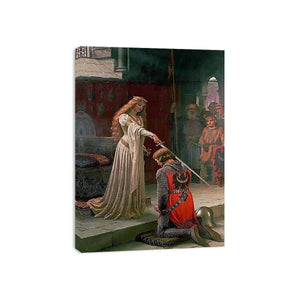
Buy museum qulaity 400- 450 canvas prints, framed prints, and 100% oil paintings of The Accolade by Edmund Blair Leighton at Alpha Art Gallery, where world-famous masterpieces are recreated with museum-quality detail, refined craftsmanship, and premium materials.
FAQS
What moment does The Accolade depict?
It depicts the ceremonial act of knighting, focusing on the moment of moral and social transition rather than celebration.
Why is The Accolade considered Edmund Blair Leighton’s most famous work?
It perfectly balances historical romanticism, technical mastery, and ethical seriousness.
What does the sword symbolise in the painting?
The sword symbolises responsibility, duty, and moral obligation rather than violence.
Is the painting historically accurate or symbolic?
It is historically inspired but primarily symbolic, using medieval ritual to express timeless values.
Is The Accolade suitable for contemporary interiors?
Yes. Its compositional clarity and dignified tone integrate well into both traditional and modern spaces.
What emotional tone does the painting convey?
It conveys solemnity, restraint, and quiet resolve rather than triumph or spectacle.
Does this artwork have lasting cultural value?
As an iconic work of historical romanticism, it holds enduring artistic and symbolic significance.
Where is the best place to display The Accolade?
It is especially well suited to studies, offices, living rooms, and gallery spaces that value honour, tradition, and reflection.