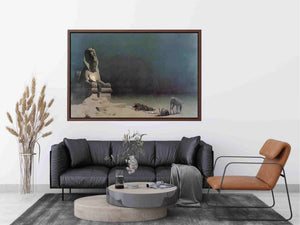
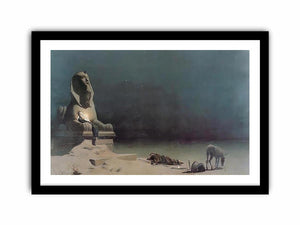
Rest on the Flight into Egypt Painting by Luc Olivier Merson
Rest on the Flight into Egypt Painting by Luc Olivier Merson is a work of profound stillness and devotional gravity, offering a contemplative interpretation of one of Christianity’s most tender yet perilous narratives. Painted in the late nineteenth century, the work reflects Merson’s ability to unite academic precision with spiritual introspection, transforming a biblical episode of escape and danger into a moment of quiet human intimacy. Rather than emphasizing fear, pursuit, or miraculous intervention, Merson centers his vision on rest—physical, emotional, and spiritual—revealing faith as something sustained through patience and endurance rather than spectacle.
Luc Olivier Merson was among the most intellectually rigorous religious painters of his generation, known for his deep engagement with symbolism, theology, and historical authenticity. Working within the French academic tradition, Merson approached sacred subjects with seriousness and restraint, seeking to restore gravity and meaning to religious painting in an age increasingly skeptical of overt devotional imagery. Rest on the Flight into Egypt exemplifies this approach, presenting a sacred narrative stripped of excess and grounded in human vulnerability.
The subject derives from the Gospel account of the Holy Family’s flight from Bethlehem to Egypt, undertaken to protect the infant Christ from Herod’s decree. Many artists have depicted this episode as a dramatic journey or miraculous rescue. Merson, by contrast, selects an interlude—a pause along the way. This choice is central to the painting’s emotional power. By focusing on rest rather than movement, Merson invites contemplation of fatigue, care, and quiet resolve, emphasizing the humanity of figures often elevated beyond reach.
Compositionally, the painting is structured with calm clarity. The figures are arranged in a stable, grounded configuration that reinforces stillness. Mary occupies a central role, her posture protective yet composed, her attention focused entirely on the child. Joseph, present as guardian rather than hero, contributes to the sense of quiet vigilance. The arrangement avoids theatrical gesture, allowing proximity and posture to convey relationship and meaning.
The landscape surrounding the figures is expansive yet subdued. Merson situates the Holy Family within a natural environment that neither threatens nor consoles overtly. The terrain suggests distance traveled and distance yet to come, but it does not dominate the scene. Nature functions as context rather than drama, reinforcing the idea that the sacred unfolds within ordinary conditions. The environment bears silent witness rather than symbolic intervention.
Light is one of the painting’s most expressive elements. Illumination is gentle and diffused, enveloping the figures without isolating them from their surroundings. There is no supernatural glow or divine spotlight. Instead, light functions as a quiet presence, revealing form with tenderness. This approach aligns with Merson’s theological sensibility, presenting divinity as something immanent rather than imposed.
Colour is handled with restraint and harmony. Merson employs a muted palette of earthy browns, soft blues, and subdued neutrals, reinforcing the painting’s atmosphere of humility and endurance. Mary’s garments are rendered with calm dignity, their tones suggesting purity without ostentation. Flesh tones are natural and unidealized, grounding the figures in physical reality. Colour serves unity rather than emphasis, allowing the scene to breathe.
Merson’s treatment of the human figure reflects academic discipline tempered by empathy. Anatomy is precise, yet never assertive. Expressions are subdued, gestures minimal. The figures do not perform holiness; they inhabit it. This restraint prevents sentimentality, allowing the viewer to encounter the scene as a moment of lived experience rather than symbolic tableau.
Emotionally, Rest on the Flight into Egypt is defined by quiet care. Mary’s attention to the child conveys protection and fatigue in equal measure. Joseph’s presence suggests responsibility carried without complaint. The infant Christ is not presented as miraculous spectacle, but as a sleeping child whose vulnerability underscores the gravity of the journey. The painting’s emotional resonance arises from recognition rather than awe.
Symbolically, the act of rest carries deep significance. In the midst of danger and displacement, rest becomes an act of trust. Merson suggests that faith is sustained not only through divine intervention, but through human attentiveness and endurance. The pause in the journey becomes a spiritual moment, where survival depends as much on care as on destiny.
Within Merson’s broader body of work, this painting reflects his commitment to religious subjects that emphasize interior life over external drama. Known also for symbolist and allegorical works, Merson here demonstrates how symbolism can be achieved through reduction rather than accumulation. Meaning arises through stillness, proportion, and silence.
Culturally, the painting belongs to a period when religious art sought renewed seriousness in response to modern doubt. Rather than appealing through sentiment or spectacle, Merson appeals through gravity and restraint. His vision affirms that sacred narratives retain relevance when approached with intellectual honesty and emotional discipline.
In contemporary interiors across the United States, the United Kingdom, Canada, Australia, and Europe, Rest on the Flight into Egypt carries quiet authority. In living rooms, it introduces a sense of calm and moral depth. In studies, libraries, and private offices, it supports reflection on care, responsibility, and endurance. In galleries and luxury residences, it communicates appreciation for nineteenth-century academic religious painting at its most thoughtful.
The painting integrates naturally into traditional interiors, where its classical composition and biblical subject align with established aesthetics. At the same time, it functions powerfully in modern and minimalist spaces, where its restraint and contemplative stillness provide contrast to visual excess. In eclectic settings, it acts as a grounding presence, uniting diverse elements through shared quietude.
The long-term artistic importance of Rest on the Flight into Egypt lies in its redefinition of sacred drama. Merson demonstrates that the most profound moments of faith may occur not in miracle or proclamation, but in rest, care, and perseverance. By honoring this truth, the painting maintains enduring relevance across cultures and generations.
Today, Rest on the Flight into Egypt continues to resonate because it speaks to universal experiences of exhaustion, protection, and trust amid uncertainty. Through compositional balance, restrained emotion, and spiritual intelligence, Luc Olivier Merson created a work that endures as a meditation on faith lived quietly, sustained through human tenderness rather than spectacle.
Buy museum qulaity 400- 450 canvas prints, framed prints, and 100% oil paintings of Rest on the Flight into Egypt by Luc Olivier Merson at Alpha Art Gallery, where world-famous masterpieces are recreated with museum-quality detail, refined craftsmanship, and premium materials.
FAQS
What biblical episode does Rest on the Flight into Egypt depict?
It depicts a moment of rest during the Holy Family’s escape to Egypt, undertaken to protect the infant Christ.
Why does Luc Olivier Merson focus on rest rather than danger?
By emphasizing rest, Merson highlights endurance, care, and quiet faith rather than dramatic action.
How is Mary portrayed in this painting?
She is shown with calm dignity and protective attention, emphasizing human care over symbolic gesture.
Is the painting meant to be overtly dramatic or miraculous?
No, it deliberately avoids spectacle, presenting divinity through stillness and humanity.
Where does this artwork work best in interior spaces?
It is well suited to living rooms, studies, libraries, galleries, and contemplative residential interiors.
Is Rest on the Flight into Egypt suitable for modern décor?
Yes, its restrained palette and contemplative tone integrate seamlessly into modern, traditional, and minimalist spaces.
Does the painting have lasting spiritual and artistic value?
Its combination of academic mastery, emotional restraint, and theological depth ensures enduring relevance.