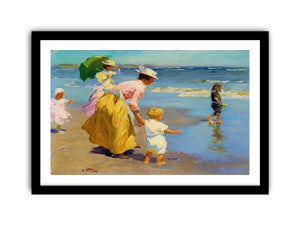
At the Beach Painting by Edward Henry Potthast
At the Beach stands as one of Edward Henry Potthast’s most luminous and psychologically buoyant interpretations of modern leisure, a painting in which light, movement, and human presence converge to express the quiet optimism of early twentieth-century coastal life. Created during Potthast’s mature period, the work reflects an artist fully committed to translating fleeting sensory experience into lasting pictorial form. Rather than presenting the seaside as a dramatic or sublime environment, Potthast renders it as a space of ease and communal rhythm, shaped by sunlight, water, and unguarded human interaction.
Edward Henry Potthast occupies a distinctive position within American Impressionism. Born in Cincinnati and later deeply influenced by European Impressionist practice, Potthast brought a refined understanding of colour, atmosphere, and painterly freedom back to American subjects. His beach scenes, for which he is best known, do not seek narrative complexity or social commentary. Instead, they affirm the value of presence itself—the experience of light on skin, the play of reflections on water, and the shared pleasure of leisure within nature. At the Beach exemplifies this philosophy with exceptional clarity.
The composition is open and fluid, structured to evoke movement without disorder. Figures are arranged loosely across the shoreline, their placement suggesting casual interaction rather than formal grouping. Potthast avoids rigid symmetry or centralised focus, allowing the eye to drift naturally across the canvas, much as one’s gaze might wander along a sunlit beach. This compositional openness reinforces the painting’s emotional register of freedom and relaxation.
Perspective is handled with Impressionist sensitivity rather than academic rigidity. The shoreline establishes a gentle diagonal that guides the viewer into depth, while figures diminish gradually, maintaining spatial coherence without strict linear construction. The horizon is present but understated, ensuring that sky, sea, and sand remain in balanced dialogue. The viewer is positioned not as observer from a distance, but as participant within the scene, sharing its light and air.
Light is the dominant expressive force in At the Beach. Potthast employs bright, natural illumination that dissolves hard edges and animates the entire surface of the painting. Sunlight reflects off water and sand, fragmenting into shimmering passages of colour. Rather than modelling form through shadow, Potthast allows light itself to define bodies and space. This approach aligns with Impressionist principles while remaining distinctly his own, characterised by warmth rather than optical detachment.
Colour is applied with confidence and joy. Potthast favours a palette of soft blues, warm creams, sunlit whites, and gentle flesh tones, punctuated by brighter accents in clothing or parasols. Colours are not blended into smooth transitions; they are placed side by side in lively conversation, allowing the eye to complete the image. This chromatic vitality reinforces the painting’s sense of immediacy and lived experience.
Potthast’s brushwork is loose yet controlled. Strokes are visible, energetic, and responsive to the scene’s movement, particularly in the treatment of water and sky. Figures are suggested rather than meticulously defined, their forms emerging through colour and gesture rather than line. This painterly freedom does not diminish clarity; instead, it enhances authenticity. The beach is not frozen in time but alive with motion and sensation.
Human presence is central to the painting’s meaning. Potthast depicts beachgoers not as individuals with specific identities, but as participants in a shared experience. Their relaxed postures, casual interactions, and unselfconscious enjoyment reflect a modern relationship with leisure—one shaped by accessibility, social openness, and bodily ease. There is no hierarchy among the figures. All are equally subject to sun, breeze, and tide.
Emotionally, At the Beach conveys contentment without sentimentality. There is pleasure, but not indulgence; ease, but not idleness. Potthast captures a balanced emotional state in which rest and vitality coexist. The painting neither dramatizes leisure nor critiques it. Instead, it affirms its legitimacy as a meaningful aspect of modern life. This emotional clarity contributes to the work’s enduring appeal.
Within Potthast’s broader oeuvre, At the Beach represents a distillation of his artistic priorities. While he painted interiors and urban scenes, his beach compositions allowed him to explore light and colour at their most expansive. This work demonstrates his ability to maintain compositional coherence while embracing spontaneity, confirming his position as one of the most accomplished American interpreters of Impressionist technique.
The painting’s relevance today remains strong across the United States, the United Kingdom, Canada, Australia, and Europe. Contemporary viewers continue to respond to its affirmation of shared public space and uncomplicated pleasure. In a modern world often dominated by speed and abstraction, At the Beach offers an image of presence grounded in physical sensation and collective calm.
In interior settings, At the Beach introduces brightness, openness, and emotional lift. In living rooms, it creates an atmosphere of light and sociability. In studies and offices, it offers visual relief and balance, reminding viewers of rhythm beyond work. In galleries and luxury residences, it signals appreciation for American Impressionism rooted in human experience rather than theory.
The painting integrates seamlessly into traditional, modern, minimalist, and eclectic décor. Traditional interiors benefit from its painterly warmth and figurative clarity. Modern spaces resonate with its looseness and light-driven structure. Minimalist environments are enlivened by its colour and movement, while eclectic interiors draw cohesion from its harmonious palette and relaxed energy.
The enduring importance of At the Beach lies in its celebration of the ordinary as worthy of artistic attention. Potthast demonstrates that beauty need not be rare or dramatic; it can emerge from shared moments under open sky. The painting endures because it recognises leisure not as escape, but as renewal—a fundamental aspect of human balance.
To live with At the Beach is to engage daily with an artwork that radiates light and ease without superficiality. Through its confident colour, fluid composition, and emotional generosity, the painting continues to affirm Edward Henry Potthast’s role as a master of American Impressionist coastal scenes. It stands as a testament to his belief that art, when attentive to lived experience, can preserve joy with lasting sincerity.
Buy museum qulaity 400- 450 canvas prints, framed prints, and 100% oil paintings of At the Beach by Edward Henry Potthast at Alpha Art Gallery, where world-famous masterpieces are recreated with museum-quality detail, refined craftsmanship, and premium materials.
FAQS
What is the main theme of At the Beach?
It explores leisure, light, and shared human presence within a modern seaside setting.
Why is Edward Henry Potthast associated with beach scenes?
He specialised in coastal subjects that allowed him to explore light, colour, and relaxed human interaction.
How does Potthast use Impressionist technique in this painting?
He employs loose brushwork, visible strokes, and vibrant colour to capture fleeting sensory experience.
Is At the Beach a narrative painting?
No. It focuses on atmosphere and presence rather than specific events or stories.
Is this artwork suitable for contemporary interiors?
Yes. Its brightness and openness work beautifully in both modern and traditional spaces.
What emotional tone does the painting convey?
It conveys ease, warmth, and quiet optimism without sentimentality.
Does At the Beach have lasting artistic value?
As a strong example of American Impressionism, it holds enduring cultural and aesthetic significance.
Where is the best place to display At the Beach?
It is especially well suited to living rooms, studies, offices, and gallery spaces that benefit from light and openness.