The End of Dinner Painting by Jules Alexandre Grun
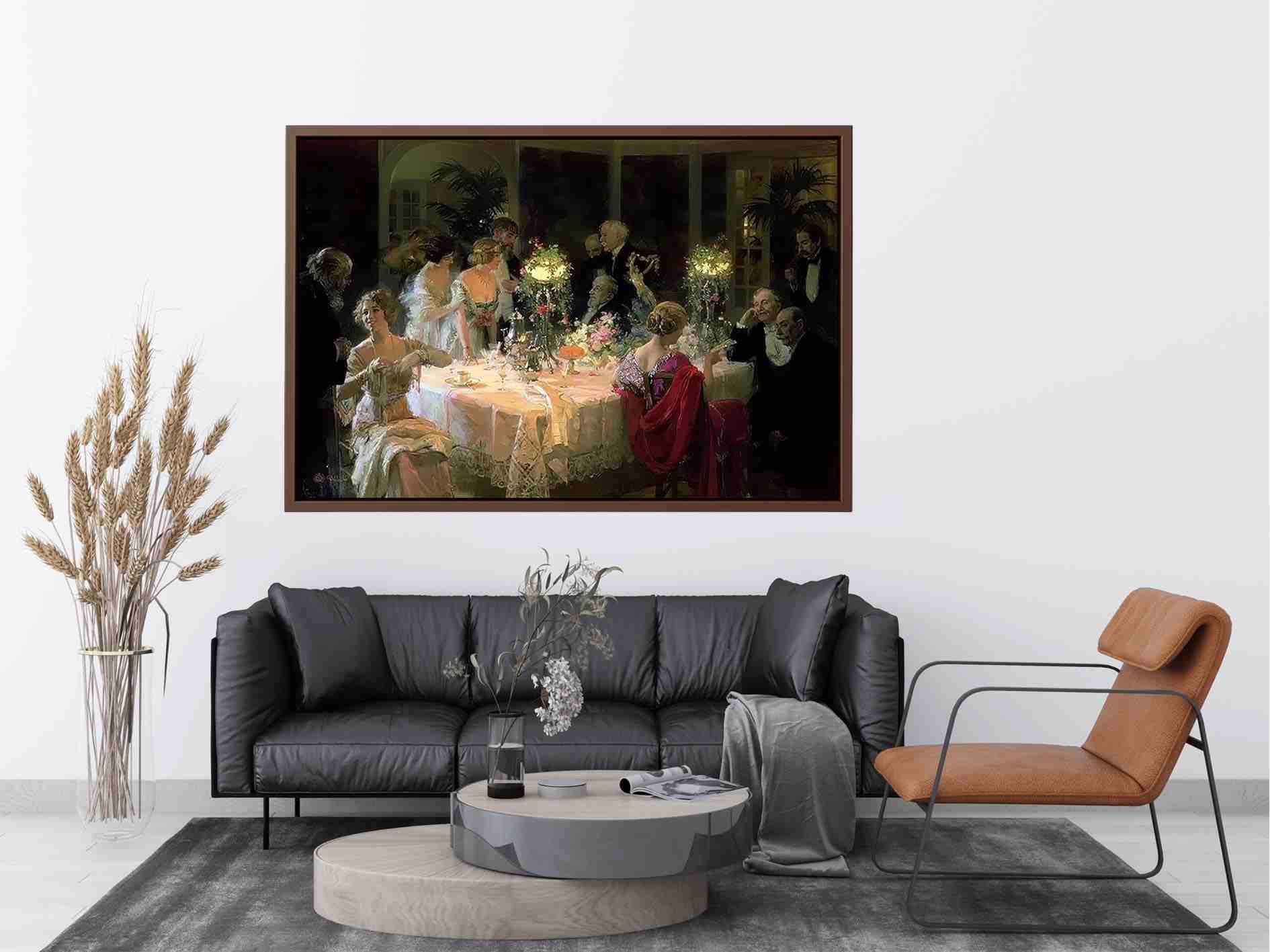
The End of Dinner Painting by Jules Alexandre Grun is a vivid and socially perceptive work that captures the charged atmosphere of Parisian modern life at the turn of the twentieth century. Neither a simple genre scene nor a theatrical tableau, the painting operates as a finely balanced observation of behavior, mood, and unspoken dynamics. Grun selects a moment that is transitional rather than climactic—the instant when conversation has ebbed, gestures have slowed, and the intimacy of shared space begins to dissolve. In doing so, he transforms a familiar social ritual into a study of modern sensibility, where elegance, fatigue, desire, and self-awareness coexist.
Jules Alexandre Grun was closely associated with the visual culture of Belle Époque Paris, a period defined by urban sophistication, café society, and evolving social roles. Known for his depictions of nightlife, fashion, and bourgeois leisure, Grun approached these subjects with acute observational intelligence. His paintings are not mere celebrations of pleasure; they are records of posture, glance, and atmosphere. The End of Dinner exemplifies this approach, revealing how social identity is performed and subtly negotiated in shared spaces.
The subject centers on the aftermath of a meal rather than the meal itself. Plates are no longer the focus; bodies and expressions are. Grun chooses a moment when formalities relax and inner states become perceptible. Guests linger, their attention drifting, their composure gently altered by time, conversation, and perhaps wine. This choice allows Grun to explore psychology rather than event. The dinner’s conclusion becomes a lens through which modern social interaction is examined.
Compositionally, the painting is carefully structured yet appears effortless. Figures are arranged to suggest proximity without uniformity, creating a sense of shared space marked by individual detachment. Grun avoids rigid symmetry, allowing the composition to breathe like a lived interior. The viewer’s eye moves naturally across the scene, guided by subtle alignments of posture and gaze. This fluid arrangement reinforces the impression of an observed moment rather than a staged one.
Perspective places the viewer within the social environment, neither elevated nor detached. This intimacy is crucial. The painting does not invite judgment from afar; it invites recognition. The viewer becomes an unacknowledged presence at the table, attentive to the nuances of expression and gesture. Grun’s perspective collapses the distance between art and experience, reinforcing the painting’s modernity.
Light plays a defining role in establishing mood. Interior illumination is warm yet softened, suggesting late evening rather than lively midday. Light settles on faces, fabrics, and surfaces with selective emphasis, revealing texture and expression without dramatization. There is no theatrical spotlighting. Instead, light functions atmospherically, evoking the gentle fatigue that follows prolonged sociability.
Colour is handled with sophistication and restraint. Grun employs a harmonious palette of warm flesh tones, deep blacks, muted reds, and refined neutrals. Clothing and surroundings reflect contemporary fashion without overwhelming the human presence. Colour serves characterization rather than display, reinforcing distinctions between individuals while maintaining compositional unity. The palette conveys elegance tinged with weariness.
Grun’s brushwork is confident and economical. Surfaces are rendered with enough detail to convey texture and material, yet never descend into excessive finish. This balance preserves immediacy. Fabrics, skin, and furniture are described through assured strokes that suggest movement and presence. The painting retains a sense of life unfolding rather than being frozen.
Emotionally, The End of Dinner is marked by ambiguity. There is no overt narrative resolution. Expressions range from contemplation to detachment, from quiet satisfaction to subtle restlessness. Grun does not impose a single mood. Instead, he allows multiple emotional registers to coexist, reflecting the complexity of social experience. The painting’s power lies in its refusal to simplify.
Symbolically, the work engages with themes of transition and performance. Dinner, as a social ritual, structures interaction and identity. Its end marks a loosening of roles, a return to individual interiority. Grun captures this threshold with sensitivity. The painting suggests that modern social life is defined not only by shared pleasure, but by moments of dispersal and self-awareness.
Within Grun’s broader oeuvre, The End of Dinner represents a mature synthesis of his interests in society, fashion, and psychology. While many of his works depict the energy of nightlife and spectacle, this painting turns inward. It reveals the quieter aftermath of sociability, demonstrating Grun’s range and depth as an observer of modern life.
Culturally, the painting reflects Belle Époque Paris as a space of refined interaction and subtle tension. It records a society conscious of itself, attentive to appearance, yet increasingly aware of interior states. This duality gives the work lasting relevance. Though rooted in a specific time and place, its insights into social behavior remain recognizable.
In contemporary interiors across the United States, the United Kingdom, Canada, Australia, and Europe, The End of Dinner integrates with elegance and narrative interest. In living rooms, it introduces warmth, sophistication, and conversational depth. In dining areas, it resonates thematically without literal repetition. In studies and offices, it reflects cultural awareness and psychological insight. In galleries and luxury residences, it communicates appreciation for refined genre painting grounded in modern observation.
The painting adapts naturally to traditional interiors, where its subject and palette align with classical furnishings. At the same time, it works effectively in modern and eclectic spaces, where its human focus and understated drama provide contrast to minimal design. Its balance of elegance and intimacy ensures versatility across settings.
The long-term artistic importance of The End of Dinner lies in its attentiveness to the in-between. Grun demonstrates that meaning often emerges not from events themselves, but from their aftermath—from pauses, glances, and shifts in posture. By honoring these moments, he elevates genre painting into a subtle form of social analysis.
Today, The End of Dinner remains compelling because it recognizes the complexity of shared experience. It does not celebrate excess nor condemn indulgence. It observes. Through compositional intelligence, refined colour, and psychological sensitivity, Jules Alexandre Grun created a painting that continues to speak to modern viewers, offering a mirror to social life that is both elegant and quietly revealing.
Buy museum qulaity 400- 450 canvas prints, framed prints, and 100% oil paintings of The End of Dinner by Jules Alexandre Grun at Alpha Art Gallery, where world-famous masterpieces are recreated with museum-quality detail, refined craftsmanship, and premium materials.
FAQS
What moment does The End of Dinner depict?
It depicts the transitional moment after a meal, focusing on mood, gesture, and social atmosphere rather than action.
Why is this painting considered psychologically nuanced?
Grun captures subtle expressions and postures that reveal inner states without overt narrative.
How does the painting reflect Belle Époque society?
It portrays refined social interaction, attentiveness to appearance, and the quiet tensions of modern urban life.
Is the work purely a genre scene?
While rooted in genre painting, it functions as a study of social behavior and modern identity.
Where does this artwork work best in interior spaces?
It is well suited to living rooms, dining areas, studies, offices, galleries, and refined residential interiors.
Is The End of Dinner compatible with modern décor?
Yes, its balanced palette and human focus integrate seamlessly into modern, traditional, and eclectic settings.
Does the painting have lasting artistic value?
Its observational depth, compositional clarity, and insight into social dynamics ensure enduring relevance.