Saint George and the Dragon Painting by Raphael
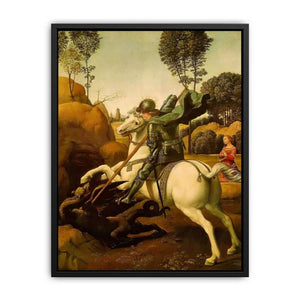
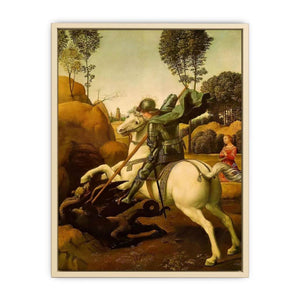
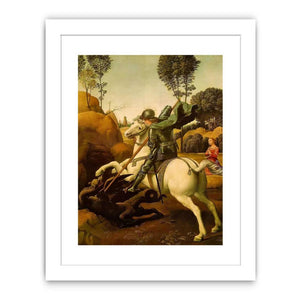
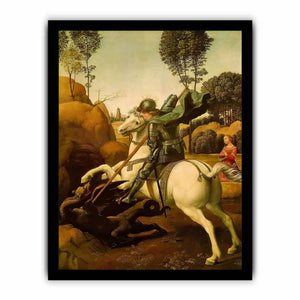
Saint George and the Dragon stands as one of Raphael’s most lyrical and psychologically refined interpretations of heroic virtue, a work in which action, grace, and moral clarity are brought into harmonious balance. Painted during Raphael’s early maturity, when his Florentine experiences were sharpening his command of movement and form, the painting transforms a legendary combat into a meditation on courage exercised with restraint. It is not a scene of brute force or theatrical violence, but an image of ethical resolve made visible through perfect compositional order.
The subject, drawn from medieval legend, depicts Saint George confronting the dragon that terrorises the land, an episode long associated with the triumph of good over evil and the protection of the innocent. Raphael approaches this narrative with characteristic intelligence, stripping it of excess while preserving its symbolic depth. Rather than presenting a chaotic struggle, he chooses the precise moment when victory becomes inevitable. Saint George is shown in controlled motion, his body aligned, his purpose clear, his action decisive yet measured.
Saint George’s figure exemplifies Raphael’s ideal of heroic beauty. He is youthful, poised, and fully present, his body moving with fluid assurance rather than strain. The saint’s armour reflects light without ostentation, serving as an extension of his disciplined character rather than a display of power. His gesture is firm and exact, directed toward the dragon with calm authority. Raphael’s hero does not rage; he acts. This distinction defines the painting’s moral centre. Courage, in Raphael’s vision, is guided by reason and alignment with higher purpose, not by fury or impulse.
The dragon, though formidable, is rendered with clarity rather than grotesque exaggeration. Its contorted form and darkened tones communicate threat, but its defeat is already assured. Raphael resists sensationalism, choosing instead to depict evil as something real yet limited, incapable of enduring against order and resolve. The dragon’s submission reinforces the painting’s ethical structure: chaos yields not to greater chaos, but to disciplined action.
Compositionally, Saint George and the Dragon is a masterclass in equilibrium. Raphael organises the scene along dynamic diagonals that convey movement while maintaining balance. Saint George’s forward motion is countered by the dragon’s retreat, creating a rhythmic exchange that animates the surface without destabilising it. The figures are integrated seamlessly into the surrounding landscape, which provides context without overwhelming the action. Space here is not incidental; it participates in the narrative by reinforcing clarity and openness.
The background landscape extends the painting’s symbolic resonance. Rolling terrain and distant forms suggest a world restored to safety by the saint’s intervention. Raphael avoids dramatic atmospherics, favouring a calm, lucid setting that reflects the ethical certainty of the moment. Nature does not mirror chaos; it affirms order. This choice aligns the painting with Renaissance humanist ideals, in which moral harmony is reflected in the natural world.
Light plays a crucial role in articulating hierarchy and meaning. Saint George is illuminated with gentle clarity, his form clearly defined and visually accessible. This light is neither harsh nor theatrical. It reveals rather than overwhelms, reinforcing the idea that truth and virtue are intelligible. In contrast, the dragon recedes into shadow, its form partially obscured, emphasising its separation from clarity and order. Raphael’s use of light does not dramatise conflict; it resolves it.
Colour further supports this moral structure. Raphael employs a refined palette of cool blues, silvery greys, and warm flesh tones to articulate Saint George’s presence, set against darker, earthier hues associated with the dragon. Yet the overall harmony remains intact. Colour contrast is carefully moderated, ensuring that difference serves meaning rather than spectacle. The painting’s chromatic balance contributes to its enduring sense of calm authority.
Raphael’s handling of anatomy reveals his deep engagement with classical ideals. Saint George’s body is idealised but never abstract. Musculature is precise, proportion measured, movement graceful. The figure embodies the Renaissance conviction that physical beauty can express moral virtue. This belief is not imposed symbolically; it is demonstrated through visual coherence. The saint’s body moves as it should, because his purpose is just.
Emotionally, the painting conveys assurance rather than tension. Although the subject is conflict, the mood is one of resolution. The viewer is not invited to fear for the outcome, but to witness the restoration of balance. This emotional restraint is central to Raphael’s genius. He understands that true drama need not rely on excess, and that clarity can be more compelling than chaos.
Within Raphael’s broader body of work, Saint George and the Dragon occupies an important place in his exploration of narrative action. While he is often celebrated for serenity and harmony, this painting demonstrates his ability to engage movement and conflict without sacrificing compositional grace. It anticipates the confidence of his later Roman works while retaining the elegance and intimacy of his Florentine period.
The painting’s relevance today remains unmistakable. In a world frequently confronted with images of conflict devoid of moral clarity, Saint George and the Dragon offers an alternative vision. It presents courage as disciplined, authority as calm, and victory as ethical rather than violent. Viewers across the United States, the United Kingdom, Canada, Australia, and Europe continue to respond to its affirmation that strength guided by principle can restore order without brutality.
In interior spaces, Saint George and the Dragon brings energy and purpose without aggression. In living rooms, it serves as a dynamic focal point that communicates confidence and clarity. In studies and offices, it reinforces themes of leadership, responsibility, and moral resolve. In galleries and luxury residences, it signals refined engagement with Renaissance ideals and narrative depth.
The painting integrates seamlessly into traditional, modern, minimalist, and eclectic décor. Traditional interiors resonate with its classical subject and harmonious composition. Modern spaces benefit from its clarity of form and restrained dynamism, which introduce movement without visual clutter. Minimalist environments find balance in its controlled palette and structural precision, while eclectic settings draw cohesion from its timeless symbolism.
The enduring importance of Saint George and the Dragon lies in its refusal to equate heroism with violence. Raphael presents victory as composed, purposeful, and aligned with order. This vision continues to resonate because it affirms that moral clarity, when embodied with discipline and grace, is itself a powerful force.
To live with Saint George and the Dragon is to engage daily with one of Raphael’s most refined expressions of heroic virtue. Through its masterful balance, luminous restraint, and ethical depth, the painting remains a compelling testament to the Renaissance belief that beauty, courage, and justice are inseparable. It stands as a timeless image of action governed by principle, offering a vision of strength that endures through harmony rather than force.
Buy museum qulaity 400- 450 canvas prints, framed prints, and 100% oil paintings of Saint George and the Dragon by Raphael at Alpha Art Gallery, where world-famous masterpieces are recreated with museum-quality detail, refined craftsmanship, and premium materials.
FAQS
What is the central meaning of Saint George and the Dragon?
The painting symbolises the triumph of disciplined virtue and moral clarity over chaos, presenting heroism as measured and purposeful.
How does Raphael portray Saint George differently from more dramatic depictions?
He presents the saint as calm and controlled, emphasising ethical resolve rather than physical aggression.
Why is the dragon rendered without grotesque exaggeration?
Raphael limits sensationalism to reinforce the idea that evil, while real, is finite and ultimately subordinate to order.
Is Saint George and the Dragon suitable for contemporary interiors?
Yes. Its balanced composition and restrained dynamism integrate seamlessly into modern and traditional spaces.
What emotional atmosphere does the painting create?
It conveys assurance, confidence, and ethical strength rather than fear or violence.
Does this artwork have long-term cultural value?
As a refined Renaissance interpretation of heroic virtue, it holds enduring artistic, symbolic, and cultural significance.
Where is the best place to display this painting?
It is especially effective in living rooms, studies, offices, and gallery spaces where purpose and clarity are valued.
Why does Saint George and the Dragon remain meaningful today?
Its vision of courage guided by restraint and principle continues to resonate in a world seeking ethical strength without excess.