


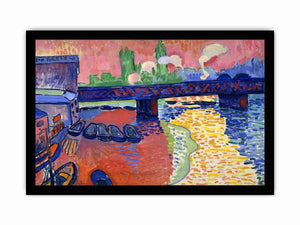

Charing Cross Bridge, London by André Derain.
Go kalles this summer with this vintage navy and white striped v-neck t-shirt from the Nike. Perfect for pairing with denim and white kicks for a stylish kalles vibe.

Charing Cross Bridge, London by André Derain.
Charing Cross Bridge, London Painting by André Derain
Painted during a decisive moment in the formation of early twentieth-century modernism, Charing Cross Bridge, London by André Derain stands as one of the most intellectually assured and visually radical interpretations of the modern city. Created during Derain’s London stay of 1906–1907, the painting belongs to a celebrated series commissioned at a time when European painting was undergoing a fundamental reassessment of colour, form, and meaning. London, long depicted through tonal subtlety and atmospheric nuance, becomes in Derain’s hands a site of chromatic conviction and structural clarity, marking a profound shift in how urban experience could be translated into paint.
The historical background of this work is inseparable from the emergence of Fauvism, a movement that rejected descriptive naturalism in favour of colour as an autonomous expressive force. Derain, alongside contemporaries such as Henri Matisse, sought to liberate painting from the obligation to imitate visible reality. In choosing Charing Cross Bridge as his subject, Derain engaged directly with a motif already laden with art-historical significance. Yet his intention was neither continuation nor revision of Impressionist precedent. Instead, he transformed the Thames and its architecture into a field of deliberate chromatic relationships, asserting that colour itself could organise space, convey emotion, and communicate intellectual purpose.
Within Derain’s own artistic development, Charing Cross Bridge, London represents a moment of synthesis rather than experimentation alone. Earlier works had already demonstrated his break from naturalistic palettes, but here that liberation is tempered by compositional discipline. The bridge anchors the composition with architectural authority, spanning the canvas as both subject and structural axis. Above and below this stabilising form, the city unfolds in carefully articulated planes, guiding the viewer’s eye through a coherent spatial progression. This balance between expressive colour and compositional order signals Derain’s maturity as a modern painter.
The painting’s significance within its artistic period lies in its refusal to treat the city as mere scenery. London is presented not as an atmospheric spectacle but as an active, constructed environment shaped by rhythm, movement, and human intervention. The Fauvist language employed here does not dissolve form; it clarifies it. Buildings are reduced to essential volumes, the river becomes a dynamic surface of chromatic interaction, and the sky operates as a field of energy rather than a descriptive backdrop. The result is a city rendered intelligible through structure rather than illusion.
Compositionally, the painting achieves equilibrium through contrast. The horizontal sweep of the bridge counters the vertical rise of buildings, while the flowing movement of the river offsets the solidity of architecture. Perspective is flattened without becoming abstract, allowing the viewer to recognise the scene while remaining aware of its constructed nature. This spatial design reinforces the painting’s modern sensibility, reminding the viewer that representation is an act of interpretation rather than transcription.
Colour is deployed with deliberate intelligence. Derain’s palette rejects the muted greys traditionally associated with London, replacing them with saturated blues, greens, oranges, and yellows that vibrate against one another. These colours do not describe light; they generate it. Illumination emerges from contrast and juxtaposition rather than reflection, transforming the scene into an arena of visual tension and harmony. Texture, achieved through confident brushwork, asserts the physical presence of paint, emphasising the artwork’s material reality and reinforcing its modernist ethos.
Symbolically, Charing Cross Bridge, London can be read as a meditation on modernity itself. The bridge functions as a metaphor for transition, connection, and movement, uniting past and present within a rapidly evolving urban landscape. Derain’s London is neither romanticised nor alienated; it is presented as a place of vitality and coherence, where human ingenuity shapes space with confidence. The painting communicates an optimism grounded in intellectual clarity, reflecting a belief in art’s capacity to reimagine the modern world.
Emotionally, the work conveys assurance rather than introspection. There is no sense of nostalgia or melancholy; instead, the painting radiates composure and control. This emotional register distinguishes Derain’s approach from both the atmospheric reverie of Impressionism and the later fragmentation of Cubism. It invites sustained contemplation, rewarding viewers who engage with its chromatic logic and spatial organisation.
Culturally, the painting occupies a crucial position in the history of urban representation. It bridges the observational traditions of the nineteenth century and the conceptual ambitions of the twentieth, demonstrating that expressive freedom need not abandon structure. Its influence extends beyond Fauvism, prefiguring later modernist approaches to cityscapes that emphasised form, rhythm, and psychological resonance over literal depiction.
The enduring relevance of Charing Cross Bridge, London lies in its capacity to speak across time and geography. In a contemporary world defined by global cities and constant visual stimulation, Derain’s disciplined use of colour offers clarity rather than excess. The painting remains meaningful because it does not depend on topical reference; instead, it addresses fundamental questions about perception, order, and human presence within constructed environments.
Within modern interiors across the United States, United Kingdom, Canada, Australia, and Europe, this artwork integrates with remarkable versatility. In living rooms, it functions as a commanding focal point, introducing intellectual depth and visual vitality. In studies and offices, it reinforces an atmosphere of cultivated modernity, aligning aesthetic sophistication with reflective purpose. Galleries and luxury residences benefit from its cultural authority, as the painting sustains attention without overwhelming its surroundings.
Its adaptability across decorative contexts further enhances its appeal. In minimalist interiors, the bold palette introduces warmth and movement, while the structured composition maintains visual discipline. Traditional settings gain renewed energy through contrast, as the painting’s modern language enlivens classical furnishings without disrupting their harmony. Eclectic spaces find cohesion in its chromatic balance, allowing diverse elements to coexist within a unified visual framework.
Ultimately, Charing Cross Bridge, London by André Derain stands as a declaration of modern painting’s potential. It affirms that colour can think, that structure can express emotion, and that the city can be understood not merely as a place but as an idea. Its lasting significance resides in this synthesis, making it an artwork of enduring intellectual and aesthetic value.
Buy museum qulaity 400- 450 canvas prints, framed prints, and 100% oil paintings of Charing Cross Bridge, London by André Derain at Alpha Art Gallery, where world-famous masterpieces are recreated with museum-quality detail, refined craftsmanship, and premium materials.
FAQS
What is the deeper meaning of Charing Cross Bridge, London by André Derain?
The painting explores modern urban life through expressive colour and structured composition, presenting the city as an organised yet dynamic environment.
Why is this work considered significant in Derain’s career?
It represents a mature moment in his Fauvist period, where expressive colour is balanced by compositional clarity and intellectual control.
How does this painting differ from Impressionist views of London?
Rather than focusing on atmosphere and fleeting light, Derain emphasises structure, colour intensity, and conceptual interpretation.
Is this artwork suitable for contemporary interiors?
Yes. Its strong palette and architectural balance allow it to complement modern, traditional, minimalist, and eclectic spaces.
What artistic movement does this painting belong to?
The work is associated with Fauvism, characterised by bold colour and formal innovation.
Does Charing Cross Bridge, London have long-term cultural value?
It holds enduring importance as a bridge between nineteenth-century representation and twentieth-century modernism.
Where does this painting work best within a home or professional setting?
It is especially effective in living rooms, studies, offices, galleries, and luxury residences where visual impact and cultural depth are valued.
Why does this artwork remain relevant today?
Its exploration of colour, structure, and urban experience continues to resonate with contemporary audiences worldwide.
| 1. Select Type |
Canvas Print, Unframed Paper Print, Hand-Painted Oil Painting, Framed Paper Print |
|---|---|
| 2. Select Finish Option |
Rolled Canvas, Rolled- No Frame, Streched Canvas, Black Floating Frame, White Floating Frame, Brown Floating Frame, Black Frame with Matt, White Frame with Matt, Black Frame No Matt, White Frame No Matt, Streched, Natural Floating Frame, Champagne Floating Frame, Gold Floating Frame |
| 3. Select Size |
60cm X 90cm [24" x 36"], 76cm X 114cm [30" x 45"], 90cm X 120cm [36" x 48"], 100cm X 150cm [40" x 60"], 16.54 x 11.69"(A3), 23.39 x 16.54"(A2), 33.11 x 23.39"(A1), 46.81 x 31.11"(A0), 54" X 36", 50cm X 60cm [16" x 24"], 121cm X 182cm [48" x 72"], 135cm X 200cm [54" x 79"], 165cm x 205cm [65" x 81"], 183cm x 228cm [72" x 90"], 22cm X 30cm [9" x 12"], 30cm x 45Cm [12" x 18"], 45cm x60cm [16" x 24'], 75cm X 100cm [30" x 40"], 121cm x 193cm [48" x 76"], 45cm x 60cm [16" x 24'], 20cm x 25Cm [8" x 10"], 35cm x 50Cm [14" x 20"], 45cm x 60 cm [18" x 24"], 35cm x 53Cm [14" x 21"], 66cm X 101cm[26" x 40"], 76cm x 116cm [30"x 46"], 50cm X 60cm 16" x 24"] |