The Fire in the Borgo: Raphael’s Dramatic Vision of Rome in Crisis
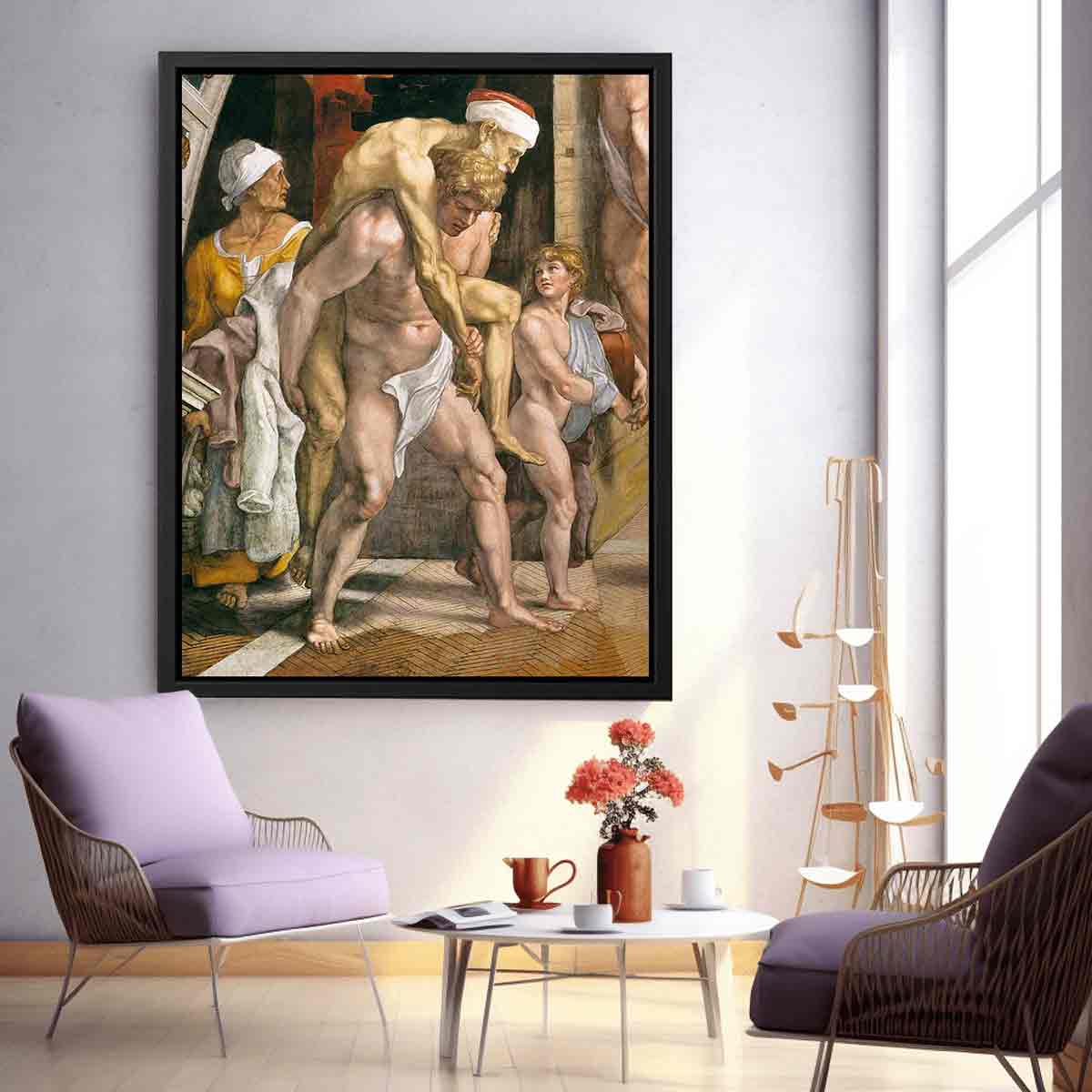
The Fire in the Borgo is one of the most theatrical compositions associated with Raphael’s Vatican rooms. The fresco depicts the legendary fire that broke out in the Borgo district of Rome in 847 and the miraculous intervention of Pope Leo IV, whose blessing was said to extinguish the flames. The work was painted in the Stanza dell’Incendio and dates to Raphael’s Roman period, although much of the execution was carried out by his workshop. A detailed reproduction is especially appealing because the composition contains a remarkable range of human movement: people flee, rescue children, climb walls, carry water and look toward the pope for salvation.
A Miracle Set Inside a City
The subject combines history, legend and Christian miracle. The fire threatens ordinary people and buildings, creating a scene of collective danger. Raphael’s design transforms that crisis into a visual narrative in which the city itself becomes a stage. Architecture establishes the setting, while the figures create waves of movement across it. The story is immediately dramatic, but the Renaissance interest in civic history also gives the fresco a documentary flavor. A reproduction can therefore appeal to collectors of historical art as well as viewers interested in religious painting.
The Human Body Under Pressure
The supplied artwork tags emphasize men, women and nude figures, and this reflects the physical intensity of Raphael’s composition. Bodies twist, stretch, bend and climb as people attempt to escape or help others. The unusual poses reveal the influence of classical figure studies and the Renaissance fascination with anatomy. Raphael’s figures are not merely narrative symbols; they become demonstrations of what the human body can communicate through action. This makes a detailed print particularly rewarding because individual poses can be studied almost like independent figure drawings.
Architecture and the Memory of Ancient Rome
Architecture plays a central role in the scene. Walls, buildings and terraces provide the physical structure through which the drama unfolds. Raphael was deeply interested in ancient Rome, and the fresco’s architectural environment contributes to the historical imagination of the scene. The result is not a simple illustration of a fire but an idealized vision of Rome in which contemporary Renaissance viewers could recognize their own city and its ancient past.
Pope Leo IV and the Power of the Blessing
At the center of the theological story is Pope Leo IV. The miracle depends on his blessing, which transforms the pope from a historical figure into a symbol of spiritual authority. The contrast between the panic of the crowd and the authority of the papal intervention creates the narrative’s emotional resolution. For collectors interested in Vatican art, papal history and Renaissance religious imagery, this makes the fresco especially distinctive.
Why a Detail Makes Striking Wall Art
A complete fresco can be visually overwhelming, but a detail can isolate the most expressive figures and gestures. This is particularly effective with The Fire in the Borgo because Raphael’s composition contains so many separate episodes. A focused reproduction can become a dramatic wall statement while still preserving the atmosphere of the larger fresco. Canvas is especially suitable for the muscular figures and strong movement; a framed print can emphasize the historical character; and a hand-painted reproduction can recreate some of the tactile quality associated with fresco painting.
Raphael’s Workshop and the Finished Fresco
Raphael’s later Vatican commissions were executed with substantial workshop assistance. The Fire in the Borgo is generally associated with designs by Raphael and execution by assistants including Giulio Romano. This is an important part of its history because it demonstrates the scale of Raphael’s studio and the collaborative nature of Renaissance monumental painting. Collectors can therefore appreciate the work both as Raphael’s invention and as evidence of the workshop system through which his designs were brought to life.
Own a Renaissance Scene Filled with Movement
The Fire in the Borgo is an excellent choice for buyers who want Renaissance art with drama, historical storytelling and physical energy. The fire, the desperate citizens, the architecture and the papal miracle create a composition that can dominate a room while rewarding close study. A fine art print, canvas, framed reproduction or hand-painted interpretation allows the Vatican-inspired scene to become part of a private collection. Its combination of Roman history, Christian legend and Raphael’s sophisticated figure design makes it especially compelling as Renaissance wall art.
Renaissance Action Designed for a Monumental Room
The physical intensity of the figures reflects the purpose of the Vatican fresco cycle. These scenes were designed to be encountered within an architectural environment, and their gestures had to remain legible across a large room. Raphael and his workshop therefore used exaggerated movement, clear silhouettes and strong directional rhythms. A modern reproduction benefits from the same qualities. At larger scale, the bodies and gestures become visually immersive, making the artwork particularly effective above a sofa, console, library wall or formal dining space.
Fire, Rescue and the Theater of Renaissance History
The human actions in the fresco give the historical event its emotional force. People carry children, climb walls and move through danger, transforming the distant story of an ancient Roman fire into a scene of immediate human urgency. Raphael’s interest in the nude body is visible in several of these dramatic poses, where anatomy becomes a means of communicating effort. This is one reason the detail can be especially effective in a large reproduction. The viewer begins to see the fresco not simply as a religious history scene but as a study of movement, fear, courage and collective action. For collectors, that mixture of history and figure design provides a distinctive form of Renaissance wall art.
The fresco’s combination of ancient Roman history and Renaissance invention makes it particularly suitable for collectors who enjoy works with a strong sense of place. The Borgo becomes more than a backdrop; it is the setting through which Raphael explores danger, rescue and divine protection. This gives the artwork narrative depth as well as visual energy.