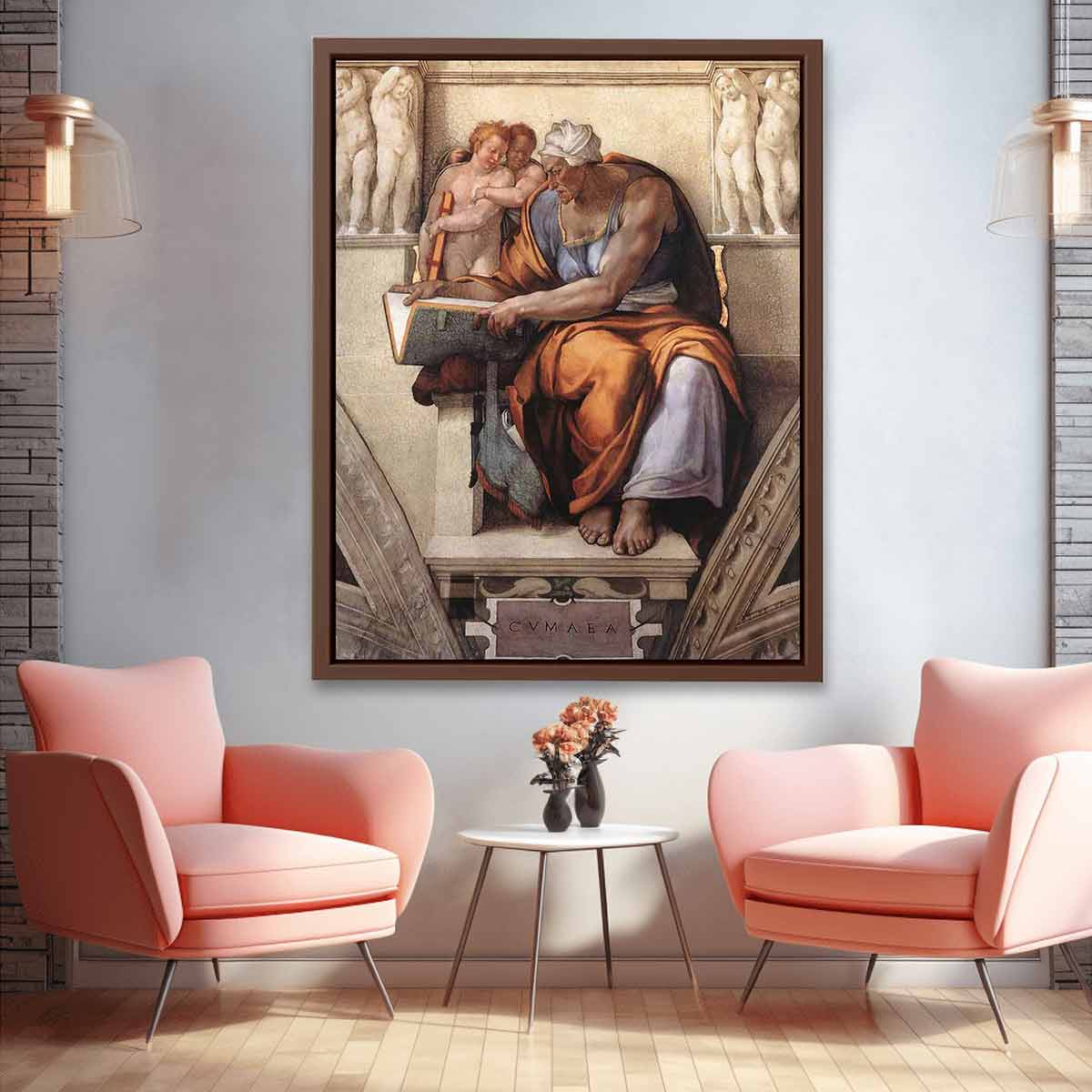
The Cumaean Sibyl by Michelangelo Buonarroti is one of the monumental prophetic figures painted on the ceiling of the Sistine Chapel in Vatican City. Created between 1508 and 1512, the figure forms part of Michelangelo’s extraordinary High Renaissance fresco program, where biblical prophets and classical sibyls surround the central scenes from Genesis. Alpha Art Gallery offers this celebrated Michelangelo artwork as a museum-quality canvas print, fine art print, framed print, or 100% hand-painted oil painting reproduction.
The original fresco is not for sale. It remains in the Sistine Chapel as part of the Vatican Museums. Alpha Art Gallery reproductions are contemporary artworks created for collectors and interiors inspired by Michelangelo’s Renaissance masterpiece.
About Michelangelo’s Cumaean Sibyl
The Cumaean Sibyl is one of the five sibyls represented by Michelangelo on the Sistine Chapel ceiling. In classical tradition, sibyls were female prophetic figures associated with the ancient Mediterranean world. Michelangelo incorporated them into a Christian theological program in which prophecy from both the biblical and classical traditions contributes to the larger story of salvation.
The Cumaean Sibyl is presented as a monumental seated woman with an open book, emphasizing the connection between prophecy, sacred knowledge, and written revelation. Her imposing physical scale and powerful posture demonstrate Michelangelo’s mastery of the human figure.
The supplied catalog classification identifies the artwork with Michelangelo, Michelangelo Buonarroti, High Renaissance, Mannerism, people, books and letters, children, men, still life, Renaissance fresco, religious art, and the Vatican Museums. These categories reflect the artwork’s prophetic subject, monumental figure, written text, and place within the Sistine Chapel fresco cycle.
Michelangelo and the Sistine Chapel Ceiling
Michelangelo painted the Sistine Chapel ceiling between 1508 and 1512 under the commission of Pope Julius II. The project became one of the defining achievements of Western art, combining biblical narratives, monumental prophets and sibyls, ancestors of Christ, ignudi, and elaborate architectural decoration.
The Cumaean Sibyl forms part of this integrated visual program. Rather than functioning as an isolated portrait, she participates in a larger theological and architectural structure that connects the Old Testament, Christian tradition, and classical prophecy.
Michelangelo’s arrangement of the prophets and sibyls around the central Genesis scenes gives the ceiling a powerful visual rhythm. Each figure has an individual character while contributing to the overall unity of the chapel.
Who Was the Cumaean Sibyl?
The Cumaean Sibyl was associated in classical tradition with Cumae, an ancient Greek colony in Italy. Sibyls were believed to possess prophetic powers, and their traditions were later incorporated into Christian interpretations of prophecy.
Michelangelo’s inclusion of the Cumaean Sibyl reflects the Renaissance fascination with classical antiquity and the relationship between ancient culture and Christian theology. Her presence alongside Hebrew prophets creates a visual dialogue between different traditions of prophetic knowledge.
The figure’s monumental scale gives this classical prophetess a visual authority comparable to the biblical prophets around her.
The Open Book and Prophecy
The open book held by the Cumaean Sibyl is an important visual attribute. Throughout the Sistine Chapel ceiling, books and scrolls help identify prophets and sibyls as figures connected with written revelation.
The book also gives the composition an intellectual quality. Michelangelo balances the extraordinary physical power of the figure with an emphasis on contemplation, reading, and prophetic knowledge.
This combination of monumental anatomy and intellectual symbolism is characteristic of Michelangelo’s approach to the Sistine Chapel figures.
Michelangelo’s Monumental Female Figure
The Cumaean Sibyl is particularly notable for the strength and monumentality of her female body. Michelangelo gives her an unusually powerful physical presence, demonstrating his ability to construct large figures with convincing weight, volume, and anatomical structure.
The pose is complex yet controlled. The figure’s body, clothing, arms, and head create a strong arrangement of forms that remains visually compelling even when viewed from the floor of the chapel far below.
Michelangelo’s treatment of the female figure does not rely on delicate proportions alone. Instead, he applies the monumental physical language of his sculpture and male figure studies to create a commanding prophetic presence.
High Renaissance and Mannerist Influence
The Cumaean Sibyl belongs to Michelangelo’s High Renaissance achievement while also demonstrating qualities that later influenced Mannerism. The monumental scale, idealized anatomy, and integration of figure and architecture reflect Renaissance principles.
At the same time, Michelangelo’s complex poses, powerful anatomy, expressive gestures, and heightened physical presence helped establish a visual language that became central to later Mannerist art.
For this reason, the Cumaean Sibyl can be appreciated both as an important High Renaissance fresco and as part of Michelangelo’s lasting influence on European figure painting.
Why the Cumaean Sibyl Is Important
The Cumaean Sibyl is important because it demonstrates Michelangelo’s ability to transform a legendary prophetic figure into a monumental study of human form. The figure combines physical strength, intellectual symbolism, classical tradition, and Christian interpretation.
The artwork also reveals Michelangelo’s extraordinary ability to design figures for a monumental architectural environment. Every gesture, fold of drapery, and anatomical form contributes to the figure’s visibility and expressive power.
For collectors, a reproduction of the Cumaean Sibyl provides an opportunity to focus on one of the Sistine Chapel’s most commanding prophetic figures rather than reproducing the entire ceiling.
Where Is the Original Cumaean Sibyl?
The original fresco remains on the ceiling of the Sistine Chapel in Vatican City. The chapel forms part of the Vatican Museums complex.
Because the artwork is an integral fresco painted directly onto the chapel architecture, it cannot be removed and sold as a conventional painting. Alpha Art Gallery reproductions provide a contemporary way to display this historic artwork as wall art.
These reproductions are not the original Vatican fresco and should not be represented as Vatican Museums originals, certified copies, or Vatican-authorized products.
Choosing a Reproduction Format
| Format |
Visual Character |
Ideal For |
| Canvas Print |
Strong wall presence that emphasizes Michelangelo’s monumental figure |
Living rooms, studies, offices, libraries and statement walls |
| Fine Art Print |
Refined printed presentation focused on the Renaissance artwork |
Collectors and traditional art displays |
| Framed Print |
Finished presentation with framing options where available |
Libraries, studies, formal interiors and gallery walls |
| Hand-Painted Oil Reproduction |
Individually painted surface with genuine brushwork and painted texture |
Collectors seeking the physical character of handmade artwork |
Canvas Prints of the Cumaean Sibyl
A canvas print can give Michelangelo’s prophetic figure a strong visual presence. The monumental composition and rich Renaissance character make canvas particularly suitable for a statement wall.
The artwork can work effectively in a living room, library, study, home office, bedroom, hallway, or reception space. Its classical and religious character can complement both traditional and contemporary interiors.
Fine Art and Framed Prints
A fine art print offers a refined way to display the Cumaean Sibyl while keeping attention on Michelangelo’s composition and figure work. It can work well alongside other Renaissance paintings, religious artworks, classical studies, and historic portraits.
A framed print offers a more formal finished presentation and can complement libraries, studies, offices, and interiors influenced by classical design.
Hand-Painted Oil Painting Reproduction
Alpha Art Gallery offers 100% hand-painted oil painting reproductions created individually by professional artists using oil on canvas. Unlike a standard print, a hand-painted reproduction contains genuine brushwork and painted texture.
The Cumaean Sibyl’s monumental figure, drapery, book, and architectural setting provide a rich subject for a painterly interpretation. This format may appeal to collectors who prefer the physical qualities of handmade artwork.
Collectors interested in this format can explore the broader selection of oil painting reproductions.
Where to Display the Cumaean Sibyl
The artwork’s monumental and intellectual character makes it particularly suitable for studies, libraries, living rooms, home offices, and formal interiors. The open book also makes the subject a natural choice for spaces associated with reading, scholarship, history, or philosophy.
Collectors creating a Renaissance-themed gallery wall can pair the Cumaean Sibyl with other Michelangelo works, Renaissance religious paintings, or classical figure studies.
Why Choose Alpha Art Gallery?
Alpha Art Gallery offers several reproduction formats for historic artworks, including museum-quality canvas prints, fine art prints, framed prints, and 100% hand-painted oil painting reproductions. Multiple sizes and frame options are available where offered.
Hand-painted reproductions are individually created by professional artists using oil on canvas. Alpha Art Gallery also provides secure packaging, worldwide delivery, and free worldwide shipping on all orders. Production facilities in the USA, Australia, United Kingdom, and Canada support regional fulfillment for international customers.
This artwork can also be explored alongside other celebrated historic works through the gallery’s Famous Paintings collection.
Frequently Asked Questions
Who painted the Cumaean Sibyl?
The Cumaean Sibyl was painted by Michelangelo Buonarroti as part of the Sistine Chapel ceiling.
Where is Michelangelo’s Cumaean Sibyl?
The original fresco remains on the ceiling of the Sistine Chapel in Vatican City, part of the Vatican Museums.
Who was the Cumaean Sibyl?
The Cumaean Sibyl was a prophetic figure associated with the ancient city of Cumae. Renaissance artists and theologians connected classical sibyl traditions with broader ideas of prophecy.
What does the Cumaean Sibyl hold?
Michelangelo depicts the Cumaean Sibyl with an open book, reinforcing her association with prophecy, sacred knowledge, and written revelation.
Can I buy the Cumaean Sibyl as a canvas print?
Yes. Alpha Art Gallery offers the artwork as a museum-quality canvas print.
Is a hand-painted oil reproduction available?
Yes. Alpha Art Gallery offers 100% hand-painted oil painting reproductions created individually by professional artists using oil on canvas.
Is the reproduction the original Vatican fresco?
No. The original remains in the Sistine Chapel. Alpha Art Gallery offers contemporary reproductions intended for wall display.
Bring Michelangelo’s Cumaean Sibyl Into Your Space
The Cumaean Sibyl combines classical prophecy, Christian symbolism, monumental Renaissance figure painting, and Michelangelo’s extraordinary command of anatomy. Choose canvas for strong wall presence, fine art or framed print for a refined presentation, or a hand-painted oil reproduction when the physical qualities of individually painted artwork are especially important to you.