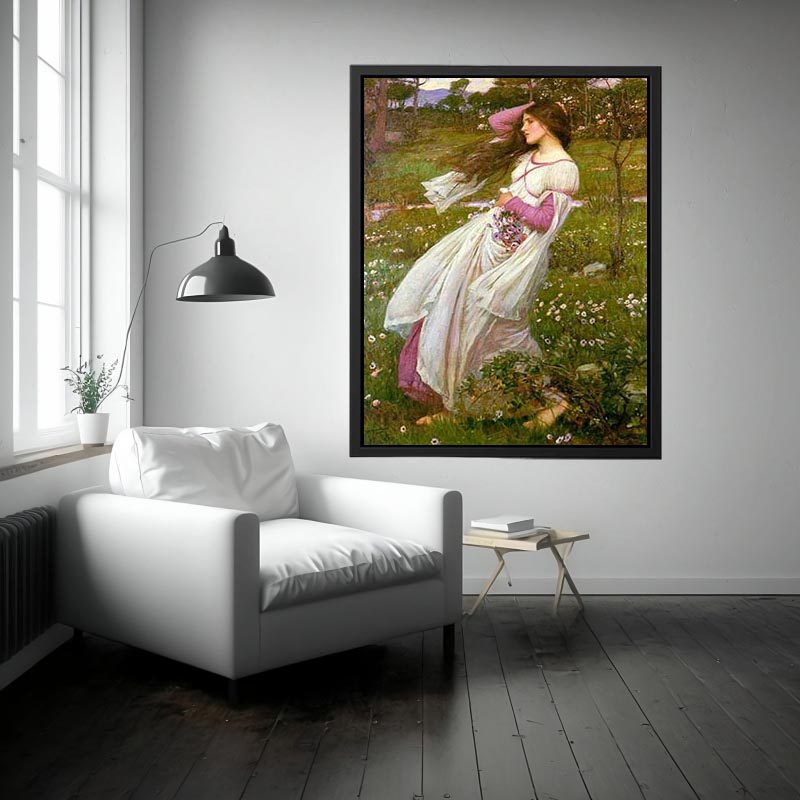
Windflowers 1903 Painting by John William Waterhouse
Windflowers 1903 Painting by John William Waterhouse is one of the most quietly lyrical and emotionally restrained works of the artist’s late career, a painting in which mood, memory, and feminine introspection converge with remarkable subtlety. Created in 1903, the work abandons overt mythological narrative in favor of psychological atmosphere, presenting a scene that feels suspended between thought and sensation. Rather than illustrating a story, Windflowers evokes an inner state—melancholy without despair, longing without urgency, and beauty tempered by transience.
By this period, John William Waterhouse had moved decisively beyond the richly detailed, narrative-driven compositions that first established his reputation. While still associated with the Pre-Raphaelite tradition, his mature works reflect a growing affinity with Symbolism and modern introspection. Windflowers exemplifies this evolution. It is not concerned with action or event, but with emotional weather—the subtle shifts of feeling that pass through the human mind as invisibly as wind through grass.
The title itself suggests fragility and impermanence. Windflowers, often associated with fleeting beauty and seasonal change, carry symbolic weight across literary and artistic traditions. Waterhouse uses this botanical reference not as decorative detail but as emotional metaphor. The flowers become extensions of the figures’ inner lives, echoing themes of youth, vulnerability, and the inevitability of passing time.
Compositionally, the painting is horizontal and open, yet psychologically enclosed. Three young women sit together in a field, their bodies arranged in a gentle rhythm that guides the viewer’s eye across the canvas. Despite their physical proximity, each figure appears inwardly isolated, absorbed in her own thoughts. This tension between closeness and solitude is central to the painting’s emotional resonance. Community exists, but introspection prevails.
Perspective places the viewer at a respectful distance, neither elevated nor intrusive. The scene unfolds at eye level, reinforcing a sense of quiet observation rather than narrative involvement. There is no dramatic focal point. Instead, attention drifts naturally from figure to figure, mirroring the wandering quality of thought itself. The painting invites contemplation rather than interpretation.
Light in Windflowers is soft, diffused, and evenly distributed. There are no strong contrasts or theatrical highlights. Illumination feels atmospheric rather than directional, as though the entire scene is enveloped in a gentle haze. This restraint enhances the painting’s mood of introspection, allowing forms to emerge gradually and without emphasis. Light here does not reveal truth suddenly; it sustains awareness gently.
The color palette is subdued and harmonious. Muted greens and browns of the landscape establish a natural, grounded setting, while the women’s garments introduce soft blues, creams, and pale earth tones. These colors do not compete for attention; they blend, reinforcing emotional unity. Color functions as tone rather than accent, shaping the painting’s quiet emotional register.
Waterhouse’s technique is fluid and economical. Brushwork remains visible enough to suggest movement in grasses and fabric, yet controlled enough to preserve calm. There is no obsession with surface detail. Instead, forms are softened, edges slightly blurred, enhancing the sense that this is a remembered or felt moment rather than a sharply observed one. This painterly restraint aligns with the work’s thematic focus on impermanence.
Psychologically, the figures are rendered with deep sensitivity. Their expressions are subdued, their gazes lowered or averted. None engages the viewer directly. Each appears caught in private reflection, suggesting themes of contemplation, memory, or unspoken emotion. Waterhouse avoids sentimentality by refusing overt expression. The painting’s emotional power lies in what is withheld rather than displayed.
Symbolically, Windflowers can be read as a meditation on youth and transition. The women are poised between stages—between innocence and experience, presence and departure. The flowers they hold or sit among emphasize the fleeting nature of such moments. Like the wind, these states cannot be grasped or preserved. They pass, leaving only awareness behind.
Within Waterhouse’s broader oeuvre, this painting represents a significant shift toward modern psychological painting. Unlike earlier mythological works that frame women within dramatic narratives, Windflowers allows its figures to exist without explanation or destiny. They are not cursed, pursued, or transformed. They simply are. This quiet autonomy marks an important evolution in Waterhouse’s portrayal of female subjects.
Culturally, the painting reflects early twentieth-century sensibilities—an increasing interest in inner life, emotional nuance, and the poetry of the everyday. As Victorian certainty gave way to modern ambiguity, works like Windflowers captured the emotional undercurrents of change. The painting feels less anchored to a specific era than to a universal human condition: reflective awareness of time passing.
In contemporary interiors across the United States, the United Kingdom, Canada, Australia, and Europe, Windflowers integrates with exceptional elegance and calm authority. In living rooms, it introduces serenity and emotional depth. In bedrooms and private studies, it fosters introspection and quiet presence. In offices, galleries, and refined residences, it offers balance and poetic restraint, harmonizing seamlessly with traditional, modern, minimalist, and eclectic décor.
The painting remains meaningful today because it honors stillness in a restless world. It acknowledges emotion without dramatizing it and presence without demanding attention. In an age saturated with urgency and noise, Waterhouse’s Windflowers offers an alternative vision—one in which meaning emerges through quiet observation and emotional honesty.
Windflowers 1903 Painting by John William Waterhouse endures as one of the most understated and emotionally intelligent works of the artist’s career. Through restrained composition, muted color, and profound sensitivity to inner life, Waterhouse transformed a simple outdoor scene into a timeless meditation on transience and reflection. The painting does not insist. It lingers—and in doing so, it endures.
Buy museum qulaity 400- 450 canvas prints, framed prints, and 100% oil paintings of Windflowers by John William Waterhouse at Alpha Art Gallery, where world-famous masterpieces are recreated with museum-quality detail, refined craftsmanship, and premium materials.
FAQs
What does Windflowers depict?
It depicts three young women seated in a field, absorbed in quiet contemplation, surrounded by windflowers that symbolize transience.
Is Windflowers based on a myth or story?
No, it is not narrative-driven and instead functions as a psychological and symbolic scene.
What do the windflowers symbolize?
They symbolize fragility, impermanence, and the fleeting nature of youth and emotion.
How does this painting reflect Waterhouse’s later style?
It shows his shift toward restraint, introspection, and Symbolist mood rather than overt narrative.
Why are the figures not interacting directly with the viewer?
Their inward focus reinforces themes of introspection and emotional privacy.
What role does color play in the painting?
Muted, harmonious tones establish calm, melancholy, and emotional unity.
Why does Windflowers remain relevant today?
Its quiet reflection on time, memory, and inner life resonates strongly in the modern world.
Where does this artwork work best in interiors?
It is ideal for living rooms, bedrooms, studies, galleries, and contemplative private spaces.