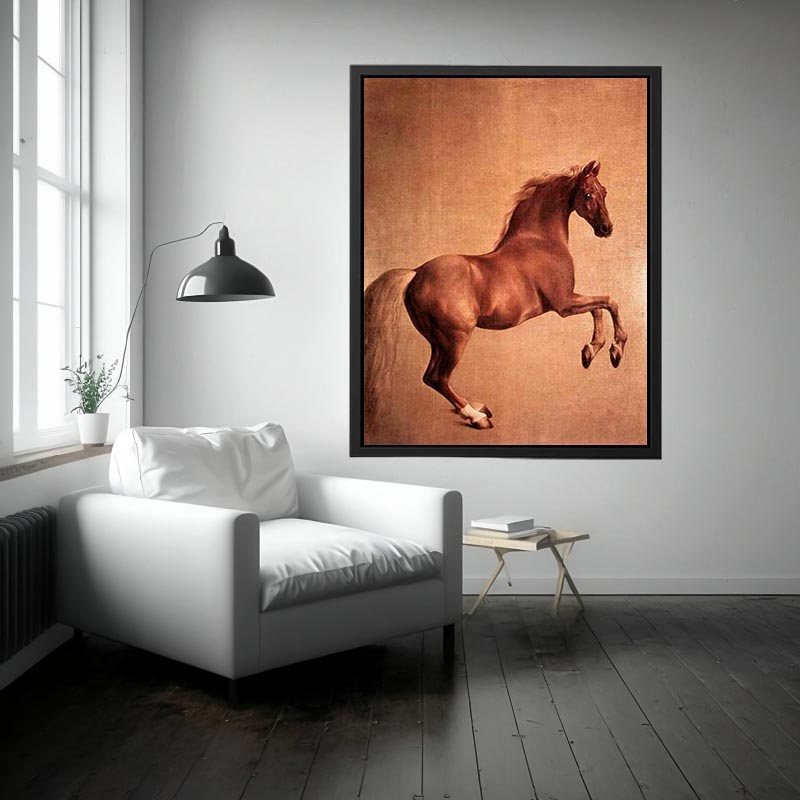
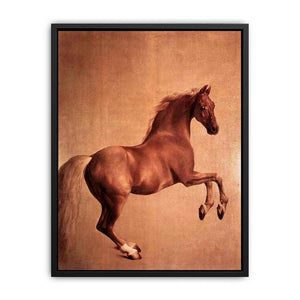
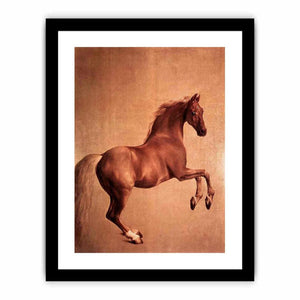
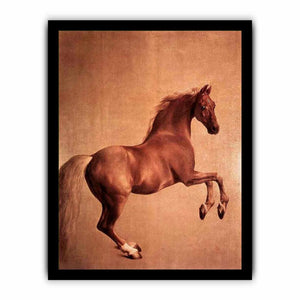
Whistlejacket 1761–62 Painting by George Stubbs
Whistlejacket stands as one of the most singular and commanding images in the history of animal painting, a work in which George Stubbs elevates the horse from supporting subject to sovereign presence. Painted in 1761–62, the canvas depicts the celebrated racehorse Whistlejacket rearing against an empty ground, untethered from narrative, rider, or landscape. In doing so, Stubbs creates not a sporting picture, nor a portrait in the conventional sense, but a study of vitality, anatomy, and individuality that redefined how animals could be represented in art.
George Stubbs approached painting from a position unlike that of most eighteenth-century artists. Largely self-taught, he devoted years to the scientific study of anatomy, dissecting horses to understand their structure with unprecedented precision. This empirical foundation distinguishes Whistlejacket from earlier equestrian imagery. Stubbs does not rely on inherited formulas or decorative flourish. Every muscle, tendon, and curve of the animal’s body is rendered with knowledge earned through direct observation. The painting is not an idealisation imposed from tradition; it is an articulation of lived form.
The composition is radical in its simplicity. Whistlejacket occupies nearly the entire canvas, isolated against a warm, neutral background that offers no sense of location or depth. There is no paddock, no stable, no racetrack, no human presence. The horse rises in a powerful rear, its forelegs lifted, head turned slightly, body caught in a moment of poised tension. By removing all contextual markers, Stubbs forces the viewer to confront the animal as a self-sufficient subject. The horse is not defined by use, ownership, or environment. It exists entirely on its own terms.
Perspective reinforces this autonomy. The viewer encounters Whistlejacket at eye level, creating an encounter rather than a spectacle. The scale is imposing, almost confrontational. The horse is not reduced to ornament or symbol; it confronts the viewer with physical and psychological immediacy. Stubbs carefully balances monumentality with control. Despite the energy of the rearing pose, the composition remains stable, contained by the horse’s own equilibrium rather than external restraint.
Light in Whistlejacket is clear and even, designed to reveal structure rather than dramatise emotion. Stubbs avoids theatrical shadow or heightened contrast. Illumination moves gently across the horse’s body, articulating musculature with scientific clarity. Light functions here as a tool of understanding, allowing the viewer to read the form as both powerful and coherent. The absence of dramatic lighting reinforces the painting’s sense of objectivity and calm authority.
Colour is restrained yet rich. The horse’s chestnut coat is rendered in nuanced variations of warm brown, gold, and subtle red, capturing both sheen and depth without exaggeration. These tones are set against the muted background, which serves to stabilise rather than compete. Stubbs resists decorative colour contrasts, allowing chromatic harmony to support anatomical truth. The result is a palette that feels timeless, neither fashionable nor ornamental.
Stubbs’s brushwork is disciplined and controlled. There is no visible bravura, no flourish designed to display the artist’s hand. Instead, technique recedes in service of form. The surface is smooth, transitions subtle, edges precise without rigidity. This restraint reflects Stubbs’s belief that art should clarify rather than embellish. The horse’s vitality emerges not from expressive brushwork, but from the accuracy and coherence of its construction.
Symbolically, Whistlejacket occupies an ambiguous yet powerful position. On one level, it functions as a celebration of a specific racehorse, commissioned within the context of aristocratic patronage and British sporting culture. On another, it transcends that context entirely. By stripping away rider and setting, Stubbs transforms the horse into a universal embodiment of strength, spirit, and independence. The animal is no longer a possession or instrument of status; it becomes an individual presence, commanding respect rather than admiration alone.
Emotionally, the painting conveys controlled energy rather than aggression. Whistlejacket is alert, animated, and powerful, yet not frantic or threatening. The raised posture suggests vitality and confidence rather than fear. There is intelligence in the animal’s expression, a sense of awareness that complicates any reading of the horse as mere physical force. The emotional tone is one of poised intensity, held in balance by discipline and form.
Within Stubbs’s artistic development, Whistlejacket represents a culmination of his anatomical and philosophical approach. While he produced many distinguished equine portraits, none achieve the same degree of abstraction and focus. This painting distils his belief that animals deserved the same seriousness of treatment as human subjects. In isolating Whistlejacket, Stubbs asserts that the study of animal life could reach the highest levels of artistic ambition.
Culturally, Whistlejacket marks a turning point in the representation of animals in Western art. Earlier traditions tended to subordinate animals to myth, allegory, or human narrative. Stubbs breaks decisively from this hierarchy. The painting anticipates modern attitudes toward animal individuality and agency, prefiguring later artistic movements that questioned human dominance as the organising principle of representation. Its bold simplicity and conceptual clarity continue to feel strikingly contemporary.
In contemporary interiors, Whistlejacket integrates with exceptional authority and visual impact. In living rooms, it functions as a commanding focal work, its scale and presence anchoring the space. In studies and offices, it communicates discipline, strength, and intellectual seriousness. In galleries and luxury residences across the United States, United Kingdom, Canada, Australia, and Europe, the painting complements both classical and modern interiors. Its minimal background and powerful form allow it to coexist effortlessly with minimalist architecture while retaining its historical gravitas.
The enduring relevance of Whistlejacket lies in its refusal to explain itself. Stubbs does not tell a story, assign a moral, or frame the horse within human ambition. He presents life—alert, powerful, and self-contained—and allows that presence to stand without justification. The painting endures because it confronts viewers with a being that exists fully in its own right. In Whistlejacket, George Stubbs achieves something rare: a portrait that transcends its subject and its time, offering a vision of vitality that remains immediate, uncompromised, and profoundly human in its resonance.
Buy museum qulaity 400- 450 canvas prints, framed prints, and 100% oil paintings of Whistlejacket by George Stubbs at Alpha Art Gallery, where world-famous masterpieces are recreated with museum-quality detail, refined craftsmanship, and premium materials.
FAQS
What does Whistlejacket by George Stubbs depict?
It depicts the famous racehorse Whistlejacket rearing against a plain background, without rider or setting.
Why is Whistlejacket considered unique in art history?
Because it isolates the horse as the sole subject, granting it the status and presence of a monumental portrait.
Was Whistlejacket painted from imagination?
No, Stubbs based the work on extensive anatomical study and direct observation of horses.
Why is there no background or landscape in the painting?
Removing context focuses attention entirely on the horse’s form, movement, and individuality.
Is the painting symbolic?
While rooted in equine portraiture, it symbolises vitality, independence, and physical intelligence without explicit allegory.
What emotional tone does the painting convey?
It conveys controlled energy and confidence rather than aggression or drama.
Is Whistlejacket suitable for contemporary interiors?
Yes, its bold simplicity and strong form suit both modern and traditional spaces.
Why does Whistlejacket remain relevant today?
Its focus on individuality, presence, and disciplined observation continues to resonate across cultures and eras.