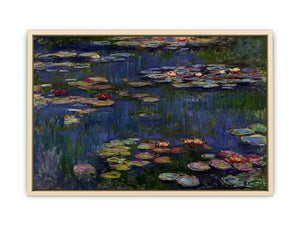
Water Lilies Painting by Claude Monet
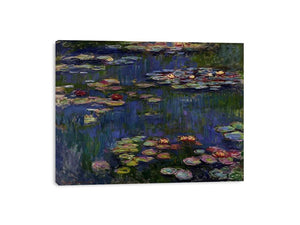
Water Lilies stands as the most enduring and transformative achievement of Claude Monet’s artistic life, a body of work in which painting ceases to function as representation and becomes an immersive field of perception. Created over the final decades of Monet’s career at Giverny, the Water Lilies paintings are not views of a garden pond in the conventional sense. They are sustained acts of attention—records of time, light, and consciousness translated into colour and rhythm. In these works, Monet does not depict nature as an external subject; he reconstructs the experience of seeing itself.
By the time Monet devoted himself fully to the water lily pond, he had already redefined landscape painting through Impressionism. Yet Water Lilies marks a further step, one that moves beyond the fleeting moment toward duration and continuity. Monet designed the pond deliberately, reshaping land and water to create a motif capable of endless variation. The surface of the pond, with its reflections of sky, foliage, and light, offered a world without fixed orientation. Horizon, shoreline, and distance dissolve, replaced by an all-over field in which perception circulates freely.
The composition of Water Lilies abandons traditional spatial hierarchy. There is no foreground to enter, no background to recede toward. The canvas becomes a continuous surface where floating blossoms, reflected clouds, and submerged stems coexist without clear boundary. Monet often eliminates the horizon entirely, flattening space while intensifying depth through colour and movement. The eye does not travel into the picture; it moves within it, guided by rhythm rather than perspective. This structural openness was unprecedented and profoundly influential.
Perspective, in the academic sense, is deliberately relinquished. Monet replaces linear recession with chromatic layering and tonal modulation. Areas of colour advance or withdraw not because of scale, but because of intensity and relationship. Reflections blur distinctions between above and below, surface and depth. Water becomes both mirror and substance, destabilising spatial certainty. The result is a painting that feels infinite despite its physical limits.
Light in Water Lilies is not directional or dramatic. It is ambient, diffused, and inseparable from colour. There are no cast shadows, no identifiable source. Illumination emerges through subtle shifts in hue and saturation, allowing luminosity to arise from within the painted surface. Monet captures light as a condition rather than an event—a constant presence that transforms everything it touches. This treatment of light marks a radical departure from earlier landscape traditions and signals a new understanding of visual experience.
Colour is the governing force of Water Lilies. Blues, greens, violets, and soft whites interweave across the canvas, punctuated by the pale pinks and creams of the blossoms themselves. Monet avoids sharp contrast, favouring gradual transitions and echoes. Each colour responds to its neighbours, creating vibration through proximity rather than opposition. The lilies are not isolated objects; they emerge and recede within the chromatic field, inseparable from water and reflection. Colour here does not describe form—it generates atmosphere.
Monet’s brushwork in Water Lilies is liberated and expansive. Individual strokes remain visible, yet they no longer correspond directly to discrete forms. Marks overlap, accumulate, and disperse, recording prolonged engagement rather than instantaneous observation. The surface bears the evidence of revision, return, and persistence. Monet painted these works over extended periods, revisiting the same canvas again and again. This temporal depth is essential to their meaning. The paintings are not moments captured; they are durations sustained.
Symbolically, Water Lilies resists interpretation. The flowers do not function as emblems, nor does the pond signify a particular narrative or philosophy. Monet had moved beyond symbolism toward an understanding of painting as experiential space. Meaning arises through immersion—through the viewer’s bodily and perceptual response to scale, colour, and continuity. The paintings do not instruct or explain; they invite presence.
Emotionally, Water Lilies conveys a profound sense of suspension and equilibrium. There is no drama, no climax, no resolution. Time appears slowed, almost dissolved, replaced by a steady attentiveness. Viewers often experience these works as meditative, not because they depict tranquillity, but because they require and reward sustained looking. The absence of spatial orientation encourages the eye to wander without urgency, mirroring Monet’s own prolonged engagement with the motif.
Within Monet’s artistic evolution, Water Lilies represents the culmination of a lifelong inquiry into perception. The concerns that animated his early Impressionist works—light, colour, immediacy—are here expanded into an all-encompassing environment. These paintings anticipate abstraction without abandoning the natural world. They stand at the threshold of modern art, influencing generations of artists who sought to move beyond representation toward experience.
Culturally, Water Lilies occupies a foundational place in twentieth-century visual culture. Its emphasis on surface, scale, and immersion reshaped expectations of what painting could be. Yet Monet’s achievement remains singular. Unlike later abstraction, Water Lilies retains a deep connection to lived environment. It is modern not because it rejects nature, but because it redefines how nature can be encountered through art.
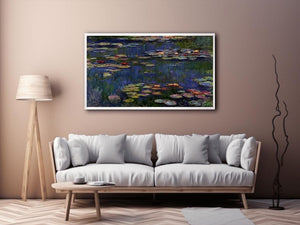
In contemporary interiors, Water Lilies integrates with exceptional authority and versatility. In living rooms, it creates an atmosphere rather than a focal point, softening space while elevating it. In studies and offices, it fosters reflection and sustained attention. In galleries and luxury residences across the United States, United Kingdom, Canada, Australia, and Europe, it communicates cultural depth and intellectual refinement. Its layered colour harmonises with modern, minimalist, and eclectic décor alike, adapting effortlessly to architectural context.
The enduring relevance of Water Lilies lies in its affirmation that art can function as a place rather than an image. Monet demonstrates that when observation is sustained beyond depiction, painting becomes environment and colour becomes time. The work endures not because it shows a famous pond, but because it offers an experience—one that unfolds slowly, rewards patience, and continues to resonate long after the act of looking has begun. In Water Lilies, Monet does not ask us to look at nature; he invites us to dwell within seeing itself.
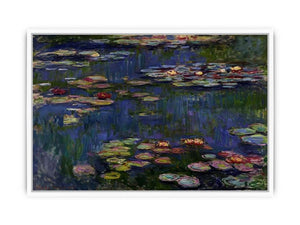
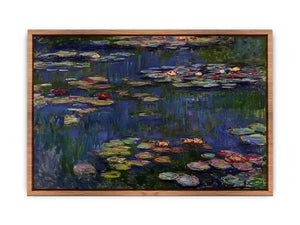
Buy museum qulaity 400- 450 canvas prints, framed prints, and 100% oil paintings of Water Lilies by Claude Monet at Alpha Art Gallery, where world-famous masterpieces are recreated with museum-quality detail, refined craftsmanship, and premium materials.
FAQS
What does Water Lilies by Claude Monet depict?
It depicts Monet’s pond at Giverny transformed into an immersive field of colour, reflection, and perception rather than a traditional landscape view.
Why are there no horizons or clear perspectives in Water Lilies?
Monet intentionally removed spatial orientation to immerse the viewer within the surface of water and reflection.
Are the water lilies symbolic?
No, they are not symbolic; they function as visual anchors within a broader perceptual environment.
Why is Water Lilies considered Monet’s greatest achievement?
It represents the culmination of his exploration of light, colour, and sustained perception.
How does Monet use colour differently in these paintings?
Colour replaces line and perspective, creating space, movement, and atmosphere through modulation and layering.
Is Water Lilies an early example of abstraction?
It anticipates abstraction while remaining rooted in direct observation of nature.
Is Water Lilies suitable for contemporary interiors?
Yes, its immersive quality and refined palette integrate seamlessly into modern and luxury spaces.
Why does Water Lilies remain relevant today?
Its emphasis on immersion, duration, and attentive seeing aligns deeply with modern visual and spatial experience.