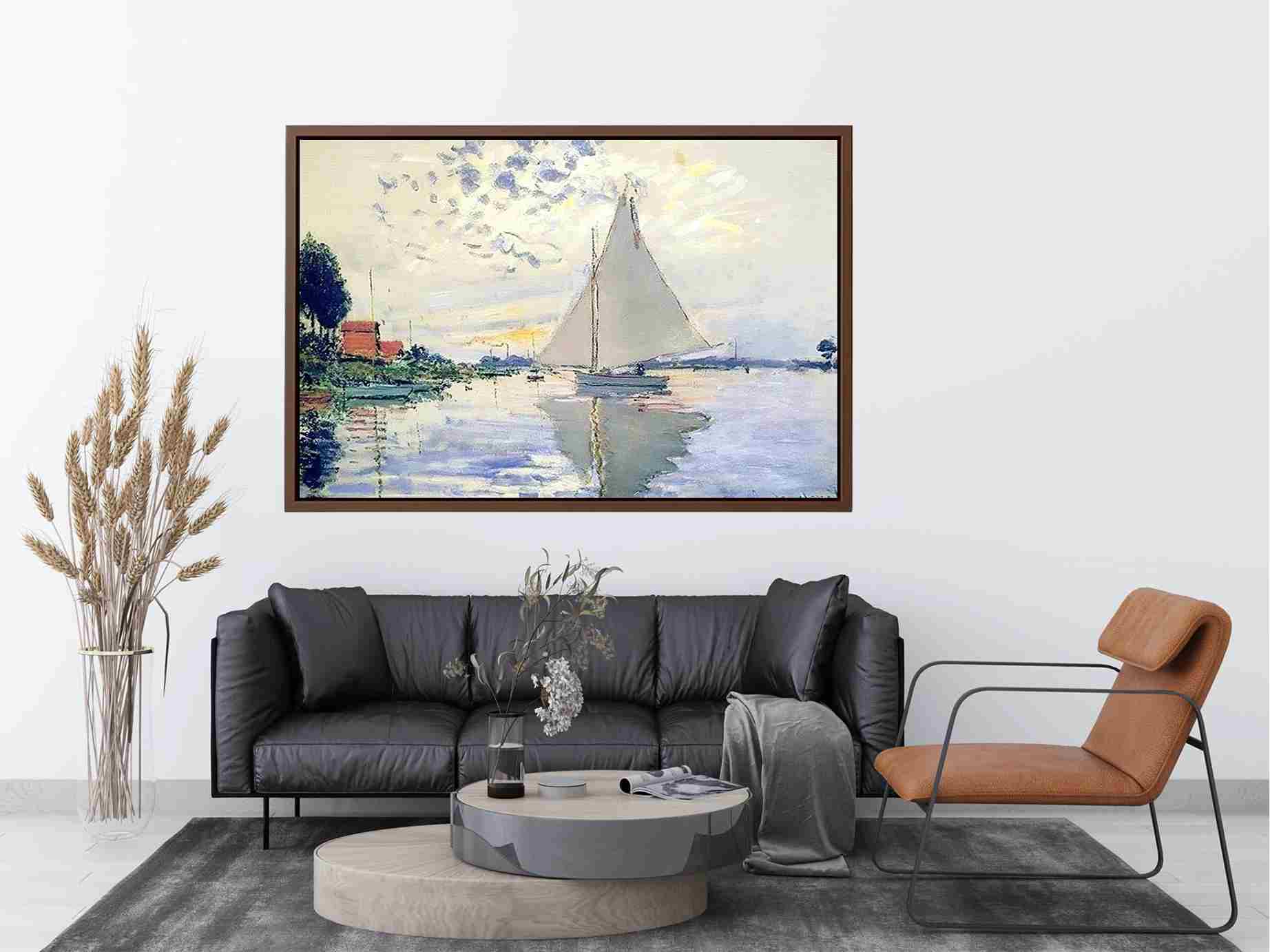
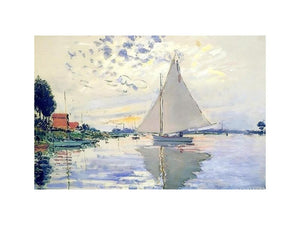
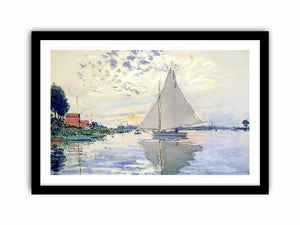
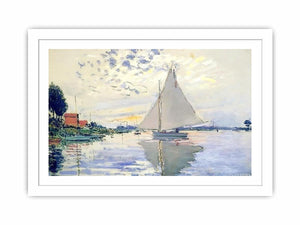
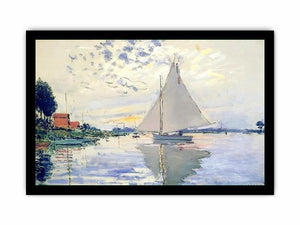
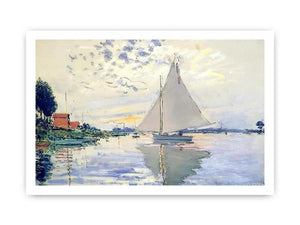
Sailboat at Le Petit Gennevilliers Painting by Claude Monet
Sailboat at Le Petit Gennevilliers stands as one of Claude Monet’s most lucid and quietly assured explorations of modern river life, a painting in which light, water, and human presence are fused into a single, balanced perceptual experience. Created during the 1870s, when Monet was working intensively along the Seine, the work reflects a period of growing confidence in his Impressionist language. Here, the river is not treated as a picturesque motif or symbolic boundary, but as a living surface—one shaped by movement, reflection, and contemporary leisure. The sailboat, modest and unassuming, becomes a stabilising form within an ever-shifting visual field.
Le Petit Gennevilliers, situated along the Seine northwest of Paris, occupied a space between rural calm and suburban expansion. It was an area associated with boating, walking, and informal recreation, emblematic of the modern relationship between city dwellers and the natural environment. Monet was drawn to such places precisely because they resisted grandeur. They offered instead a continuous play of light and atmosphere, conditions ideally suited to his belief that painting should register sensation rather than impose narrative. Sailboat at Le Petit Gennevilliers emerges from this context as an image grounded in observation, attentive to how ordinary scenes unfold through time.
The composition is restrained and harmoniously structured. The sailboat occupies a central yet unobtrusive position, floating calmly on the river’s surface. Its vertical mast introduces a quiet counterpoint to the dominant horizontals of water and shoreline. Monet avoids dramatic framing or theatrical angles, opting instead for a viewpoint that feels immediate and natural, as though the viewer stands at the river’s edge. The surrounding landscape—trees, bank, and distant forms—remains understated, serving to support rather than compete with the primary interaction between boat and water.
Perspective is shallow and experiential. Monet does not construct depth through rigid linear recession, but through overlapping forms and tonal modulation. The river stretches outward with gentle continuity, its surface reflecting sky and vegetation in broken, fluid passages. Distance is suggested through softening colour and reduced contrast rather than precise delineation. This approach mirrors the way the eye perceives water in motion, where clarity gives way to shimmer and reflection.
Light operates as the painting’s unifying force. Sunlight spreads evenly across the scene, touching sail, hull, and river without dramatic emphasis. There are no harsh shadows or theatrical contrasts. Instead, illumination appears ambient, allowing colour and form to coexist within a single luminous condition. Monet treats light not as a spotlight revealing objects, but as a presence that reorganises them, dissolving boundaries between solid form and reflected image.
Colour is employed with characteristic sensitivity. Blues and greens dominate the palette, establishing a calm, cool foundation that evokes open air and moving water. These tones are subtly varied, infused with warmer notes where light strikes more directly. The sailboat itself introduces pale, neutral hues that catch the light gently, anchoring the composition without asserting dominance. Colour functions relationally, each tone responding to its neighbour, ensuring harmony without monotony.
Monet’s brushwork is open, fluid, and visibly present. Short, broken strokes articulate the rippling surface of the river, allowing reflections to fragment and recombine. The sailboat is rendered with economy, its form suggested rather than fully described, preserving the sense of motion and impermanence. The surrounding landscape is handled with a lighter touch, maintaining atmospheric softness. The surface records the act of looking, preserving immediacy rather than finish.
Symbolically, Sailboat at Le Petit Gennevilliers resists allegory. The boat does not stand for adventure, industry, or escape. It is simply there, part of the river’s rhythm. Yet this very neutrality carries meaning. Monet presents modern leisure not as spectacle, but as presence—an everyday condition shaped by light, movement, and shared space. The painting affirms that significance arises through attention rather than through narrative emphasis.
Emotionally, the work conveys composure and clarity. There is no urgency, no dramatic event unfolding. The sailboat drifts rather than charges forward, reinforcing a sense of measured time. Viewers often experience the painting as calming and expansive, its balance offering visual ease without emptiness. The scene feels open yet contained, alive yet unforced.
Within Monet’s artistic evolution, this painting reflects a period of consolidation and assurance. It demonstrates his mastery of Impressionist principles—outdoor observation, visible brushwork, and attention to fleeting effects—applied with restraint and confidence. Sailboat at Le Petit Gennevilliers shows Monet trusting perception itself to carry meaning, without recourse to narrative or compositional drama.
Culturally, the painting participates in a broader nineteenth-century shift toward recognising leisure and everyday environments as worthy subjects of serious art. Rivers once associated primarily with commerce or symbolism become spaces of lived experience. Monet’s treatment avoids both romanticisation and critique. He observes, allowing painting to function as a record of modern perception rather than commentary.
In contemporary interiors, Sailboat at Le Petit Gennevilliers integrates with exceptional elegance and adaptability. In living rooms, it introduces calm movement and spatial openness without visual dominance. In bedrooms and private spaces, it reinforces tranquillity and light. In studies and offices, it supports focus and reflection, offering visual rhythm without distraction. Across interiors in the United States, United Kingdom, Canada, Australia, and Europe, the painting complements traditional, modern, minimalist, and coastal-inspired décor alike. Its balanced palette harmonises naturally with contemporary materials and architectural lines.
The enduring relevance of Sailboat at Le Petit Gennevilliers lies in its affirmation of the ordinary as perceptually rich. Monet demonstrates that a single boat on a quiet stretch of river can sustain profound visual interest when seen with patience and clarity. The painting endures not because it depicts a notable event, but because it recreates the experience of seeing—of watching light move across water, of recognising stillness within motion. In doing so, Monet offers a work that continues to resonate as a meditation on balance, presence, and the quiet intelligence of the visible world.
Buy museum qulaity 400- 450 canvas prints, framed prints, and 100% oil paintings of Sailboat at Le Petit Gennevilliers by Claude Monet at Alpha Art Gallery, where world-famous masterpieces are recreated with museum-quality detail, refined craftsmanship, and premium materials.
FAQS
What does Sailboat at Le Petit Gennevilliers by Claude Monet depict?
It depicts a sailboat on the Seine at Le Petit Gennevilliers, focusing on light, water, and modern river life.
Why did Monet paint so many river scenes along the Seine?
The Seine offered constant variation in light and reflection, making it ideal for Monet’s Impressionist exploration of perception.
Is the sailboat symbolic in this painting?
No, Monet treats it as a visual anchor rather than a symbol, emphasising observation over allegory.
How does Monet represent water in this work?
Through broken, horizontal brushstrokes that suggest movement and shimmering reflection.
What role does light play in the composition?
Light unifies the scene, softening forms and dissolving boundaries between object and reflection.
Is this painting representative of Impressionism?
Yes, it exemplifies Impressionist principles of outdoor painting, visible brushwork, and attention to fleeting effects.
Is Sailboat at Le Petit Gennevilliers suitable for contemporary interiors?
Yes, its calm palette and balanced composition suit a wide range of modern and traditional spaces.
Why does Sailboat at Le Petit Gennevilliers remain relevant today?
Its focus on everyday scenes, stillness, and perceptual clarity continues to resonate with modern viewers.