


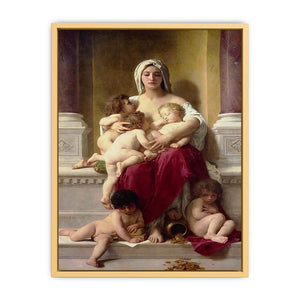


Charity 1878
Go kalles this summer with this vintage navy and white striped v-neck t-shirt from the Nike. Perfect for pairing with denim and white kicks for a stylish kalles vibe.

Charity 1878
Charity 1878 Painting by William Adolphe Bouguereau
Charity stands as one of William Adolphe Bouguereau’s most philosophically composed and emotionally disciplined allegorical works, a painting in which moral idealism, maternal tenderness, and academic mastery are united with exceptional clarity. Painted in 1878, during the height of Bouguereau’s artistic authority, the work exemplifies his conviction that virtue could be expressed not through dramatic gesture or didactic symbolism, but through balance, restraint, and idealised human form. Charity is not an illustration of moral instruction; it is a visual meditation on selfless love rendered with serenity and structural intelligence.
Bouguereau’s lifelong engagement with allegorical subjects was shaped by his belief that timeless virtues could be communicated most effectively through the human figure. Trained rigorously within the French academic tradition, he regarded clarity of form, anatomical perfection, and compositional harmony as essential tools for conveying ethical meaning. In Charity, these principles are employed with extraordinary refinement. The painting does not argue for compassion; it embodies it, presenting generosity as a state of being rather than an act performed.
The composition is centred on a maternal figure who anchors the scene with calm authority. She is surrounded by children who cling to her with trust and dependency, their bodies arranged in a circular rhythm that reinforces unity and care. Bouguereau constructs the group with classical stability, ensuring that no single figure dominates at the expense of the whole. The arrangement evokes Renaissance precedents, yet the emotional tone remains distinctly Bouguereau’s own—gentle, controlled, and inwardly focused.
The central female figure is idealised with Bouguereau’s characteristic precision, yet she is not remote or abstract. Her posture conveys openness and protection, her presence radiating assurance rather than command. Bouguereau avoids overt expressions of sacrifice or suffering. Charity here is not portrayed as burden or martyrdom, but as natural abundance. The maternal figure gives not because she must, but because generosity flows from her very being.
The children are rendered with tenderness and anatomical sensitivity. Bouguereau captures their vulnerability without sentimentality, emphasising trust rather than neediness. Their varied gestures—leaning, resting, reaching—create a subtle rhythm of dependence that reinforces the painting’s thematic coherence. Each child is distinct, yet none disrupts the collective harmony. Innocence here is not passive; it is responsive, sustained through care and presence.
Light in Charity is soft and enveloping, unifying the figures within a single atmospheric field. Bouguereau avoids dramatic contrast or directional illumination. Instead, light settles gently across flesh and fabric, reinforcing the painting’s mood of calm continuity. This diffused illumination contributes to the sense that the scene exists outside specific time or place, aligning the allegory with universality rather than narrative specificity.
Colour is restrained and harmonised with exceptional subtlety. Bouguereau relies on warm flesh tones, muted whites, and gentle earth hues, avoiding strong saturation. The palette reinforces emotional equilibrium, ensuring that no element asserts itself aggressively. Colour here serves moral clarity rather than visual excitement, supporting the idea that true charity is quiet, steady, and enduring.
Bouguereau’s surface treatment is famously smooth, with brushwork rendered virtually invisible. This polished finish was integral to his artistic philosophy. By eliminating visible process, he allowed form and meaning to appear inevitable and complete. In Charity, this smoothness enhances the painting’s sense of timelessness, removing any distraction that might disrupt contemplation.
Symbolically, the painting operates with deliberate economy. There are no overt attributes, no dramatic gestures, no textual references. Charity is communicated through relationship and posture rather than iconography. Bouguereau trusts the viewer to recognise the virtue through visual harmony alone. The maternal figure becomes both literal and allegorical, embodying compassion as lived experience rather than abstract ideal.
Emotionally, Charity is profoundly reassuring. It does not evoke pity, urgency, or moral anxiety. Instead, it offers a vision of care as stability—a world in which vulnerability is met with calm abundance. This emotional restraint distinguishes the painting from more theatrical allegories of the period and underscores Bouguereau’s intellectual seriousness. Compassion here is not reactive; it is foundational.
Within Bouguereau’s broader oeuvre, Charity occupies a significant place among his allegorical works. Unlike his mythological paintings, which explore desire and transformation, or his religious works, which address transcendence, Charity focuses on ethical life within the human realm. It demonstrates Bouguereau’s belief that moral ideals could be expressed with the same beauty and rigor as myth or theology.
The painting’s relevance today remains strong across cultures and regions. Viewers in the United States, the United Kingdom, Canada, Australia, and Europe continue to respond to its quiet authority and emotional clarity. In a contemporary world often marked by spectacle and moral fragmentation, Charity offers an image of coherence and care that feels both classical and urgently human.
In interior settings, Charity introduces warmth, balance, and contemplative calm. In living rooms, it creates an atmosphere of reassurance and stability. In studies and offices, it offers a visual reminder of responsibility, generosity, and human connection. In galleries and luxury residences, it signals refined appreciation for nineteenth-century academic painting at its most humane and philosophically grounded.
The painting integrates seamlessly into traditional, modern, minimalist, and eclectic décor. Traditional interiors resonate with its classical composition and allegorical subject. Modern spaces benefit from its emotional restraint and visual clarity. Minimalist environments find contrast in its figurative richness without excess, while eclectic interiors draw cohesion from its balanced structure.
The enduring importance of Charity lies in its refusal to dramatise virtue. Bouguereau presents compassion not as heroic exception, but as natural order. The painting endures because it recognises generosity as a sustaining force rather than a spectacle, offering a vision of ethical life grounded in presence, care, and quiet strength.
To live with Charity is to engage daily with one of Bouguereau’s most resolved and humane visions. Through its flawless technique, balanced composition, and emotional intelligence, the painting continues to affirm that moral ideals can be expressed with beauty and restraint. It stands as a testament to Bouguereau’s belief that art, when guided by discipline and sincerity, can illuminate virtue without proclamation.
Buy museum qulaity 400- 450 canvas prints, framed prints, and 100% oil paintings of Charity 1878 by William Adolphe Bouguereau at Alpha Art Gallery, where world-famous masterpieces are recreated with museum-quality detail, refined craftsmanship, and premium materials.
FAQS
What does Charity represent in this painting?
It represents selfless love and compassion, embodied through maternal care rather than symbolic attributes.
Why is Charity considered an important Bouguereau work?
It exemplifies his ability to unite academic perfection with moral and emotional clarity.
How does Bouguereau portray compassion differently from other allegorical artists?
He presents it as calm presence and abundance rather than sacrifice, drama, or instruction.
What role do the children play in the composition?
They express trust and dependence, reinforcing charity as a sustaining and relational virtue.
Is Charity suitable for contemporary interiors?
Yes. Its serene palette and balanced composition integrate beautifully into both traditional and modern spaces.
What emotional atmosphere does the painting convey?
It conveys reassurance, stability, and quiet generosity rather than urgency or sentimentality.
Does this artwork have lasting cultural value?
As a refined allegorical work by Bouguereau, it holds enduring artistic and ethical significance.
Where is the best place to display Charity?
It is especially well suited to living rooms, studies, galleries, and spaces intended for calm reflection.
| 1. Select Type |
Canvas Print, Unframed Paper Print, Hand-Painted Oil Painting, Framed Paper Print |
|---|---|
| 2. Select Finish Option |
Rolled Canvas, Rolled- No Frame, Streched Canvas, Black Floating Frame, White Floating Frame, Brown Floating Frame, Black Frame with Matt, White Frame with Matt, Black Frame No Matt, White Frame No Matt, Streched, Natural Floating Frame, Champagne Floating Frame, Gold Floating Frame |
| 3. Select Size |
60cm X 90cm [24" x 36"], 76cm X 114cm [30" x 45"], 90cm X 120cm [36" x 48"], 100cm X 150cm [40" x 60"], 16.54 x 11.69"(A3), 23.39 x 16.54"(A2), 33.11 x 23.39"(A1), 46.81 x 31.11"(A0), 54" X 36", 50cm X 60cm [16" x 24"], 121cm X 182cm [48" x 72"], 135cm X 200cm [54" x 79"], 165cm x 205cm [65" x 81"], 183cm x 228cm [72" x 90"], 22cm X 30cm [9" x 12"], 30cm x 45Cm [12" x 18"], 45cm x60cm [16" x 24'], 75cm X 100cm [30" x 40"], 121cm x 193cm [48" x 76"], 45cm x 60cm [16" x 24'], 20cm x 25Cm [8" x 10"], 35cm x 50Cm [14" x 20"], 45cm x 60 cm [18" x 24"], 35cm x 53Cm [14" x 21"], 66cm X 101cm[26" x 40"], 76cm x 116cm [30"x 46"], 50cm X 60cm 16" x 24"] |