

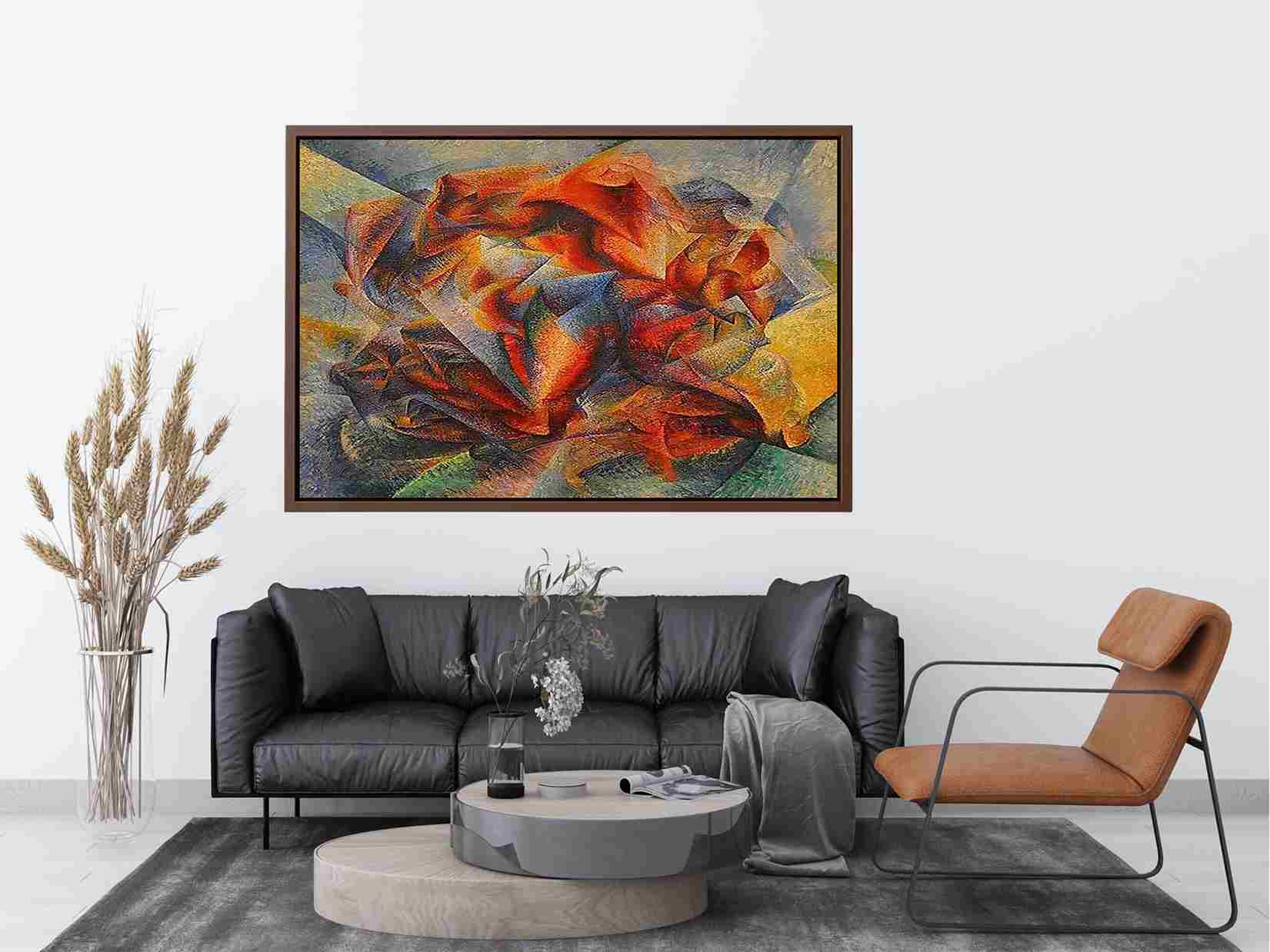






Dynamism of a Soccer Player
Go kalles this summer with this vintage navy and white striped v-neck t-shirt from the Nike. Perfect for pairing with denim and white kicks for a stylish kalles vibe.

Dynamism of a Soccer Player
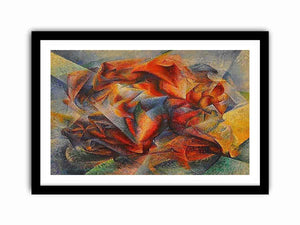
Dynamism of a Soccer Player Painting by Umberto Boccioni
Dynamism of a Soccer Player Painting by Umberto Boccioni stands as one of the most intellectually radical and visually decisive statements of early twentieth-century modern art, a work in which motion itself becomes the true subject of painting. Created in 1913, at the height of the Futurist movement, the work rejects traditional representation in favor of an entirely new pictorial language—one capable of expressing speed, energy, simultaneity, and the transformation of the human body under modern forces. Rather than depicting a footballer as a stable figure in space, Boccioni dissolves the body into movement, asserting that reality is not static but perpetually in flux.
Umberto Boccioni was the central theoretical and artistic force behind Italian Futurism, a movement that sought to overthrow the aesthetic values of the past and replace them with an art suited to the modern age. He believed that traditional painting, rooted in fixed perspective and stable form, was incapable of expressing the lived experience of modernity. Dynamism of a Soccer Player is one of the clearest realizations of this belief. It does not record an action; it embodies action.
The subject of the painting—a soccer player in motion—was itself a deliberate choice. Football represented modern physicality, collective energy, and speed, qualities Futurism celebrated as symbols of a new era. Yet Boccioni does not depict a match, a stadium, or even a recognizable athlete. The soccer player is fragmented, multiplied, and reconstituted through force lines and overlapping planes. The figure exists not as an individual identity, but as a convergence of energies moving through space.
Compositionally, the painting is built around centrifugal motion. Forms radiate outward from a central axis, creating the sensation of propulsion rather than containment. There is no single focal point; the eye is driven continuously across the canvas, mirroring the unstoppable momentum of the figure. This deliberate refusal of visual rest is fundamental to the painting’s meaning. To stop looking is to contradict the subject itself.
Perspective in Dynamism of a Soccer Player is entirely non-classical. Boccioni rejects Renaissance depth in favor of simultaneity, presenting multiple moments of motion at once. Limbs appear repeated, fractured, and interpenetrated by surrounding space. Foreground and background collapse into each other, reinforcing the Futurist conviction that objects cannot be separated from the environments they traverse. The soccer player does not move through space; he generates it.
Colour plays a crucial structural role. Boccioni employs a vibrant yet controlled palette of blues, greens, yellows, and earthy tones, layered and interwoven to create rhythmic tension. Colour is not used descriptively, but dynamically. It amplifies motion, creating visual vibration that reinforces the painting’s kinetic force. The contrasts are sharp but purposeful, guiding the eye along trajectories of movement rather than outlining form.
Light in the painting is not naturalistic. There is no identifiable source, no consistent illumination. Instead, light is absorbed into the system of movement itself. Highlights appear as energy bursts rather than reflections, contributing to the sense that the figure is breaking through resistance. This approach eliminates the distinction between object and atmosphere, aligning with Boccioni’s belief that modern perception is immersive and continuous.
Boccioni’s brushwork is assertive and structural. Strokes are not blended into illusionistic smoothness; they retain their directional force. Each mark participates in the overall motion, reinforcing the idea that the painting is constructed through energy rather than contour. The surface feels charged, as though movement has been compressed into pigment.
Emotionally, Dynamism of a Soccer Player is not celebratory in a sentimental sense. It does not depict joy, competition, or victory. Instead, it conveys intensity, acceleration, and transformation. The human body appears almost overwhelmed by motion, suggesting both empowerment and dissolution. This ambiguity is essential. Boccioni does not present modern speed as purely liberating or destructive; he presents it as inescapable.
Symbolically, the painting operates as a manifesto. The soccer player becomes a metaphor for modern humanity itself—defined not by static identity, but by perpetual motion and interaction with force. Individual boundaries dissolve into systems of energy. In this sense, the painting extends beyond sport to address industrialization, mechanization, and the redefinition of the human subject in the twentieth century.
Within Boccioni’s artistic evolution, this work represents a critical moment of synthesis. It draws upon Cubist fragmentation while rejecting Cubism’s analytical detachment. Where Cubism dissects form intellectually, Boccioni reassembles it emotionally and physically. The result is a painting that feels lived rather than observed, experienced rather than analyzed.
Culturally, Dynamism of a Soccer Player occupies a foundational position in the history of modern art. It demonstrates how representation could be reimagined to reflect new modes of perception shaped by speed, sport, and urban life. The painting anticipates later developments in abstraction, kinetic art, and even digital visualization, making it a key reference point for understanding twentieth-century visual culture.
In contemporary interiors across the United States, the United Kingdom, Canada, Australia, and Europe, this painting functions as a bold intellectual statement. In living rooms, it introduces movement, modernity, and conceptual energy. In studies and offices, it reflects forward-thinking sensibility and engagement with radical art history. In galleries and architecturally refined residences, it asserts cultural confidence and an appreciation for foundational modernist ideas.
The work integrates powerfully into modern and minimalist interiors, where its dynamism contrasts with clean lines and restrained environments. At the same time, it can energize eclectic spaces, acting as a visual catalyst that unifies diverse elements through motion. Even in more traditional settings, it functions as a deliberate counterpoint, signaling intellectual openness rather than stylistic conformity.
The long-term artistic importance of Dynamism of a Soccer Player lies in its uncompromising rejection of stasis. Boccioni demonstrates that modern art need not describe reality; it can participate in it. The painting remains relevant because it addresses conditions that continue to define contemporary life: speed, fragmentation, and the constant negotiation between body and environment.
Today, Dynamism of a Soccer Player remains one of the clearest visual expressions of modern movement as lived experience. It does not ask the viewer to admire form; it asks the viewer to feel force. Through conceptual rigor, chromatic energy, and structural daring, Umberto Boccioni created a work that continues to challenge perception and redefine what painting can do. It endures not as an artifact of Futurism alone, but as a lasting statement on motion as the defining condition of modern existence.
Buy museum qulaity 400- 450 canvas prints, framed prints, and 100% oil paintings of Dynamism of a Soccer Player by Umberto Boccioni at Alpha Art Gallery, where world-famous masterpieces are recreated with museum-quality detail, refined craftsmanship, and premium materials.
FAQS
What does Dynamism of a Soccer Player represent?
It represents motion itself, portraying the soccer player as a convergence of energy rather than a static figure.
Why is this painting important in modern art history?
It is a foundational Futurist work that redefined how movement, time, and space could be represented in painting.
How does this work differ from Cubism?
While influenced by Cubist fragmentation, it emphasizes physical energy and lived motion rather than analytical structure.
Why did Boccioni choose a soccer player as his subject?
Football symbolized modern physicality, speed, and collective energy aligned with Futurist ideals.
Is this painting suitable for contemporary interiors?
Yes, it integrates especially well into modern, minimalist, and architecturally designed spaces.
What emotions does the painting convey?
It conveys intensity, acceleration, and transformation rather than narrative emotion.
Does Dynamism of a Soccer Player have lasting relevance today?
Its exploration of speed, fragmentation, and modern perception ensures enduring cultural and artistic significance.
| 1. Select Type |
Canvas Print, Unframed Paper Print, Hand-Painted Oil Painting, Framed Paper Print |
|---|---|
| 2. Select Finish Option |
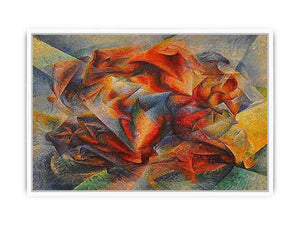
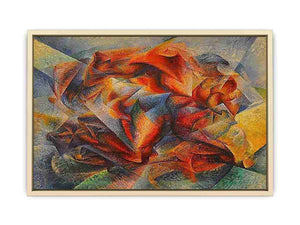
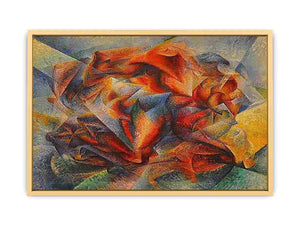
Rolled Canvas, Rolled- No Frame, Streched Canvas, Black Floating Frame, White Floating Frame, Brown Floating Frame, Black Frame with Matt, White Frame with Matt, Black Frame No Matt, White Frame No Matt, Streched, Natural Floating Frame, Champagne Floating Frame, Gold Floating Frame |
| 3. Select Size |
60cm X 90cm [24" x 36"], 76cm X 114cm [30" x 45"], 90cm X 120cm [36" x 48"], 100cm X 150cm [40" x 60"], 16.54 x 11.69"(A3), 23.39 x 16.54"(A2), 33.11 x 23.39"(A1), 46.81 x 31.11"(A0), 54" X 36", 50cm X 60cm [16" x 24"], 121cm X 182cm [48" x 72"], 135cm X 200cm [54" x 79"], 165cm x 205cm [65" x 81"], 183cm x 228cm [72" x 90"], 22cm X 30cm [9" x 12"], 30cm x 45Cm [12" x 18"], 45cm x60cm [16" x 24'], 75cm X 100cm [30" x 40"], 121cm x 193cm [48" x 76"], 45cm x 60cm [16" x 24'], 20cm x 25Cm [8" x 10"], 35cm x 50Cm [14" x 20"], 45cm x 60 cm [18" x 24"], 35cm x 53Cm [14" x 21"], 66cm X 101cm[26" x 40"], 76cm x 116cm [30"x 46"], 50cm X 60cm 16" x 24"] |