








The Knight at the Crossroads
Go kalles this summer with this vintage navy and white striped v-neck t-shirt from the Nike. Perfect for pairing with denim and white kicks for a stylish kalles vibe.

The Knight at the Crossroads
The Knight at the Crossroads Painting by Viktor Vasnetsov
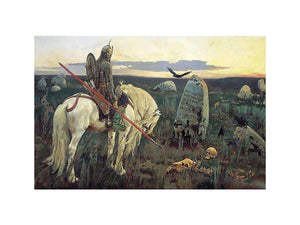
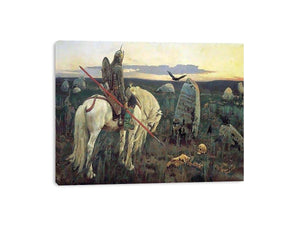
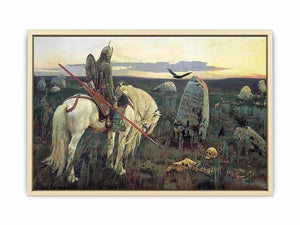
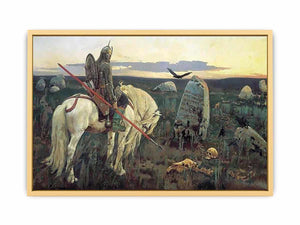
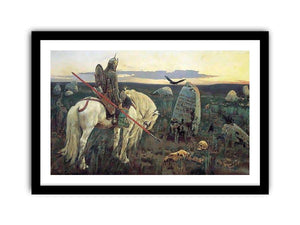
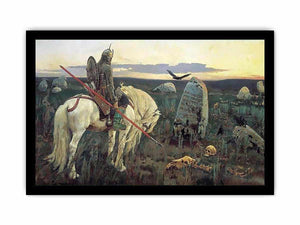
The Knight at the Crossroads Painting by Viktor Vasnetsov stands as one of the most philosophically charged and psychologically resonant works of nineteenth-century Russian art, a painting in which myth, moral choice, and national identity converge with austere clarity. Created in the late 1870s and refined over subsequent years, the work draws upon Slavic epic tradition while transcending illustration to become a meditation on destiny itself. Vasnetsov does not depict a moment of action, victory, or defeat. Instead, he captures the silence before decision, when all paths remain possible and the weight of consequence is most keenly felt.
Viktor Vasnetsov occupies a unique position in art history as the painter who forged a bridge between Russian folklore and monumental fine art. At a time when Russian painters were divided between academic classicism and social realism, Vasnetsov turned toward the nation’s medieval legends, fairy tales, and epic poems, not as escapism, but as a means of exploring moral and spiritual questions. The Knight at the Crossroads exemplifies this ambition. It uses the language of legend to address universal human experience: the confrontation with irreversible choice.
The subject derives from Russian byliny, epic folk tales in which a lone knight encounters a stone at a crossroads bearing an inscription that foretells death, loss, or suffering depending on the chosen path. Vasnetsov selects not the aftermath, but the moment of confrontation itself. The knight has halted his horse before the stone, reading its warning. No movement occurs, yet the painting is charged with tension. The stillness is deliberate, forcing the viewer into the same state of contemplation as the figure depicted.
Compositionally, the painting is spare and monumental. The knight is placed slightly off-center, his armored figure silhouetted against an open, desolate landscape. This placement avoids heroic symmetry and reinforces uncertainty. The horizon stretches outward, offering no comfort or guidance. Space functions not as backdrop, but as psychological extension. The emptiness surrounding the knight mirrors the isolation inherent in moral choice, where responsibility cannot be shared.
The horse, weary and lowered in posture, plays a crucial role in the composition. Unlike heroic steeds depicted mid-stride or rearing, this horse stands still, its head bowed. It reflects the exhaustion of the journey already undertaken and the gravity of what lies ahead. Vasnetsov treats the animal not as an accessory, but as an emotional counterpart to the knight, reinforcing the painting’s tone of restraint and endurance.
The stone at the crossroads serves as the symbolic core of the painting. Its rough surface, weathered and ancient, suggests inevitability and continuity across time. The inscription carved upon it is not clearly legible to the viewer, a deliberate choice that shifts emphasis from specific prophecy to the concept of fate itself. Meaning lies not in the words, but in their presence. The stone embodies the voice of destiny, impersonal and unyielding.
Colour in The Knight at the Crossroads is subdued and deliberate. Vasnetsov employs a restrained palette of earthy browns, muted greys, and desaturated blues, reinforcing the painting’s somber mood. There is no decorative flourish or chromatic indulgence. The colours bind figure and landscape into a single emotional field, emphasizing that the knight is not separate from his environment, but shaped by it.
Light is handled with exceptional subtlety. Illumination is even and subdued, avoiding dramatic contrast or symbolic radiance. There is no divine beam or heroic glow. Instead, light reveals the scene with impartial clarity, as though nature itself bears silent witness. This neutrality reinforces the painting’s philosophical stance: choice is not rewarded or punished in advance; it must be made without assurance.
Vasnetsov’s handling of armor and material detail demonstrates academic discipline tempered by expressive intent. The knight’s armor is rendered with accuracy and weight, yet it does not shine. It appears worn, dulled by use, suggesting experience rather than glory. This treatment reinforces the painting’s rejection of romantic heroism. The knight is not an untested champion, but a figure shaped by prior decisions, now confronted with the limits of endurance.
Psychologically, the painting is defined by introspection. The knight’s face is partially obscured, denying the viewer easy emotional access. Vasnetsov resists expressive dramatization, allowing posture and stillness to convey inner conflict. The knight neither advances nor retreats. He reads, considers, and waits. This pause becomes the painting’s true subject. It invites the viewer to reflect not on what will happen, but on what it means to choose.
Symbolically, The Knight at the Crossroads operates on several interconnected levels. On one level, it is a faithful evocation of Slavic legend. On another, it is a universal allegory of moral decision. The crossroads represent the moments in life when forward movement requires sacrifice, when every option carries loss. Vasnetsov does not offer resolution. He affirms uncertainty as an essential condition of human agency.
Within Vasnetsov’s artistic development, this painting marks a decisive turn toward epic symbolism. While he later produced grander and more populated scenes drawn from folklore, The Knight at the Crossroads remains among his most concentrated statements. Its power lies in reduction rather than accumulation. By limiting narrative elements, Vasnetsov achieves philosophical density.
Culturally, the painting holds a central place in Russian art because it articulates a national sensibility grounded in endurance, moral seriousness, and confrontation with fate. It rejects triumphalism in favor of contemplation. For generations of viewers, the image has resonated not merely as folklore, but as an expression of ethical gravity shaped by history, geography, and spiritual tradition.
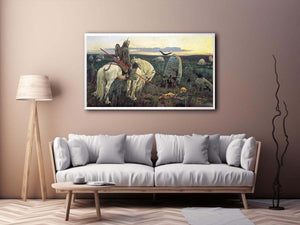
In contemporary interiors across the United States, the United Kingdom, Canada, Australia, and Europe, The Knight at the Crossroads carries exceptional intellectual and emotional weight. In living rooms, it introduces depth, seriousness, and narrative presence without spectacle. In studies, libraries, and private offices, it reflects philosophical engagement and respect for myth as moral language. In galleries and curated residences, it communicates cultural literacy and appreciation for symbolist realism.
The painting integrates naturally into traditional interiors, where its historical subject and subdued palette align with classical design. At the same time, it works powerfully in modern and minimalist spaces, where its stark composition and existential theme provide contrast and focus. In eclectic environments, it serves as a grounding presence, anchoring diverse elements through shared seriousness.
The long-term artistic importance of The Knight at the Crossroads lies in its refusal to simplify the idea of destiny. Vasnetsov does not depict fate as external force alone, nor as purely personal choice. He presents it as an encounter between circumstance and conscience. This balance ensures the painting’s enduring relevance across cultures and eras.
Today, the painting remains profoundly resonant because it speaks to moments that define human life but resist representation: hesitation, responsibility, and the knowledge that some decisions cannot be undone. In an age often driven by speed and certainty, Vasnetsov’s vision insists on pause and reflection. The Knight at the Crossroads endures not as a tale of heroism, but as a timeless image of moral solitude, securing its place as one of the most philosophically compelling achievements of nineteenth-century art.
Buy museum qulaity 400- 450 canvas prints, framed prints, and 100% oil paintings of The Knight at the Crossroads by Viktor Vasnetsov at Alpha Art Gallery, where world-famous masterpieces are recreated with museum-quality detail, refined craftsmanship, and premium materials.
FAQS
What story inspires The Knight at the Crossroads by Viktor Vasnetsov?
It is inspired by Russian epic folklore in which a knight confronts a stone that foretells the consequences of different paths.
Why is the painting considered philosophically important?
It focuses on the moment of moral choice rather than action, emphasizing responsibility, uncertainty, and destiny.
What does the crossroads symbolize in the painting?
The crossroads symbolize irreversible life decisions where every option carries consequence.
Why is the knight shown in stillness rather than action?
Vasnetsov emphasizes contemplation over heroics, making inner conflict the painting’s central subject.
Where does this painting work best in interior spaces?
It is well suited to studies, libraries, living rooms, galleries, and spaces that value intellectual depth.
Is The Knight at the Crossroads compatible with modern décor?
Yes, its restrained palette and strong symbolic presence integrate seamlessly into modern and minimalist interiors.
Does the painting have lasting cultural and artistic value?
Its universal theme of moral choice and its role in elevating folklore into serious art ensure enduring significance.
| 1. Select Type |
Canvas Print, Unframed Paper Print, Hand-Painted Oil Painting, Framed Paper Print |
|---|---|
| 2. Select Finish Option |
Rolled Canvas, Rolled- No Frame, Streched Canvas, Black Floating Frame, White Floating Frame, Brown Floating Frame, Black Frame with Matt, White Frame with Matt, Black Frame No Matt, White Frame No Matt, Streched, Natural Floating Frame, Champagne Floating Frame, Gold Floating Frame |
| 3. Select Size |
60cm X 90cm [24" x 36"], 76cm X 114cm [30" x 45"], 90cm X 120cm [36" x 48"], 100cm X 150cm [40" x 60"], 16.54 x 11.69"(A3), 23.39 x 16.54"(A2), 33.11 x 23.39"(A1), 46.81 x 31.11"(A0), 54" X 36", 50cm X 60cm [16" x 24"], 121cm X 182cm [48" x 72"], 135cm X 200cm [54" x 79"], 165cm x 205cm [65" x 81"], 183cm x 228cm [72" x 90"], 22cm X 30cm [9" x 12"], 30cm x 45Cm [12" x 18"], 45cm x60cm [16" x 24'], 75cm X 100cm [30" x 40"], 121cm x 193cm [48" x 76"], 45cm x 60cm [16" x 24'], 20cm x 25Cm [8" x 10"], 35cm x 50Cm [14" x 20"], 45cm x 60 cm [18" x 24"], 35cm x 53Cm [14" x 21"], 66cm X 101cm[26" x 40"], 76cm x 116cm [30"x 46"], 50cm X 60cm 16" x 24"] |