





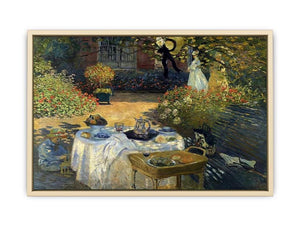
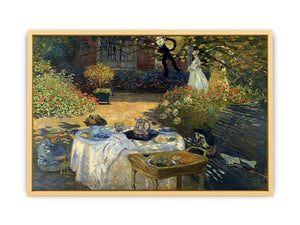
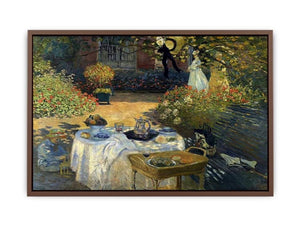

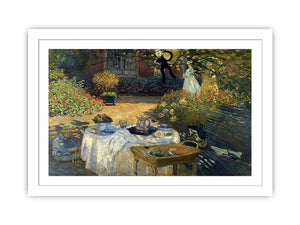


The Luncheon (Monet's Garden At Argenteuil)
Go kalles this summer with this vintage navy and white striped v-neck t-shirt from the Nike. Perfect for pairing with denim and white kicks for a stylish kalles vibe.

The Luncheon (Monet's Garden At Argenteuil)
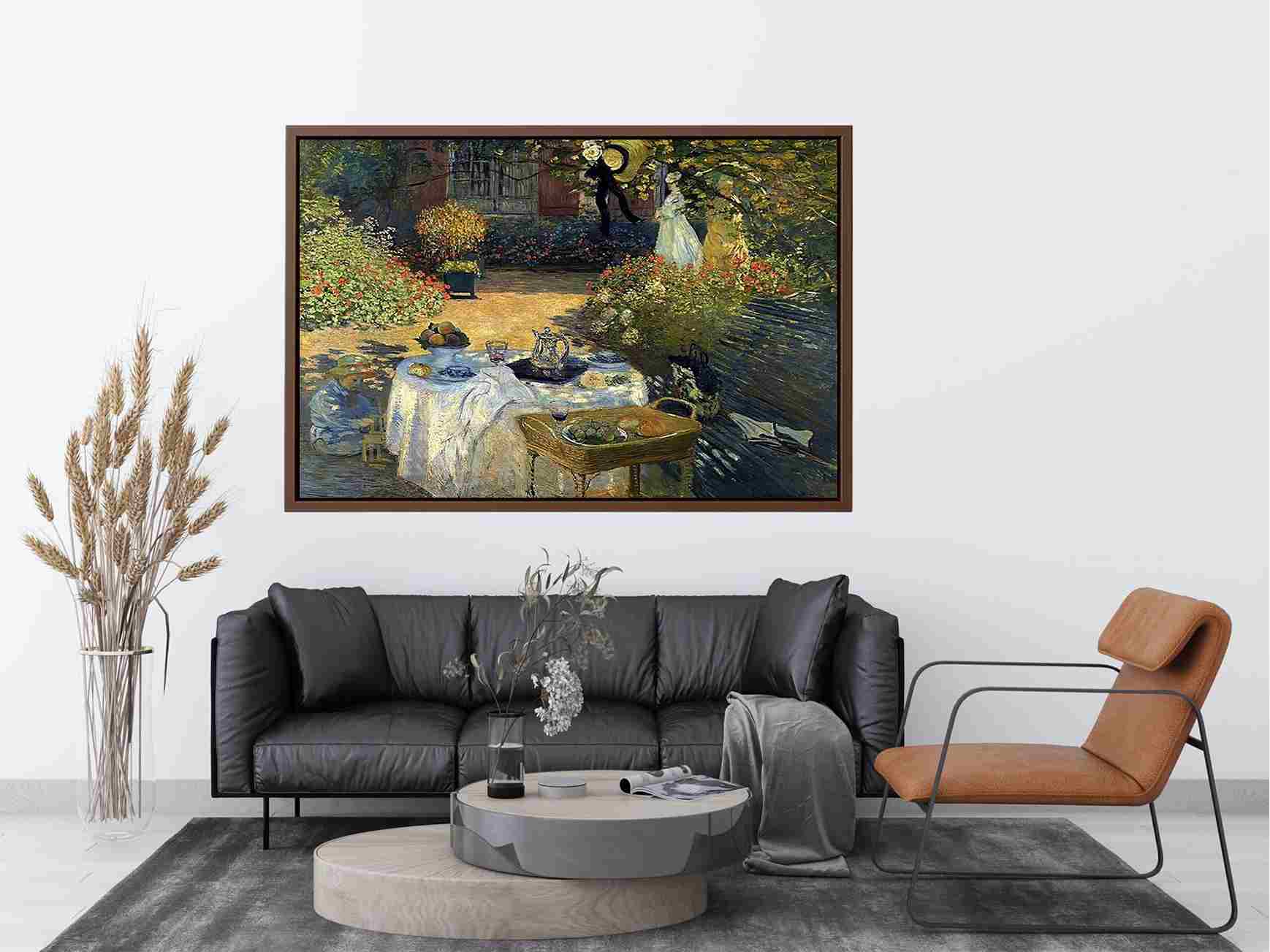
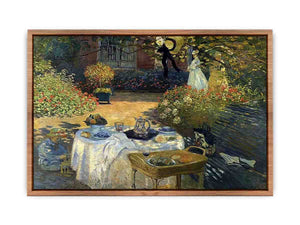
The Luncheon (Monet’s Garden at Argenteuil) Painting by Claude Monet
The Luncheon (Monet’s Garden at Argenteuil) stands as one of Claude Monet’s most nuanced meditations on modern life, where domestic leisure, cultivated nature, and perceptual truth converge within a single, quietly complex scene. Painted in 1873, during Monet’s productive years in Argenteuil, the work occupies a pivotal position in his artistic evolution. It reveals an artist exploring how contemporary social rituals—informal, private, and untheatrical—could be absorbed into the language of Impressionism without reverting to anecdote or sentimentality. Here, the act of dining outdoors becomes a framework for studying light, colour, and spatial experience rather than a narrative event.
Argenteuil, situated along the Seine northwest of Paris, offered Monet an environment ideally suited to his ambitions. It was a place where suburban gardens, leisure culture, and modern domestic life intersected naturally. Monet’s own garden became both subject and studio, a controlled yet living environment that allowed him to observe daily routines under changing conditions of light and season. The Luncheon (Monet’s Garden at Argenteuil) emerges from this context as a painting deeply rooted in lived experience. It does not depict a formal gathering or celebratory occasion; it captures the ordinariness of a shared meal, observed with attentiveness rather than emphasis.
The composition is carefully balanced between structure and openness. A table set for a meal occupies the foreground, anchoring the scene with a horizontal plane that introduces order and stability. Around it, figures are arranged informally, their placement suggesting presence rather than interaction. Monet resists the conventions of genre painting, where gestures and expressions carry narrative weight. Instead, figures remain absorbed in the moment, integrated into the surrounding garden. The eye moves fluidly across the canvas, guided by colour relationships and spatial rhythms rather than by a central focal point.
Perspective is experiential rather than constructed. Monet situates the viewer at garden level, close enough to feel included yet not intruding upon the scene. Depth unfolds through overlapping forms, shifts in colour intensity, and the placement of figures at varying distances. There is no theatrical recession or dramatic viewpoint. Space is felt as it is lived—intimate, layered, and continuous. The garden does not frame the luncheon; it envelops it.
Light functions as the painting’s unifying element. Sunlight filters gently through foliage, touching tablecloth, figures, and grass with equal delicacy. There are no strong shadows or sharp contrasts. Illumination appears diffuse, binding objects together rather than separating them. Monet captures the sensation of a bright day not through brilliance, but through coherence. Everything exists within the same luminous condition, reinforcing the idea that human activity and natural environment share a single perceptual field.
Colour is handled with remarkable sensitivity. Whites of the tablecloth and clothing are infused with reflected greens, blues, and warm undertones, demonstrating Monet’s understanding that no colour exists in isolation. Greens dominate the surrounding garden, modulated endlessly to suggest depth, texture, and filtered light. Accents of warmer hues—skin tones, subtle reds, and ochres—punctuate the scene without asserting dominance. Colour operates relationally, establishing harmony and rhythm rather than contrast for effect.
Monet’s brushwork remains open and visibly present. Short, broken strokes describe foliage and grass, conveying movement and growth without botanical precision. The table and figures are rendered with economy, their forms suggested rather than defined. This refusal of finish preserves immediacy, aligning the painting’s surface with the act of perception itself. The scene feels alive because it resists closure; it appears as though it could continue beyond the frame, unchanged by the act of being painted.
Symbolically, The Luncheon (Monet’s Garden at Argenteuil) resists allegory. Its significance lies not in what the meal represents, but in how it is seen. Yet the painting carries cultural weight in its redefinition of subject matter. By treating a private, domestic moment as worthy of sustained artistic attention, Monet challenges inherited hierarchies that privileged historical or moral narratives. The luncheon becomes a modern ritual—unremarkable, recurrent, and therefore meaningful through repetition rather than exception.
Emotionally, the painting conveys calm attentiveness. There is no overt conviviality, no theatrical display of sociability. Instead, the mood is one of quiet coexistence. Figures share space rather than drama, presence rather than exchange. Viewers often experience the work as intimate without being sentimental, its restraint fostering a sense of authenticity. The painting does not ask to be interpreted; it asks to be observed.
Within Monet’s career, this work represents an important extension of Impressionist principles into the sphere of domestic life. Painted shortly before the first Impressionist exhibition, it demonstrates Monet’s confidence in applying perceptual methods to subjects traditionally associated with genre painting. The Luncheon (Monet’s Garden at Argenteuil) shows how modern painting could absorb social life without sacrificing immediacy or visual coherence. It marks a moment when Impressionism proved capable of encompassing not only landscapes and cityscapes, but also the quiet rituals of everyday existence.
Culturally, the painting reflects broader transformations in nineteenth-century society. Outdoor leisure, private gardens, and informal dining were increasingly characteristic of bourgeois modernity. Monet does not critique or celebrate this condition; he observes it. By doing so, he aligns painting with contemporary experience as it is lived, not as it is idealised. The work becomes a document of perception rather than of social commentary.
In contemporary interiors, The Luncheon (Monet’s Garden at Argenteuil) integrates with exceptional warmth and balance. In living rooms, it introduces human presence without visual dominance, fostering a sense of continuity and ease. In dining spaces, it resonates naturally with themes of gathering and shared time without becoming illustrative. In studies and offices, it offers compositional calm and chromatic harmony, supporting reflection rather than distraction. Across interiors in the United States, United Kingdom, Canada, Australia, and Europe, the painting complements traditional, modern, minimalist, and eclectic décor alike. Its natural palette and social intimacy lend it enduring adaptability.
The enduring relevance of The Luncheon (Monet’s Garden at Argenteuil) lies in its affirmation of the everyday as perceptually rich. Monet demonstrates that meaning does not arise from spectacle, but from attention. By observing a simple meal in a garden with patience and clarity, he transformed a fleeting domestic moment into a lasting meditation on light, presence, and modern life. The painting endures because it continues to recreate the experience of being there—of sharing space, time, and perception within the quiet intelligence of the visible world.
Buy museum qulaity 400- 450 canvas prints, framed prints, and 100% oil paintings of The Luncheon (Monet’s Garden at Argenteuil) by Claude Monet at Alpha Art Gallery, where world-famous masterpieces are recreated with museum-quality detail, refined craftsmanship, and premium materials.
FAQS
What does The Luncheon (Monet’s Garden at Argenteuil) by Claude Monet depict?
It depicts an informal outdoor meal in Monet’s garden at Argenteuil, focusing on light, colour, and everyday domestic life.
Why is Argenteuil significant in Monet’s work?
Argenteuil was where Monet developed key Impressionist ideas while engaging closely with modern suburban living.
Is this painting a genre scene or a landscape?
It merges both, treating domestic activity as part of the surrounding landscape rather than a separate narrative subject.
How does Monet use light in this painting?
Light is diffuse and unifying, binding figures, table, and garden into a single perceptual condition.
Are the figures central to the painting’s meaning?
They provide scale and presence, but meaning arises primarily from observation rather than interaction.
What distinguishes this work from traditional depictions of meals?
It avoids storytelling and symbolism, focusing instead on perception and atmosphere.
Is The Luncheon suitable for contemporary interiors?
Yes, its balanced composition and social intimacy suit a wide range of modern and traditional spaces.
Why does The Luncheon (Monet’s Garden at Argenteuil) remain relevant today?
Its celebration of ordinary moments, attentiveness, and shared space resonates strongly with contemporary life.
| 1. Select Type |
Canvas Print, Unframed Paper Print, Hand-Painted Oil Painting, Framed Paper Print |
|---|---|
| 2. Select Finish Option |
Rolled Canvas, Rolled- No Frame, Streched Canvas, Black Floating Frame, White Floating Frame, Brown Floating Frame, Black Frame with Matt, White Frame with Matt, Black Frame No Matt, White Frame No Matt, Streched, Natural Floating Frame, Champagne Floating Frame, Gold Floating Frame |
| 3. Select Size |
60cm X 90cm [24" x 36"], 76cm X 114cm [30" x 45"], 90cm X 120cm [36" x 48"], 100cm X 150cm [40" x 60"], 16.54 x 11.69"(A3), 23.39 x 16.54"(A2), 33.11 x 23.39"(A1), 46.81 x 31.11"(A0), 54" X 36", 50cm X 60cm [16" x 24"], 121cm X 182cm [48" x 72"], 135cm X 200cm [54" x 79"], 165cm x 205cm [65" x 81"], 183cm x 228cm [72" x 90"], 22cm X 30cm [9" x 12"], 30cm x 45Cm [12" x 18"], 45cm x60cm [16" x 24'], 75cm X 100cm [30" x 40"], 121cm x 193cm [48" x 76"], 45cm x 60cm [16" x 24'], 20cm x 25Cm [8" x 10"], 35cm x 50Cm [14" x 20"], 45cm x 60 cm [18" x 24"], 35cm x 53Cm [14" x 21"], 66cm X 101cm[26" x 40"], 76cm x 116cm [30"x 46"], 50cm X 60cm 16" x 24"] |