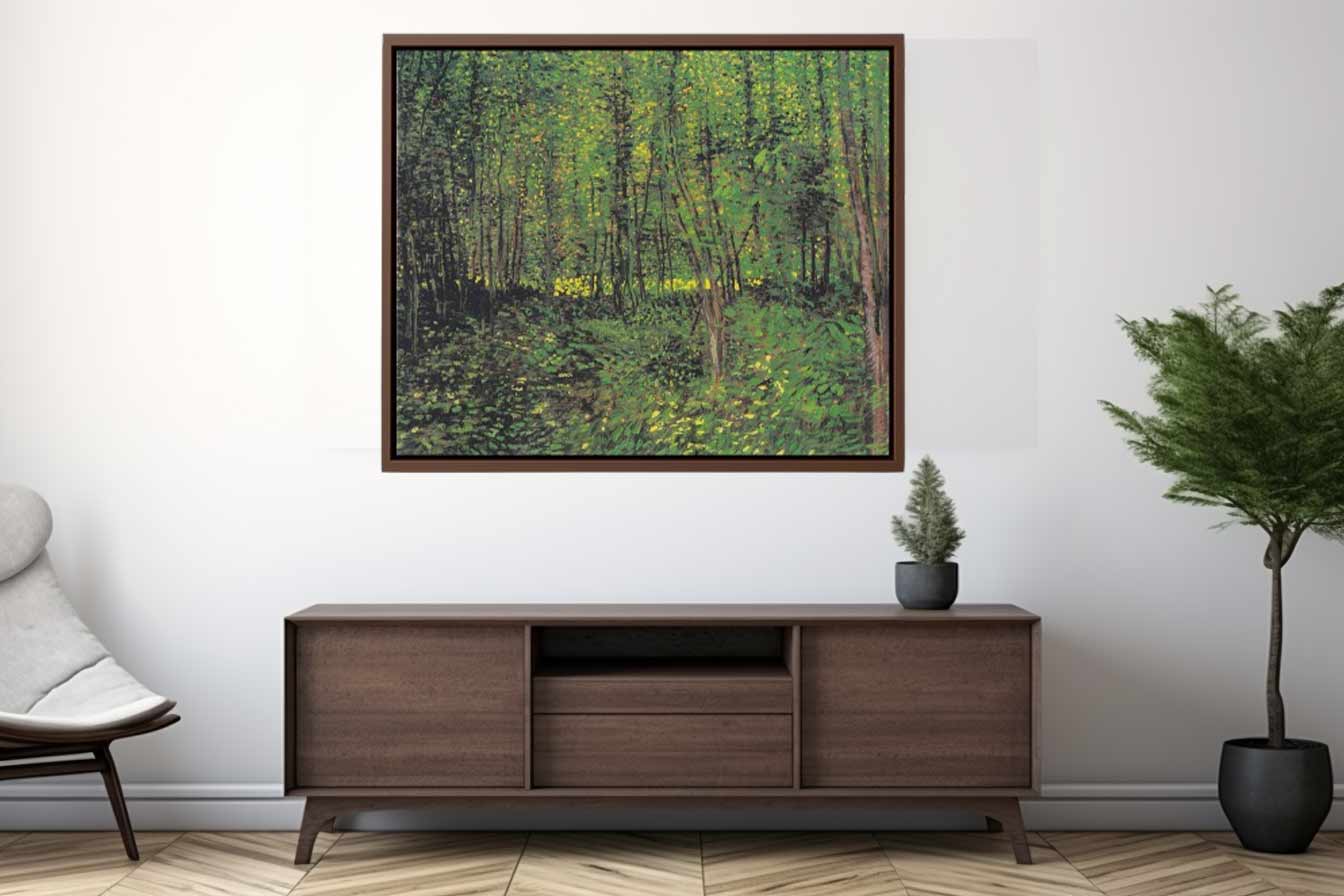
Tree and Undergrowth by Van Gogh corresponds to a second distinct Vincent van Gogh painting commonly titled Trees and Undergrowth, created in Paris during the summer of 1887 and catalogued as F 307 / JH 1318. Unlike the wider F 309a painting with the same English title, this work has a vertical format measuring approximately 46 × 36 cm. The historical oil-on-canvas painting is in the Van Gogh Museum in Amsterdam. Alpha Art Gallery offers reproductions as canvas prints, fine art prints, framed prints and 100% hand-painted oil paintings.
A Different Trees and Undergrowth by Vincent van Gogh
Van Gogh painted numerous woodland and vegetation studies while living in Paris, so artwork titles alone can sometimes be misleading. This product refers specifically to Trees and Undergrowth, catalogue F 307 / JH 1318. It should not be confused with F 309a / JH 1312, another 1887 Van Gogh Museum painting carrying the same English title.
F 307 measures approximately 46 cm high by 36 cm wide and is therefore vertically oriented. The portrait format gives this woodland subject a different decorative character from Van Gogh’s wider horizontal forest study and provides a useful point of distinction for collectors and buyers selecting between the two works.
Van Gogh’s Paris Experiments With Nature
Van Gogh’s stay in Paris from 1886 to early 1888 transformed his approach to painting. He arrived with an artistic background shaped largely by darker Dutch tonal traditions. In Paris, he encountered a radically different environment: Impressionism, newer experiments in divided colour, Japanese prints and a network of contemporary painters.
Landscape studies gave him an opportunity to put these lessons into practice. Trees, foliage and undergrowth offered countless variations of light and colour without requiring a carefully staged subject. As sunlight moved through vegetation, the same area could contain several different greens, areas of shadow and sudden touches of brighter colour.
Van Gogh’s woodland paintings from 1887 are therefore useful records of his changing technique. They stand between the restrained palette of his earlier Dutch work and the increasingly forceful colour he would use after moving to Arles in 1888.
Why Paint Trees and Undergrowth?
A forest interior presents a painter with unusual challenges. There may be no open horizon, monumental building or dominant human figure to organize the view. Instead, depth must be communicated through overlapping vegetation, differences in light and the relationships between nearer and more distant forms.
For Van Gogh, this kind of subject also encouraged attention to the physical act of painting. Tree forms provide strong directional structures, while foliage and ground vegetation can be translated through shorter, more varied touches. The result is a subject particularly suited to experimentation with visible brushwork.
The 1887 woodland studies show how Van Gogh could turn an apparently ordinary fragment of nature into an independent visual experience.
Vertical Format and Wall Display
One practical characteristic clearly distinguishes F 307 from the other Van Gogh Museum painting of the same title: its vertical proportions. At approximately 46 × 36 cm, the original directs the eye upward rather than outward across a broad landscape.
That makes this version especially useful for reproduction buyers with narrower walls. A vertical Van Gogh forest print can fit beside shelving, between architectural features, above a narrow console or within a grouped art display where a broad landscape would be difficult to accommodate.
Increasing the reproduction size can also strengthen the sense of immersion. The viewer encounters woodland rather than looking across a conventional panoramic landscape.
Post-Impressionism and the Paris Transition
Van Gogh is generally classified as a Post-Impressionist artist, but his Paris period cannot be understood without recognizing his engagement with Impressionist and Neo-Impressionist ideas. He studied how contemporary artists used brighter palettes, complementary contrasts and distinct touches of colour.
He did not simply become a follower of one movement. Instead, his Paris work shows experimentation. Different paintings try different solutions, and that searching quality is one of the period’s most important characteristics.
For this reason, Post-Impressionism is the most useful primary movement classification for Trees and Undergrowth. Neo-Impressionist ideas belong to the context of Van Gogh’s development rather than requiring the painting to be classified solely as a Neo-Impressionist work.
Why Van Gogh’s 1887 Landscapes Matter
The famous Van Gogh of Sunflowers, Irises, The Starry Night and the Saint-Rémy cypress paintings was still developing during 1887. Paris gave him access to artistic ideas that changed how he understood colour and the painted surface.
His forest scenes are valuable precisely because they show this process happening through direct engagement with nature. Trees and undergrowth become opportunities to experiment with how colour can create light, how marks can suggest vegetation and how a painting can remain visibly constructed from brushstrokes.
Collectors exploring other historic masterpieces can place this woodland study within Van Gogh’s larger transition from his Dutch years toward the mature paintings of Provence.
Historical Artwork Details
| Artist |
Vincent van Gogh |
| Title |
Trees and Undergrowth |
| Catalogue references |
F 307 / JH 1318 |
| Date |
Summer 1887 |
| Place |
Paris period |
| Original medium |
Oil on canvas |
| Original dimensions |
Approximately 46 × 36 cm |
| Orientation |
Vertical |
| Primary movement |
Post-Impressionism |
| Current collection |
Van Gogh Museum, Amsterdam |
This is a reproduction of Vincent van Gogh’s historical artwork. Alpha Art Gallery does not sell the Van Gogh Museum’s original painting and is not affiliated with or endorsed by the museum. “Museum-quality” describes Alpha Art Gallery’s reproduction options rather than museum approval or certification.
Choose Your Trees and Undergrowth Reproduction
| Format |
Character |
Best Suited To |
| Canvas Print |
Textured presentation with strong decorative presence |
Vertical feature-wall display |
| Fine Art Print |
Refined traditional printed presentation |
Collectors and smaller art arrangements |
| Framed Print |
Finished presentation with a defined external border |
Narrow walls and structured interiors |
| Hand-Painted Oil Reproduction |
Real oil paint and individually created brushwork |
Buyers who value painted texture and craftsmanship |
400–450 GSM Canvas Print
Alpha Art Gallery’s museum-quality canvas prints use 400–450 GSM canvas. The portrait orientation of F 307 makes canvas particularly useful for tall wall spaces where a broad landscape composition would be unsuitable.
Canvas also gives the forest subject visual presence without necessarily requiring a traditional frame, allowing the image to remain the primary focus.
Fine Art and Framed Prints
A fine art print offers a restrained, traditional interpretation of the image. This can work particularly well for smaller-scale presentation or for buyers assembling a collection of Van Gogh prints.
A framed print is useful when the woodland scene needs stronger separation from the surrounding interior. The regular geometry of a frame can create an effective contrast with the organic character of trees and undergrowth.
100% Hand-Painted Oil Reproduction
Alpha Art Gallery’s hand-painted oil painting reproductions are individually painted by professional artists using oil on canvas. Each piece therefore contains actual brushwork and natural surface differences inherent in handmade painting.
For a Van Gogh woodland work, this can be especially relevant because the historical painting belongs to the phase in which visible touches of paint were becoming increasingly important to his artistic language.
Which Format Should You Choose?
Choose canvas if you want strong visual presence and a relatively direct wall-art presentation. Choose a fine art print if you prefer the character of a traditional printed work. Framing suits spaces where a finished external boundary is important.
For buyers primarily attracted to Van Gogh’s painterly technique, a hand-painted oil reproduction provides something fundamentally different: actual layers and strokes of oil paint rather than a printed representation of those marks.
Choosing a Size for This Vertical Van Gogh Landscape
The F 307 painting’s portrait proportions make it particularly adaptable to narrower spaces. Measure both the available wall height and width before selecting a size. A tall reproduction can create substantial presence without requiring the broad horizontal area needed by many landscape paintings.
A smaller framed print can also work within a gallery-wall arrangement alongside portraits, still lifes and other Van Gogh works. If the painting will be displayed alone, increasing its scale can make the woodland subject more immersive.
Where Can I Buy This Trees and Undergrowth Reproduction?
Alpha Art Gallery offers Van Gogh’s F 307 Trees and Undergrowth as a canvas print, fine art print, framed print and 100% hand-painted oil painting reproduction. Multiple sizes and frame choices are available where applicable.
Orders are securely packaged and include free worldwide shipping. Alpha Art Gallery has production facilities in the USA, Australia, United Kingdom and Canada to support international fulfilment.
Frequently Asked Questions
Who painted Trees and Undergrowth F 307?
Vincent van Gogh painted the work during the summer of 1887 while living in Paris. The painting belongs to a transitional period in which his palette, brushwork and approach to colour changed substantially through contact with modern French art.
Is this the same Trees and Undergrowth as F 309a?
No. F 307 and F 309a are two distinct Van Gogh paintings that share the English title Trees and Undergrowth. F 307 measures approximately 46 × 36 cm and has a vertical format, while F 309a is approximately 46.5 × 55.5 cm and is horizontal.
Where is the original F 307 painting?
The historic F 307 / JH 1318 painting is in the Van Gogh Museum in Amsterdam. Alpha Art Gallery offers reproductions and does not sell the museum’s original work.
What art movement does the painting belong to?
Vincent van Gogh is primarily associated with Post-Impressionism. The painting comes from his Paris period, when he was also absorbing lessons from Impressionism and experimenting with aspects of the divided colour and brushwork associated with Neo-Impressionist artists.
Can I buy this Trees and Undergrowth as a canvas print?
Yes. Alpha Art Gallery offers the F 307 composition on 400–450 GSM museum-quality canvas in multiple available sizes. Its portrait orientation makes it particularly suitable for taller, narrower wall spaces.
Can I buy a framed print?
Yes. Framed print options are available where applicable. The format can be particularly effective for this woodland scene because a frame gives the organic composition a clearly defined outer boundary.
Can I order a hand-painted oil reproduction?
Yes. Alpha Art Gallery offers a 100% hand-painted oil reproduction on canvas, individually painted by professional artists. Actual brushwork, texture and subtle handmade variations become part of every painted reproduction.
Does Alpha Art Gallery provide free worldwide shipping?
Yes. Free worldwide shipping is included on all Alpha Art Gallery orders, with artwork securely packaged for delivery.
Choose the Van Gogh Woodland That Fits Your Space
This vertical version of Trees and Undergrowth offers a different presentation from Van Gogh’s wider F 309a woodland painting. Its portrait proportions make it especially useful for narrower walls while preserving the forest subject and experimental character of Van Gogh’s 1887 Paris period. Choose canvas, fine art, framed or hand-painted oil presentation in the size that works with your interior.