







Bridge Over Rose Water Lily Pond
Go kalles this summer with this vintage navy and white striped v-neck t-shirt from the Nike. Perfect for pairing with denim and white kicks for a stylish kalles vibe.

Bridge Over Rose Water Lily Pond
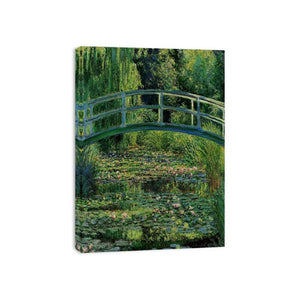
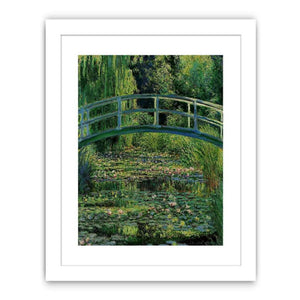
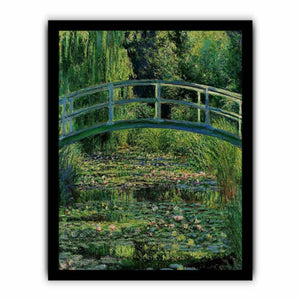
Bridge Over Rose Water Lily Pond Painting by Claude Monet
Bridge Over Rose Water Lily Pond stands as one of Claude Monet’s most distilled and philosophically resolved statements on perception, time, and immersion, a painting in which nature, memory, and vision are fused into a single, continuous experience. Created during Monet’s mature years at Giverny, the work belongs to the period when subject matter had ceased to function as depiction and instead became a vehicle for sustained contemplation. The bridge, the pond, and the water lilies are no longer separate motifs; they exist as interdependent elements within a self-contained world shaped entirely by light, colour, and duration.
By the late nineteenth and early twentieth centuries, Monet had deliberately narrowed his focus. Having explored cities, rivers, coasts, and fields, he turned inward—both geographically and conceptually. The garden he designed at Giverny was not merely a place to paint; it was a constructed environment intended to be painted repeatedly, under changing conditions, across years. The Japanese bridge and the water lily pond became central to this vision. Bridge Over Rose Water Lily Pond emerges from this sustained engagement as a painting that no longer records a moment, but embodies time itself as an accumulated presence.
The composition is organised around the gentle arc of the bridge, which spans the upper portion of the canvas without asserting architectural dominance. Rather than functioning as a passage from one side to another, the bridge acts as a rhythmic contour, echoing the organic curves of foliage and water below. The pond fills the pictorial space almost entirely, dissolving conventional foreground and background. There is no invitation to enter or cross; the viewer is already within the scene. Space becomes immersive rather than directional.
Perspective is intentionally destabilised. Monet abandons traditional depth cues, allowing the surface of the painting to operate as both space and plane simultaneously. The water does not recede; it expands outward. Reflections of sky, leaves, and flowers mingle with the physical presence of the lilies themselves, collapsing distinctions between what is above and what is below. This ambiguity is central to the painting’s effect. Vision is no longer guided toward distance; it circulates within the field of colour and form.
Light is not represented as a source, but as a condition saturating everything equally. There are no shadows cast by the bridge, no directional illumination to organise form. Instead, light is diffused, absorbed, and reflected by water, petals, and foliage. Monet treats light as inseparable from colour, allowing it to manifest through chromatic vibration rather than tonal contrast. The result is a scene that feels luminous without brightness, radiant without clarity.
Colour is the painting’s governing force and primary structure. Rose-toned water lilies float across the surface, their soft hues modulated through pinks, mauves, and pale reds that shift subtly with surrounding tones. Greens and blues interweave beneath and around them, suggesting depth without defining it. Monet avoids sharp contrasts, preferring layered harmonies that create resonance rather than separation. Colour here does not describe objects; it creates an environment. The painting reads as an atmosphere rather than a scene.
Monet’s brushwork is liberated and fully autonomous. Individual strokes remain visible, yet they no longer describe discrete forms. Instead, they function as units of sensation—marks that register movement, reflection, and temporal accumulation. The lilies are suggested through clustered touches rather than outlined shapes. The water is built from overlapping strokes that resist stillness. The surface becomes a record of sustained looking, where perception unfolds through repetition rather than resolution.
Symbolically, Bridge Over Rose Water Lily Pond resists all conventional allegory. The bridge does not signify transition, nor do the lilies function as emblems. Monet had moved beyond symbolism toward something more elemental. The painting proposes that meaning resides not in what is depicted, but in the act of seeing itself. Nature is not interpreted or idealised; it is experienced as a continuous field of presence. The work becomes less about the garden and more about consciousness engaged with the visible world.
Emotionally, the painting conveys immersion and suspension. There is no narrative tension, no beginning or end. Time feels slowed, almost dissolved, replaced by a steady attentiveness. Viewers often experience the work as meditative, not because it depicts tranquillity, but because it requires and rewards sustained looking. The absence of spatial hierarchy encourages the eye to wander without urgency, mirroring Monet’s own prolonged engagement with the motif.
Within Monet’s artistic evolution, this painting represents the culmination of his lifelong inquiry. The bridge and water lilies are no longer subjects among many; they are the site where painting becomes perception itself. Bridge Over Rose Water Lily Pond anticipates abstraction without abandoning the natural world, demonstrating how representation can dissolve into pure visual experience while remaining rooted in observation. It stands as one of the clearest articulations of modern painting’s shift away from depiction toward immersion.
Culturally, the work occupies a foundational place in the history of twentieth-century art. Its flattening of space, emphasis on surface, and prioritisation of colour over form would resonate deeply with later developments in modernism. Yet Monet’s achievement remains singular. Unlike later abstraction, this painting retains a profound connection to lived environment. It is modern not because it rejects nature, but because it redefines how nature can be seen.
In contemporary interiors, Bridge Over Rose Water Lily Pond integrates with exceptional authority and calm. In living rooms, it creates a focal presence that invites contemplation without visual dominance. In studies and private rooms, it fosters reflection and sustained attention. In offices and galleries, it communicates cultural depth and intellectual refinement. Across luxury residences in the United States, United Kingdom, Canada, Australia, and Europe, the painting harmonises effortlessly with modern, minimalist, and eclectic décor. Its layered colour and immersive composition soften architectural lines while elevating the atmosphere of the space.
The enduring relevance of Bridge Over Rose Water Lily Pond lies in its affirmation that art can function as a space rather than an image. Monet demonstrates that when observation is sustained deeply enough, the boundary between subject and perception dissolves. The painting endures not because of what it shows, but because of what it allows the viewer to experience: immersion, continuity, and the quiet intelligence of seeing itself. In this work, Monet does not ask us to look at nature; he invites us to dwell within it.
Buy museum qulaity 400- 450 canvas prints, framed prints, and 100% oil paintings of Bridge Over Rose Water Lily Pond by Claude Monet at Alpha Art Gallery, where world-famous masterpieces are recreated with museum-quality detail, refined craftsmanship, and premium materials.
FAQS
What does Bridge Over Rose Water Lily Pond by Claude Monet depict?
It depicts Monet’s Japanese bridge at Giverny spanning a pond filled with rose-toned water lilies, rendered as an immersive visual environment.
Why is the bridge important in Monet’s water lily paintings?
The bridge provides rhythmic structure without narrative emphasis, integrating human design into natural perception.
Is this painting symbolic or abstract?
It is observational rather than symbolic, and while not abstract, it moves toward abstraction through colour and surface.
How does Monet treat space in this painting?
Traditional depth is dissolved, allowing space to unfold as a continuous, immersive field rather than linear recession.
What role does colour play in the composition?
Colour functions as the primary structural element, creating atmosphere, rhythm, and spatial coherence.
Is Bridge Over Rose Water Lily Pond a late work by Monet?
Yes, it belongs to Monet’s mature period at Giverny, when he was fully focused on the water lily motif.
Is this artwork suitable for contemporary interiors?
Yes, its immersive composition and refined palette integrate seamlessly into modern and luxury spaces.
Why does Bridge Over Rose Water Lily Pond remain relevant today?
Its emphasis on immersion, perception, and sustained attention resonates strongly with modern visual and interior culture.
| 1. Select Type |
Canvas Print, Unframed Paper Print, Hand-Painted Oil Painting, Framed Paper Print |
|---|---|
| 2. Select Finish Option |
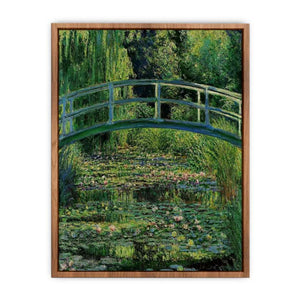
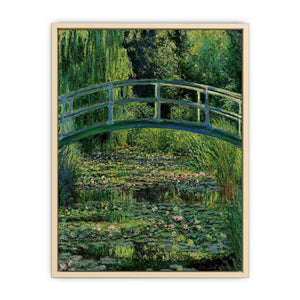
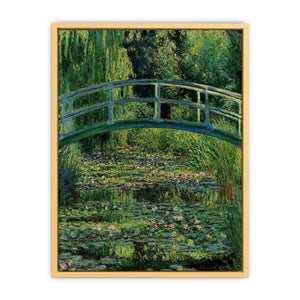
Rolled Canvas, Rolled- No Frame, Streched Canvas, Black Floating Frame, White Floating Frame, Brown Floating Frame, Black Frame with Matt, White Frame with Matt, Black Frame No Matt, White Frame No Matt, Streched, Natural Floating Frame, Champagne Floating Frame, Gold Floating Frame |
| 3. Select Size |
60cm X 90cm [24" x 36"], 76cm X 114cm [30" x 45"], 90cm X 120cm [36" x 48"], 100cm X 150cm [40" x 60"], 16.54 x 11.69"(A3), 23.39 x 16.54"(A2), 33.11 x 23.39"(A1), 46.81 x 31.11"(A0), 54" X 36", 50cm X 60cm [16" x 24"], 121cm X 182cm [48" x 72"], 135cm X 200cm [54" x 79"], 165cm x 205cm [65" x 81"], 183cm x 228cm [72" x 90"], 22cm X 30cm [9" x 12"], 30cm x 45Cm [12" x 18"], 45cm x60cm [16" x 24'], 75cm X 100cm [30" x 40"], 121cm x 193cm [48" x 76"], 45cm x 60cm [16" x 24'], 20cm x 25Cm [8" x 10"], 35cm x 50Cm [14" x 20"], 45cm x 60 cm [18" x 24"], 35cm x 53Cm [14" x 21"], 66cm X 101cm[26" x 40"], 76cm x 116cm [30"x 46"], 50cm X 60cm 16" x 24"] |