


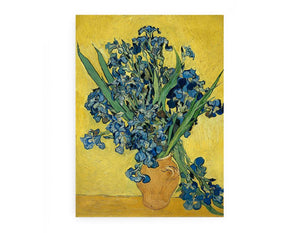


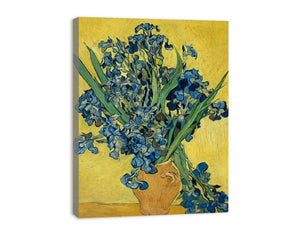


Vase Of Irises By Van Gogh
Go kalles this summer with this vintage navy and white striped v-neck t-shirt from the Nike. Perfect for pairing with denim and white kicks for a stylish kalles vibe.

Vase Of Irises By Van Gogh
Vase of Irises by Vincent van Gogh reproduces the 1890 floral still life officially titled Irises by The Metropolitan Museum of Art. Van Gogh painted the bouquet at Saint-Rémy-de-Provence in May 1890, just before leaving the asylum of Saint-Paul-de-Mausole. The sweeping arrangement of irises was originally conceived with violet flowers against a soft pink background, although some colours have faded over time. The historic oil-on-canvas painting is now in The Metropolitan Museum of Art in New York. Alpha Art Gallery offers reproductions as canvas prints, fine art prints, framed prints and 100% hand-painted oil paintings.
About Vase of Irises by Vincent van Gogh
Vincent van Gogh painted Irises in May 1890 during the final days of his year-long stay at Saint-Rémy-de-Provence in southern France. The painting is a floral still life rather than the famous 1889 garden painting of irises now at the J. Paul Getty Museum. In this later work, cut iris stems are gathered into a broad vessel and spread dramatically across a horizontal canvas.
The Metropolitan Museum of Art records the original as an oil painting on canvas measuring approximately 73.7 × 92.1 cm, or 29 × 36 1/4 inches. Its museum object number is 58.187. The horizontal proportions allow Van Gogh’s long leaves and bending flowers to extend widely across the composition instead of forming a compact upright bouquet.
The painting belongs to one of Van Gogh’s last major experiments with flower still life. Together with three companion paintings—another arrangement of irises and two paintings of roses—it formed a concentrated series exploring contrasting flowers, formats and colour relationships.
One of Van Gogh’s Final Saint-Rémy Flower Paintings
Van Gogh entered Saint-Paul-de-Mausole at Saint-Rémy in May 1889 and remained there for approximately one year. Gardens, olive trees, cypresses, wheat fields and the surrounding landscape became major subjects during this period, while ambitious flower still lifes were comparatively rare.
That changed dramatically in May 1890. As his departure approached and the hospital garden came into spring bloom, Van Gogh produced four substantial flower paintings in rapid succession: two compositions of irises and two of roses.
The Metropolitan Museum of Art describes the quartet as a coordinated series or ensemble. Van Gogh varied not only the flowers but also the orientation and colour relationships. One iris painting is upright and one horizontal; the same contrast appears in the rose paintings. This method allowed him to explore how similar botanical subjects could generate distinctly different visual effects.
Van Gogh left Saint-Rémy on 16 May 1890. The newly painted bouquets remained behind temporarily so that they could dry and were later sent to him after he had moved to Auvers-sur-Oise.
What Does Vase of Irises Depict?
The painting depicts an abundant bouquet of long-stemmed irises gathered in a broad pitcher-like vessel. Leaves and stems rise, bend and sweep outward, while individual blossoms turn in several directions. Instead of constructing a formally symmetrical flower arrangement, Van Gogh creates a sense of organic movement.
The horizontal canvas is important to this effect. There is enough lateral space for leaves and blossoms to extend across the image without being compressed into a tall central column. Curving stems lead the eye from one side of the bouquet to the other, producing an almost calligraphic rhythm.
The vase sits close to the centre but does not function as the only visual focus. The flowers themselves command attention through overlapping silhouettes and changing directions. Some blossoms stand upright, others bend toward the edges, and long leaves create sweeping lines through the composition.
For wall display, this broad arrangement gives the painting a different character from a traditional narrow flower still life. The image reads almost as a floral landscape, spreading horizontally rather than rising primarily upward.
The Original Colours Were Different
One of the most fascinating aspects of Van Gogh’s Irises is that the painting no longer looks exactly as it did in 1890. Van Gogh described the flowers as violet and placed them against a pink background. Today, the irises appear considerably bluer and much of the background appears pale or nearly white.
The change resulted from the fading of light-sensitive red pigments used in the original paint mixtures. As the red component diminished, violet passages shifted toward blue and the pink background lost much of its original warmth.
The Metropolitan Museum of Art has studied this colour change extensively. The altered appearance provides an important reminder that historic paintings are physical objects whose pigments can change chemically over time.
For modern viewers, this makes Irises particularly interesting: the painting can be appreciated both for the colours visible today and for the carefully planned pink, green and violet harmony Van Gogh originally intended.
Van Gogh Wanted a “Harmonious and Soft” Effect
The horizontal Irises was designed around a gentler colour relationship than its upright companion. According to Van Gogh’s correspondence and Met research, he intended violet irises against a pink background to create a harmonious, soft effect.
The upright iris composition, now in the Van Gogh Museum in Amsterdam, was designed differently. There Van Gogh placed violet flowers against a striking yellow background to create a much stronger complementary contrast.
Comparing the two works reveals how deliberately Van Gogh approached colour. He was not merely recording the natural appearance of flowers in front of him. He was testing how the same botanical subject could create different emotional and visual effects through format, background and complementary relationships.
Irises, Roses and a Four-Painting Ensemble
The Met’s Irises belongs to a group of four floral still lifes created during Van Gogh’s final days at Saint-Rémy. The group consists of two iris paintings and two rose paintings, each exploring contrasting orientation and colour schemes.
The horizontal Irises is at The Metropolitan Museum of Art in New York. Its upright iris counterpart is in the Van Gogh Museum in Amsterdam. One of the rose paintings is also at The Met, while the other belongs to the National Gallery of Art in Washington, D.C.
The four paintings were reunited in a major Metropolitan Museum of Art exhibition in 2015, the first time the quartet had been displayed together since Van Gogh’s death. Seeing them as an ensemble makes their carefully planned relationships much easier to understand.
The series also recalls Van Gogh’s earlier interest in creating groups of paintings that could work together decoratively. His celebrated Sunflowers paintings in Arles similarly explored repetition, variation and intense colour through related floral compositions.
Brushwork and Movement
The painting’s appeal is not limited to its flowers. Van Gogh’s brushwork gives the bouquet its vitality. Long, sinuous strokes describe leaves and stems, while shorter curved marks articulate petals and blossoms.
The individual strokes remain visible rather than being blended into a perfectly smooth surface. This allows the viewer to follow the physical movement of the painter’s hand while simultaneously recognizing the flowers being represented.
The broad bouquet seems almost to sway across the canvas. Leaves sweep in arcs, blossoms lean outward and the irregular arrangement prevents the painting from becoming static. Even though the flowers are contained within a vase, Van Gogh gives them the energy normally associated with growing plants outdoors.
This characteristic is particularly relevant when choosing a reproduction. A printed format reproduces the appearance of Van Gogh’s brushwork, whereas a hand-painted oil reproduction can introduce actual painted texture and individually created marks.
Japanese Art and Van Gogh’s Irises
Irises held particular visual interest for Van Gogh, and Japanese art formed an important part of his artistic education. He collected Japanese ukiyo-e prints and admired their clear contours, cropped compositions, decorative patterning and distinctive treatment of plants.
The Met connects Van Gogh’s fascination with irises to both the spring landscape of southern France and the botanical motifs he encountered in Japanese prints. His approach, however, was never simply imitation. He combined those influences with European oil painting, colour theory and direct observation of nature.
In this floral still life, the sweeping leaves and strongly defined blossoms create a decorative linear rhythm that works independently from conventional modelling or deep perspective.
Why Vase of Irises Is Important
Irises is significant because it represents Van Gogh working with confidence immediately before leaving Saint-Rémy. His letters from this period describe an intense final burst of work on bouquets of roses and violet irises.
The painting also summarizes several artistic interests that had occupied him for years: flowers, complementary colour, Japanese art, decorative ensembles and expressive brushwork. Yet it does so in a restrained manner that differs noticeably from the dramatic night landscapes and cypress paintings for which the Saint-Rémy period is often remembered.
Its importance is therefore not simply that it is a beautiful flower painting. It demonstrates Van Gogh thinking systematically about how format and colour can transform an apparently simple still-life subject.
Visitors exploring other celebrated paintings from art history can place this work alongside Van Gogh’s better-known landscapes and flower paintings to appreciate the extraordinary range of his final years.
Historical Artwork Details
| Artist | Vincent van Gogh |
|---|---|
| Museum title | Irises |
| Common reproduction title | Vase of Irises |
| Date | 1890 |
| Created at | Saint-Rémy-de-Provence, France |
| Original medium | Oil on canvas |
| Dimensions | Approximately 73.7 × 92.1 cm |
| Orientation | Horizontal |
| Genre | Floral still life |
| Movement | Post-Impressionism |
| Current collection | The Metropolitan Museum of Art, New York |
| Museum object number | 58.187 |
The Metropolitan Museum of Art holds Van Gogh’s historical original. Alpha Art Gallery offers reproductions of the artwork and does not sell the museum’s original painting. Alpha Art Gallery is not affiliated with or endorsed by The Metropolitan Museum of Art, and “museum-quality” describes Alpha Art Gallery’s reproduction format rather than museum certification.
Choose Your Vase of Irises Reproduction
The broad floral composition works well in several reproduction formats. Your choice should depend on whether you value canvas presence, traditional print presentation, framing or the physical surface of oil paint.
| Format | Presentation | Best Suited To |
|---|---|---|
| Canvas Print | Textured canvas presentation with strong decorative presence | Feature walls and buyers wanting Van Gogh artwork on canvas |
| Fine Art Print | Refined traditional printed presentation | Collectors who prefer a classic art-print format |
| Framed Print | Finished presentation with a defined outer boundary | Living rooms, bedrooms, offices and structured interiors |
| Hand-Painted Oil Reproduction | Real oil paint with individually created brushwork and texture | Buyers especially interested in Van Gogh’s painterly surface |
Museum-Quality Canvas Print
Alpha Art Gallery’s museum-quality canvas prints use substantial 400–450 GSM canvas. The horizontal spread of the bouquet makes this format particularly attractive at larger sizes, where the long leaves and outward-moving flowers can occupy a broad wall without feeling visually compressed.
Canvas provides a strong decorative presentation while keeping Van Gogh’s image itself as the main visual focus.
Fine Art and Framed Prints
A fine art print is suited to buyers who prefer a refined traditional printed presentation. The many curving stems and flower outlines can be appreciated clearly without adding physical painted texture to the surface.
A framed print introduces a stronger geometric boundary around the irregular bouquet. This contrast can be particularly effective because Van Gogh’s flowers seem to expand freely across the horizontal composition while the frame creates a controlled outer structure.
100% Hand-Painted Oil Painting Reproduction
For buyers drawn to Van Gogh’s visible brushwork, Alpha Art Gallery also offers 100% hand-painted oil painting reproductions. Each piece is individually painted by professional artists using oil on canvas.
Real brushwork, painted texture and subtle handmade differences become part of each reproduction. This can be especially appealing in Vase of Irises, where the movement of stems, leaves and petals depends heavily on the direction and rhythm of painted marks.
A hand-painted reproduction remains a reproduction of Van Gogh’s artwork and should not be confused with the historical original at The Metropolitan Museum of Art.
Which Format Works Best for Vase of Irises?
Choose canvas if you want a strong decorative presentation and enough scale for the broad bouquet to become a focal point. Choose a fine art print if you prefer a traditional printed artwork.
A framed print works well when you want the composition integrated into a structured interior. A hand-painted oil reproduction is particularly suitable for buyers who value actual brushwork, physical texture and the handmade character of individually painted artwork.
Because this painting is wider than it is tall, all four formats can work especially well on horizontal wall spaces.
How to Display Vase of Irises as Wall Art
The original’s horizontal proportions make it naturally suitable above a sofa, sideboard, bed, desk or console. Unlike a narrow flower still life, the leaves and blossoms extend widely across the canvas, so the composition benefits from sufficient wall width.
A larger canvas can turn the bouquet into statement wall art in a living room or reception space. In a bedroom, study or office, a framed or fine art print can provide a more contained presentation.
The combination of botanical subject and expressive Post-Impressionist brushwork allows the painting to work across different interior styles. In a traditional room, it brings an important nineteenth-century artwork into the space; in a contemporary interior, the sweeping forms and simplified arrangement can feel surprisingly modern.
Choosing the Right Size
Measure the available wall before choosing your reproduction. A larger format gives the individual iris blossoms, long leaves and moving contours more visual room and makes the bouquet feel increasingly immersive.
For a broad feature wall, a larger canvas or hand-painted oil reproduction can emphasize the painting’s unusual width. For a smaller wall or gallery arrangement, a fine art or framed print may provide a more restrained scale.
Alpha Art Gallery offers multiple sizes, allowing buyers to select a reproduction according to the actual proportions of their space rather than relying on a single standard dimension.
Where Can I Buy Vase of Irises by Van Gogh?
Alpha Art Gallery offers Vincent van Gogh’s Irises, sold here as Vase of Irises, as a canvas print, fine art print, framed print and 100% hand-painted oil painting reproduction. Multiple sizes and frame options are available where applicable.
Orders are securely packaged and include free worldwide shipping. Alpha Art Gallery has production facilities in the USA, Australia, United Kingdom and Canada to support worldwide delivery.
Why Choose Alpha Art Gallery?
- Multiple reproduction formats: choose canvas, fine art, framed or individually hand-painted oil.
- 400–450 GSM canvas: a substantial canvas option suited to the painting’s broad floral composition.
- Hand-painted reproduction: professional artists individually paint oil reproductions on canvas.
- Multiple sizes: choose a scale appropriate for your available wall space.
- Frame choices: available where applicable for a finished presentation.
- Secure packaging: artwork is prepared carefully for delivery.
- Free worldwide shipping: included on every Alpha Art Gallery order.
Frequently Asked Questions About Vase of Irises
Who painted Vase of Irises?
Vincent van Gogh painted the artwork in 1890. The Metropolitan Museum of Art officially titles the painting Irises. Van Gogh created it at Saint-Rémy-de-Provence shortly before leaving the Saint-Paul-de-Mausole asylum in May 1890.
Is Vase of Irises the same painting as Van Gogh’s famous garden Irises?
No. The Met’s 1890 Irises is a still life showing cut flowers arranged in a vase or pitcher. Van Gogh’s famous 1889 Irises at the J. Paul Getty Museum depicts flowers growing outdoors in the garden at Saint-Rémy. They are separate paintings created approximately a year apart.
Where is Van Gogh’s original Vase of Irises?
The original 1890 Irises is held by The Metropolitan Museum of Art in New York. The museum records it under object number 58.187. Alpha Art Gallery offers reproductions and does not sell the Met’s historical original.
How large is the original Irises painting at The Met?
The Metropolitan Museum of Art records the painting as approximately 73.7 × 92.1 cm, or 29 × 36 1/4 inches. Its horizontal format gives the bouquet considerably more lateral space than Van Gogh’s upright companion iris painting.
Why do Van Gogh’s irises look blue today?
Many of the flowers originally appeared violet rather than the predominantly blue colour visible today. Light-sensitive red pigments used in the paint have faded over time, removing part of the red component needed to produce violet. The painting’s originally pink background has also become much paler.
What colours did Van Gogh originally intend?
Van Gogh described violet irises against a pink background, with greens appearing throughout the stems and leaves. He intended the horizontal composition to create a harmonious and soft effect. Fading of red pigments has significantly altered that original relationship.
Was Vase of Irises part of a series?
Yes. Van Gogh painted two iris arrangements and two rose arrangements during his final days at Saint-Rémy. The four works were conceived in contrasting formats and colour schemes and can be understood as a coordinated floral ensemble.
Can I buy Vase of Irises as a canvas print?
Yes. Alpha Art Gallery offers the painting on 400–450 GSM museum-quality canvas in multiple sizes. Its horizontal bouquet and sweeping leaves make it especially suitable for wider wall spaces and larger canvas presentations.
Can I buy a framed Vase of Irises print?
Yes. Framed print options are available where applicable. A frame provides a defined visual boundary around Van Gogh’s freely spreading bouquet and offers a finished presentation suited to living rooms, bedrooms, offices and other interiors.
Can I order a hand-painted reproduction of Van Gogh’s Irises?
Yes. Alpha Art Gallery offers a 100% hand-painted oil painting reproduction on canvas. Each piece is individually painted by professional artists, resulting in actual brushwork, physical texture and subtle handmade variation. It remains a reproduction rather than Van Gogh’s historical original.
Which reproduction format is best for this artwork?
Canvas is a strong choice for decorative scale, while fine art prints provide a traditional printed presentation. Framed prints work well in more structured interiors. A hand-painted oil reproduction is particularly appropriate for buyers who want real paint texture and individually created brushwork.
Does Alpha Art Gallery ship Vase of Irises worldwide?
Yes. Alpha Art Gallery provides free worldwide shipping on all orders. Reproductions are securely packaged and offered internationally in canvas, fine art, framed and hand-painted oil formats.
Bring Van Gogh’s Final Saint-Rémy Flowers Into Your Space
Vase of Irises captures Van Gogh at the end of his Saint-Rémy period, transforming a spring bouquet into a sweeping study of movement and carefully balanced colour. Its long leaves, turning blossoms, fascinating history of pigment fading and connection to his final floral series make it much more than a conventional flower still life. Choose a canvas print, fine art print, framed version or individually hand-painted oil reproduction in the size that best suits your space.
| 1. Select Type |
Museum Canvas, Fine Art Paper, Hand-Painted Oil Painting, Satin Photo Paper |
|---|---|
| 2. Select Finish Option |
Rolled Canvas, Rolled- No Frame, Black Frame with Matt, White Frame with Matt, Black Frame No Matt, White Frame No Matt, Streched Canvas, Black Floating Frame, White Floating Frame, Brown Floating Frame, Rolled No Framed, Streched, Natural Floating Frame, Champagne Floating Frame, Gold Floating Frame |
| 3. Select Size |
60cm X 90cm [24" x 36"], 76cm X 114cm [30" x 45"], 82cm X 120cm [32" x 48"], 100cm X 150cm [40" x 60"], 22cm X 30cm [9" x 12"], 16.54 x 11.69"(A3), 25cm x 76cm [10" x 30"], 41cm x 61cm [16" x 24"], 20cm x 25Cm [8" x 10"], 30cm x 45Cm [12" x 18"], 35cm x 50Cm [14" x 20"], 45cm x 60 cm [18" x 24"], 35cm x 53Cm [14" x 21"], 66cm X 101cm[26" x 40"], 76cm x 116cm [30"x 46"], 50cm X 60cm [16" x 24"], 121cm X 182cm [48" x 72"], 135cm X 200cm [54" x 79"], 165cm x 205cm [65" x 81"], 183cm x 228cm [72" x 90"], 45cm x60cm [16" x 24'], 75cm X 100cm [30" x 40"], 121cm x 193cm [48" x 76"], 45cm x 60cm [16" x 24'], 50cm X 60cm 16" x 24"] |