


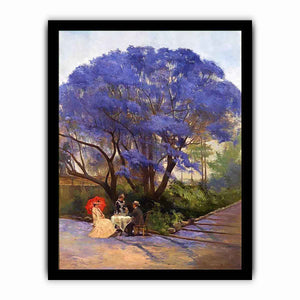
Under The Jacaranda by Godfrey Rivers
Go kalles this summer with this vintage navy and white striped v-neck t-shirt from the Nike. Perfect for pairing with denim and white kicks for a stylish kalles vibe.

Under The Jacaranda by Godfrey Rivers
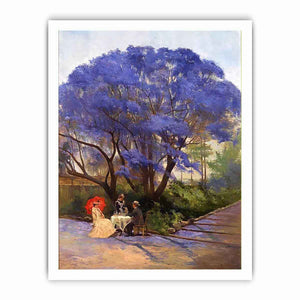
Under The Jacaranda Painting by Godfrey Rivers
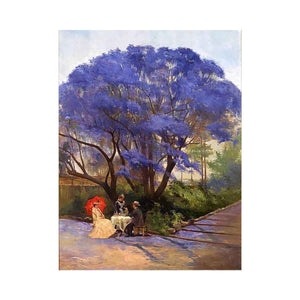
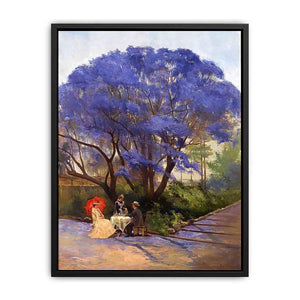
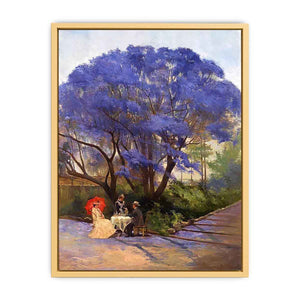
Under The Jacaranda Painting by Godfrey Rivers is a quietly resonant meditation on light, landscape, and colonial-era Australian identity, revealing an artist attuned to atmosphere rather than spectacle. Painted during a period when Australian art was still negotiating its visual language, the work reflects Rivers’ commitment to observation, restraint, and tonal harmony. Rather than dramatizing the landscape or idealizing rural life, Rivers presents a moment of stillness beneath the jacaranda tree, where human presence and environment coexist in calm equilibrium.
Godfrey Rivers was a foundational figure in Queensland’s early art history and an influential teacher whose legacy shaped generations of Australian artists. Trained in Europe yet deeply responsive to local conditions, Rivers approached painting with academic discipline softened by sensitivity to climate and light. Under The Jacaranda exemplifies this synthesis. It neither imitates European pastoral conventions nor asserts a nationalist bravura. Instead, it offers a reflective vision grounded in lived experience of place.
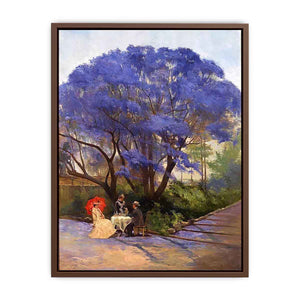
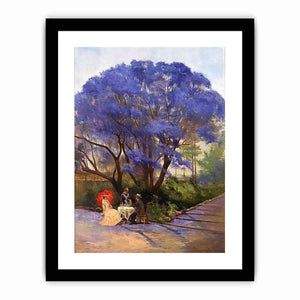
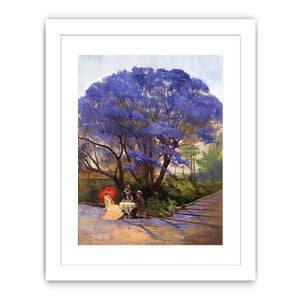
The subject centers on figures resting or gathered beneath the spreading canopy of a jacaranda tree, its branches filtering sunlight into dappled shade. The tree itself functions as both shelter and compositional anchor. Rivers does not treat it as a decorative motif, but as a living structure that shapes space and mood. The human figures remain secondary, integrated into the landscape rather than commanding it. Their presence suggests pause, conversation, or quiet contemplation, without narrative emphasis.
Compositionally, the painting is structured through balance and enclosure. The jacaranda’s broad canopy frames the upper portion of the canvas, while trunks and branches guide the eye downward toward the figures and ground plane. This vertical sheltering is countered by horizontal spreads of shadow and earth, creating a stable, grounded composition. The scene feels held rather than open, reinforcing the sense of refuge and intimacy.
Perspective is natural and unforced. Rivers avoids dramatic recession or exaggerated depth, allowing space to unfold gently through overlapping forms and tonal shifts. Foreground and middle ground are clearly articulated, yet they blend seamlessly into one another. The viewer is positioned at a respectful distance, invited to observe rather than enter. This compositional choice reinforces the painting’s contemplative tone.
Color is restrained and atmospheric. Rivers employs muted greens, earthy browns, soft violets, and warm highlights, all modulated to reflect filtered sunlight and shade. The jacaranda’s characteristic hue is suggested rather than emphasized, allowing harmony to take precedence over botanical specificity. Color serves to unify the scene, binding figures, foliage, and ground into a coherent whole.
Light is central to the painting’s emotional register. Sunlight does not strike directly; it diffuses through leaves, creating patterns of brightness and shadow that animate the surface without disrupting calm. Rivers uses light to articulate time and climate, evoking the warmth and stillness of an Australian afternoon. Illumination becomes experiential rather than descriptive, reinforcing the painting’s sense of lived presence.
Rivers’ brushwork is controlled yet responsive. Forms are clearly modeled, but edges remain soft, allowing transitions between light and shadow to feel natural. The paint surface does not assert itself aggressively; instead, it supports observation and atmosphere. This restraint reflects Rivers’ academic grounding while demonstrating his sensitivity to environment and mood.
Emotionally, Under The Jacaranda conveys repose and quiet connection. There is no urgency, no dramatic gesture. The figures appear settled, absorbed in the moment rather than in action. The mood is one of ease and attentiveness, suggesting the restorative power of shade and shared presence. Rivers presents leisure not as indulgence, but as necessary pause.
Psychologically, the painting reflects a colonial society learning to inhabit a new landscape. The jacaranda, itself an introduced species, becomes a symbol of adaptation and belonging. Rivers does not foreground this symbolism explicitly, yet it resonates subtly. Human figures find comfort beneath the tree, suggesting a tentative harmony between culture and environment.
Symbolically, the scene resists grand allegory. Its meaning arises from observation rather than intention. The painting does not assert a narrative of progress or conquest. Instead, it records a moment of coexistence—people and place meeting without dominance. This quietness distinguishes the work from more assertive colonial imagery of the period.
Within Rivers’ artistic development, Under The Jacaranda represents his mature engagement with Australian subject matter. While his early training emphasized European models, works like this demonstrate his responsiveness to local light, vegetation, and social rhythm. The painting reveals an artist increasingly confident in allowing environment to shape expression.
Culturally, the work occupies an important place in early Australian art, offering an alternative to heroic or pastoral mythologies. Rivers contributes a vision of domestic landscape—intimate, shaded, and human-scaled. This approach helped broaden the possibilities of Australian painting, paving the way for later artists to explore atmosphere and everyday experience.
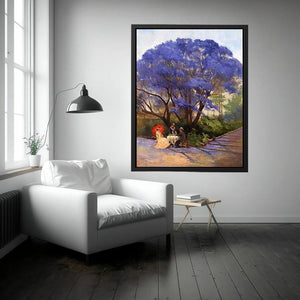
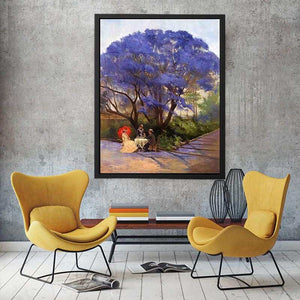
In contemporary interiors across the United States, the United Kingdom, Canada, Australia, and Europe, Under The Jacaranda offers gentle authority. In living rooms, it introduces warmth and calm. In studies and offices, it supports reflection and balance. In galleries and luxury residences, it signals appreciation for early regional works that combine academic discipline with environmental sensitivity.
The painting integrates naturally into traditional interiors, where its tonal harmony and figurative restraint resonate with classical taste. It also complements modern and minimalist spaces, where its softness and organic subject provide contrast to clean lines. In eclectic interiors, it acts as a unifying presence through shared atmosphere.
The long-term artistic importance of Under The Jacaranda lies in its affirmation that landscape painting can be intimate without being insular. Rivers demonstrates that attention to light, shade, and human presence can yield enduring meaning. The painting remains relevant because it values pause, observation, and coexistence over assertion.
Today, Under The Jacaranda continues to speak quietly yet persuasively. In a world often defined by acceleration and exposure, its shaded stillness feels restorative. Through measured composition, restrained color, and atmospheric light, Godfrey Rivers created a painting that endures as a reflection on place, presence, and the subtle poetry of shelter.
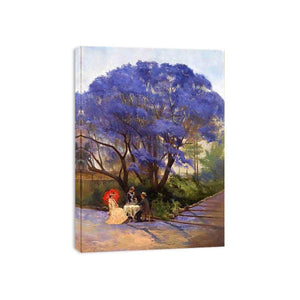
Buy museum qulaity 400- 450 canvas prints, framed prints, and 100% oil paintings of Under The Jacaranda by Godfrey Rivers at Alpha Art Gallery, where world-famous masterpieces are recreated with museum-quality detail, refined craftsmanship, and premium materials.
FAQS
What does Under The Jacaranda by Godfrey Rivers depict?
It depicts figures resting beneath a jacaranda tree, emphasizing shade, atmosphere, and quiet presence.
Why is this painting important in Australian art?
It reflects early efforts to interpret Australian light and landscape with sensitivity rather than spectacle.
Is the jacaranda tree symbolically significant?
While not explicit, it suggests adaptation and comfort within a cultivated landscape.
What mood does the painting convey?
It conveys calm, repose, and gentle human connection with nature.
Where does this artwork work best in interior spaces?
It suits living rooms, studies, offices, galleries, and refined residential interiors.
Is Under The Jacaranda suitable for modern décor?
Yes, its restrained palette and atmospheric tone integrate well into modern and minimalist spaces.
Does the painting have lasting artistic value?
It is valued for its role in shaping early Australian landscape painting and its enduring sense of place.
| 1. Select Type |
Canvas Print, Unframed Paper Print, Hand-Painted Oil Painting, Framed Paper Print |
|---|---|
| 2. Select Finish Option |
Rolled Canvas, Rolled- No Frame, Streched Canvas, Black Floating Frame, White Floating Frame, Brown Floating Frame, Black Frame with Matt, White Frame with Matt, Black Frame No Matt, White Frame No Matt, Streched, Natural Floating Frame, Champagne Floating Frame, Gold Floating Frame |
| 3. Select Size |
60cm X 90cm [24" x 36"], 76cm X 114cm [30" x 45"], 90cm X 120cm [36" x 48"], 100cm X 150cm [40" x 60"], 16.54 x 11.69"(A3), 23.39 x 16.54"(A2), 33.11 x 23.39"(A1), 46.81 x 31.11"(A0), 54" X 36", 50cm X 60cm [16" x 24"], 121cm X 182cm [48" x 72"], 135cm X 200cm [54" x 79"], 165cm x 205cm [65" x 81"], 183cm x 228cm [72" x 90"], 22cm X 30cm [9" x 12"], 30cm x 45Cm [12" x 18"], 45cm x60cm [16" x 24'], 75cm X 100cm [30" x 40"], 121cm x 193cm [48" x 76"], 45cm x 60cm [16" x 24'], 20cm x 25Cm [8" x 10"], 35cm x 50Cm [14" x 20"], 45cm x 60 cm [18" x 24"], 35cm x 53Cm [14" x 21"], 66cm X 101cm[26" x 40"], 76cm x 116cm [30"x 46"], 50cm X 60cm 16" x 24"] |