

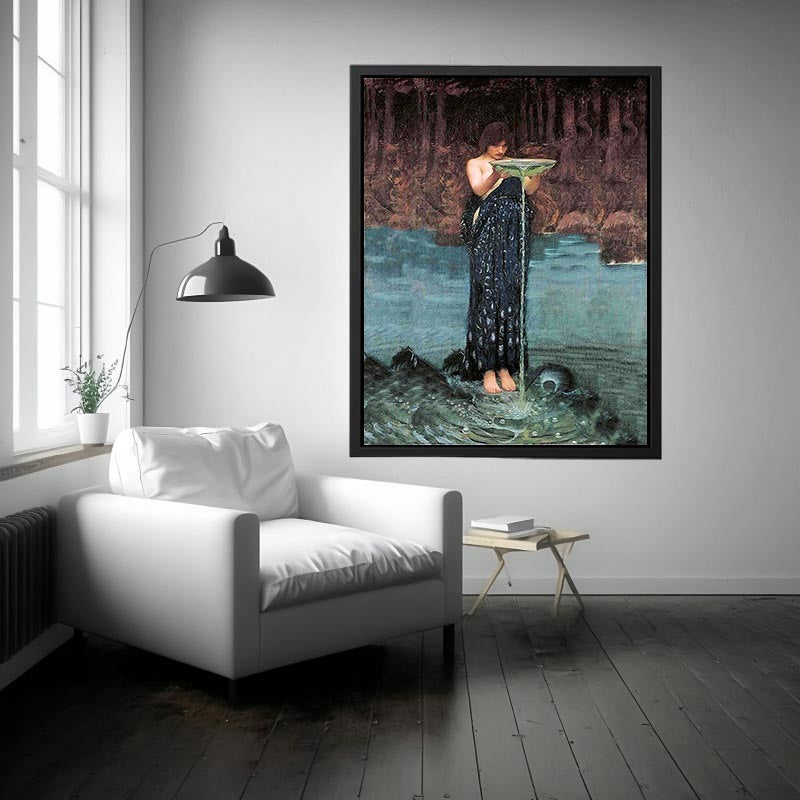




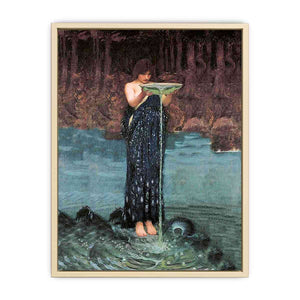


Circe Invidiosa 1892
Go kalles this summer with this vintage navy and white striped v-neck t-shirt from the Nike. Perfect for pairing with denim and white kicks for a stylish kalles vibe.

Circe Invidiosa 1892
Circe Invidiosa 1892 Painting by John William Waterhouse
Circe Invidiosa 1892 Painting by John William Waterhouse is one of the most psychologically severe and symbolically concentrated works of the artist’s career, a painting in which myth is transformed into a study of corrosive emotion and moral isolation. Painted in 1892, the work presents Circe not as a theatrical enchantress or romantic anti-heroine, but as a figure consumed by envy—an inward poison that reshapes both self and world. Waterhouse abandons narrative embellishment in favor of emotional intensity, creating an image that is austere, unsettling, and intellectually uncompromising.
At this point in his artistic development, John William Waterhouse was moving decisively beyond the ornamental richness often associated with Pre-Raphaelite mythological painting. While still deeply engaged with classical sources, he increasingly emphasized psychological states over narrative clarity. Circe Invidiosa exemplifies this shift. It does not recount a mythic episode in detail; it isolates a moral condition and renders it visible. The result is a painting that feels less like a story and more like an exposure.
The subject derives from Homeric mythology, in which Circe is a powerful sorceress known for transforming men into animals. In many artistic traditions, Circe is portrayed as seductive, alluring, or dangerously beautiful. Waterhouse’s interpretation is radically different. Here, Circe is defined not by sensuality but by bitterness. The title itself—Invidiosa, meaning envious—signals the painting’s central theme. This is Circe at the moment when jealousy curdles into malice, when emotion becomes act.
Compositionally, the painting is stark and vertical, dominated by Circe’s imposing figure as she descends a flight of steps. Her posture is rigid, controlled, and forward-moving, conveying determination rather than grace. She does not pause or hesitate. The architectural framing compresses the space, directing attention downward and inward. The composition denies expansiveness, reinforcing the claustrophobic nature of obsession.
Perspective places the viewer slightly below Circe’s eye level, intensifying her authority and menace. She looms rather than invites. The viewer is not seduced into the scene but confronted by it. This positional imbalance is deliberate. Waterhouse forces recognition of power without glamour, presence without empathy. Circe’s dominance is moral as well as physical, yet it is deeply unsettling.
Light in Circe Invidiosa is cold and unforgiving. There is no warmth, no atmospheric softness. Illumination isolates Circe’s pale form against the darker stone surroundings, sharpening her silhouette and heightening psychological severity. Light here functions as exposure rather than revelation. It reveals the hardness of intent without offering redemption or ambiguity.
The color palette is deliberately restricted. Cool greens, greys, and stone-like neutrals dominate the environment, creating a hostile, mineral atmosphere. Circe’s skin appears almost marble-like, drained of warmth and vitality. The poisonous green liquid she pours—a visual focal point—introduces a jarring chromatic accent, symbolizing envy made material. Color in this painting is not decorative; it is moral and chemical.
Waterhouse’s technique is precise and disciplined. Brushwork is controlled, surfaces smooth, and forms clearly articulated. There is little painterly softness. This restraint reinforces the painting’s emotional severity. The absence of lush texture or decorative detail denies visual pleasure, compelling the viewer to confront content rather than surface beauty. The painting’s power lies in its refusal to console.
The act depicted—Circe pouring poison into the water below—is both literal and symbolic. In myth, this poison transforms Scylla, Circe’s rival, into a monster. Waterhouse does not show the victim. Instead, he focuses entirely on the act of intention. The unseen consequence amplifies the painting’s psychological weight. What matters here is not transformation, but the decision to harm. Envy, once acted upon, becomes irreversible.
Psychologically, Circe is rendered with chilling clarity. Her expression is fixed, devoid of doubt or remorse. She does not look at the poison, nor at the viewer. Her gaze is directed forward, inwardly resolved. This absence of emotional conflict is the painting’s most disturbing feature. Waterhouse suggests that the true danger of envy lies not in passion, but in certainty.
Within Waterhouse’s broader oeuvre, Circe Invidiosa stands apart for its severity and moral focus. Unlike works such as Hylas and the Nymphs or The Lady of Shalott, which explore vulnerability and surrender, this painting confronts agency and responsibility. Circe is not a victim of fate or desire. She is the author of consequence. This ethical clarity gives the painting its enduring force.
Culturally, the painting reflects late nineteenth-century anxieties about power, emotion, and the destructive potential of the inner life. As psychological inquiry gained prominence, artists increasingly explored states such as jealousy, obsession, and alienation. Circe Invidiosa anticipates modern psychological realism, presenting emotion not as decoration but as motive force.
In contemporary interiors across the United States, the United Kingdom, Canada, Australia, and Europe, Circe Invidiosa commands exceptional presence. In studies and offices, it conveys intellectual rigor, moral seriousness, and psychological depth. In galleries and refined private residences, it anchors space with stark authority, integrating powerfully with traditional, modern, minimalist, and eclectic décor through its controlled palette and commanding composition.
The painting remains profoundly relevant today because it addresses a timeless human failing: the transformation of inner resentment into outward harm. In an era still shaped by rivalry, grievance, and moral certainty, Waterhouse’s vision feels uncomfortably current. Circe Invidiosa does not soften its message. It insists that emotion carries responsibility.
Circe Invidiosa 1892 Painting by John William Waterhouse endures as one of the most uncompromising psychological images of its time. Through compositional severity, symbolic precision, and moral clarity, Waterhouse transformed a classical sorceress into a timeless study of envy’s destructive power. The painting does not enchant. It exposes.
Buy museum qulaity 400- 450 canvas prints, framed prints, and 100% oil paintings of Circe Invidiosa by John William Waterhouse at Alpha Art Gallery, where world-famous masterpieces are recreated with museum-quality detail, refined craftsmanship, and premium materials.
FAQs
What does Circe Invidiosa depict?
It depicts Circe pouring a poisonous substance into the water, an act driven by envy rather than seduction or desire.
How does this painting differ from other depictions of Circe?
Waterhouse presents Circe as severe and psychologically rigid, avoiding romantic or sensual interpretations.
What does the green poison symbolize?
It symbolizes envy made material—emotion transformed into irreversible action.
Why is Scylla not shown in the painting?
By omitting the victim, Waterhouse emphasizes intention and moral responsibility rather than spectacle.
How does the composition contribute to the painting’s mood?
The compressed space and descending movement reinforce inevitability and emotional severity.
Is this painting connected to Symbolism?
Yes, it reflects Symbolist concerns with inner states, moral psychology, and emotional consequence.
Why does Circe Invidiosa remain relevant today?
Its exploration of envy and responsibility resonates strongly in modern ethical and psychological contexts.
Where does this artwork work best in interiors?
It is best suited to studies, offices, galleries, and serious private collections.
| 1. Select Type |
Canvas Print, Unframed Paper Print, Hand-Painted Oil Painting, Framed Paper Print |
|---|---|
| 2. Select Finish Option |
Rolled Canvas, Rolled- No Frame, Streched Canvas, Black Floating Frame, White Floating Frame, Brown Floating Frame, Black Frame with Matt, White Frame with Matt, Black Frame No Matt, White Frame No Matt, Streched, Natural Floating Frame, Champagne Floating Frame, Gold Floating Frame |
| 3. Select Size |
60cm X 90cm [24" x 36"], 76cm X 114cm [30" x 45"], 90cm X 120cm [36" x 48"], 100cm X 150cm [40" x 60"], 16.54 x 11.69"(A3), 23.39 x 16.54"(A2), 33.11 x 23.39"(A1), 46.81 x 31.11"(A0), 54" X 36", 50cm X 60cm [16" x 24"], 121cm X 182cm [48" x 72"], 135cm X 200cm [54" x 79"], 165cm x 205cm [65" x 81"], 183cm x 228cm [72" x 90"], 22cm X 30cm [9" x 12"], 30cm x 45Cm [12" x 18"], 45cm x60cm [16" x 24'], 75cm X 100cm [30" x 40"], 121cm x 193cm [48" x 76"], 45cm x 60cm [16" x 24'], 20cm x 25Cm [8" x 10"], 35cm x 50Cm [14" x 20"], 45cm x 60 cm [18" x 24"], 35cm x 53Cm [14" x 21"], 66cm X 101cm[26" x 40"], 76cm x 116cm [30"x 46"], 50cm X 60cm 16" x 24"] |