





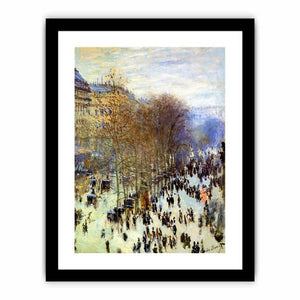


Boulevard des Capucines 3
Go kalles this summer with this vintage navy and white striped v-neck t-shirt from the Nike. Perfect for pairing with denim and white kicks for a stylish kalles vibe.

Boulevard des Capucines 3
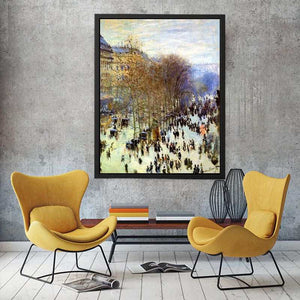
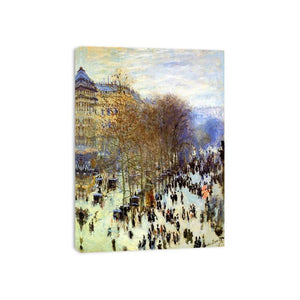
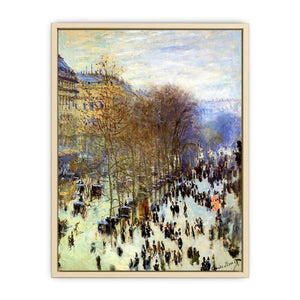
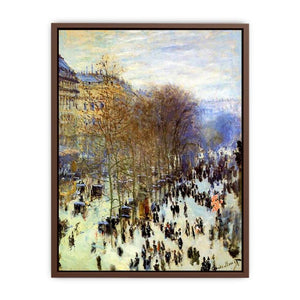
Boulevard des Capucines 3 Painting by Claude Monet
Boulevard des Capucines stands as one of Claude Monet’s most decisive engagements with the modern city, a painting in which movement, anonymity, and perceptual flux are elevated to the status of serious artistic inquiry. Painted in the early 1870s, during the formative years of Impressionism, the work captures a Parisian boulevard not as an architectural entity or social theatre, but as a living system of motion, light, and collective presence. In this painting, Monet does not describe the city; he experiences it, translating the tempo of modern life into a surface alive with rhythm and vibration.
The Boulevard des Capucines itself was emblematic of Haussmann’s transformed Paris—a space defined by width, circulation, and visibility. It was designed to be seen and traversed, a conduit for crowds, carriages, and commerce. Monet approached this environment without nostalgia or moral framing. Rather than isolating individual figures or emphasising urban landmarks, he allowed the boulevard’s essential character—its flow—to dictate the structure of the painting. What emerges is not a portrait of Paris, but a perceptual register of modernity in motion.
The composition is elevated, as though viewed from an upper window or balcony, placing the observer above the street rather than within it. This vantage point dissolves individual identity. Pedestrians below are reduced to animated marks, their forms abbreviated and transient. The boulevard stretches horizontally across the canvas, its breadth emphasised through repetition and density rather than linear depth. Monet avoids a fixed focal point, allowing the eye to move continuously across the surface, mirroring the ceaseless movement of the crowd itself.
Perspective is deliberately unstable. While the street recedes into the distance, it does so without architectural precision. Monet is uninterested in exact spatial mapping. Instead, depth is suggested through tonal shifts and diminishing contrast, allowing the far end of the boulevard to soften into atmosphere. Trees lining the street punctuate the composition vertically, their dark trunks anchoring the scene while their branches dissolve into lighter passages above. Space is felt as vibration rather than construction.
Light operates as the painting’s organising force. Sunlight filters through winter air, catching on hats, coats, carriage roofs, and bare branches. Monet does not depict light as illumination falling upon objects; he renders it as a condition that fragments them. Forms are broken apart by reflection and movement, their boundaries softened by atmosphere. The boulevard exists within a single luminous field, where clarity gives way to sensation.
Colour is restrained yet highly responsive. Greys, blacks, muted blues, and soft ochres dominate the palette, reflecting the wintery urban environment. Within this limited range, Monet achieves extraordinary variation. Cool tones suggest distance and shadow, while warmer notes emerge where light strikes more directly. Colour is never fixed; it shifts continuously across the surface, reinforcing the sense of impermanence that defines the scene. The city appears not as solid mass, but as chromatic movement.
Monet’s brushwork is openly assertive and radical. Short, rapid strokes and dashes articulate the crowd below, refusing descriptive detail in favour of immediacy. Figures are not drawn; they are implied. This technique was deeply unsettling to contemporary viewers, who saw in it a rejection of finish and clarity. Yet it is precisely this handling that allows the painting to convey the sensation of urban life as it is perceived—fragmentary, fleeting, and collective. The surface records speed and simultaneity rather than stability.
Symbolically, Boulevard des Capucines resists interpretation. The crowd is not heroic, threatening, or celebratory. It simply exists. Monet offers no narrative, no social critique, no moral lens. The painting’s meaning resides in its refusal to isolate or explain. Modern life is presented as a field of impressions, experienced rather than analysed. In this sense, anonymity itself becomes the subject, marking a decisive break from earlier traditions of portraiture and genre painting.
Emotionally, the work conveys energy without drama. There is vitality and density, yet no single event draws attention. The mood is animated but neutral, reflecting the everyday pulse of the city rather than exceptional occurrence. Viewers often experience the painting as immersive and kinetic, its surface encouraging movement of the eye rather than contemplation of form. It captures not excitement or anxiety, but the steady momentum of urban existence.
Within Monet’s artistic evolution, Boulevard des Capucines occupies a foundational position. It exemplifies the Impressionist commitment to painting contemporary life as it is seen, not as it is structured by convention. Alongside works by Edgar Degas and Camille Pissarro, this painting helped redefine the city as a legitimate subject for serious art. Monet’s contribution lies in his refusal to dramatise or moralise. He allowed perception itself to shape the image, trusting sensation as artistic truth.
Culturally, the painting represents a profound shift in visual consciousness. It aligns art with the conditions of modernity—speed, density, and collective anonymity. In doing so, it anticipates later developments in modern art that would further dismantle narrative, hierarchy, and individual focus. Boulevard des Capucines does not celebrate the city, nor does it condemn it. It observes, registering the city as a phenomenon of movement and light.
In contemporary interiors, Boulevard des Capucines integrates with exceptional relevance and authority. In living rooms, it introduces movement and intellectual vitality without decorative excess. In offices and studies, it communicates cultural literacy and modern awareness, offering visual stimulation without distraction. In galleries and luxury residences across the United States, United Kingdom, Canada, Australia, and Europe, the painting complements modern, minimalist, and urban-inspired décor with particular strength. Its restrained palette harmonises with contemporary interiors, while its dynamic surface brings energy and depth.
The enduring relevance of Boulevard des Capucines lies in its recognition that modern life cannot be reduced to stable forms or singular narratives. Monet demonstrates that painting can register complexity without explanation, movement without chaos, and presence without permanence. The work endures not because it depicts a famous street, but because it captures a way of seeing that remains essential in any age shaped by crowds, motion, and shared space. In Boulevard des Capucines, Monet did not merely paint the modern city—he articulated its visual logic, creating an image that continues to resonate with the rhythms of contemporary life.
Buy museum qulaity 400- 450 canvas prints, framed prints, and 100% oil paintings of Boulevard des Capucines 3 by Claude Monet at Alpha Art Gallery, where world-famous masterpieces are recreated with museum-quality detail, refined craftsmanship, and premium materials.
FAQS
What does Boulevard des Capucines by Claude Monet depict?
It depicts a busy Parisian boulevard viewed from above, rendered as a field of movement, light, and collective presence.
Why is this painting considered important in Impressionism?
It exemplifies the Impressionist focus on modern life, perceptual immediacy, and visible brushwork.
Why are the figures painted so indistinctly?
Monet emphasises collective motion and anonymity rather than individual identity.
How does Monet convey movement in the scene?
Through rapid, broken brushstrokes and fragmented forms that suggest constant motion.
Is the painting narrative or symbolic?
No, it avoids narrative and symbolism, allowing meaning to arise through perception alone.
What role does light play in the composition?
Light fragments forms and unifies the scene into a single atmospheric condition.
Is Boulevard des Capucines suitable for contemporary interiors?
Yes, its urban energy and restrained palette integrate well into modern and minimalist spaces.
Why does Boulevard des Capucines remain relevant today?
Its portrayal of crowds, motion, and anonymity continues to reflect the realities of modern urban life.
| 1. Select Type |
Canvas Print, Unframed Paper Print, Hand-Painted Oil Painting, Framed Paper Print |
|---|---|
| 2. Select Finish Option |
Rolled Canvas, Rolled- No Frame, Streched Canvas, Black Floating Frame, White Floating Frame, Brown Floating Frame, Black Frame with Matt, White Frame with Matt, Black Frame No Matt, White Frame No Matt, Streched, Natural Floating Frame, Champagne Floating Frame, Gold Floating Frame |
| 3. Select Size |
60cm X 90cm [24" x 36"], 76cm X 114cm [30" x 45"], 90cm X 120cm [36" x 48"], 100cm X 150cm [40" x 60"], 16.54 x 11.69"(A3), 23.39 x 16.54"(A2), 33.11 x 23.39"(A1), 46.81 x 31.11"(A0), 54" X 36", 50cm X 60cm [16" x 24"], 121cm X 182cm [48" x 72"], 135cm X 200cm [54" x 79"], 165cm x 205cm [65" x 81"], 183cm x 228cm [72" x 90"], 22cm X 30cm [9" x 12"], 30cm x 45Cm [12" x 18"], 45cm x60cm [16" x 24'], 75cm X 100cm [30" x 40"], 121cm x 193cm [48" x 76"], 45cm x 60cm [16" x 24'], 20cm x 25Cm [8" x 10"], 35cm x 50Cm [14" x 20"], 45cm x 60 cm [18" x 24"], 35cm x 53Cm [14" x 21"], 66cm X 101cm[26" x 40"], 76cm x 116cm [30"x 46"], 50cm X 60cm 16" x 24"] |