


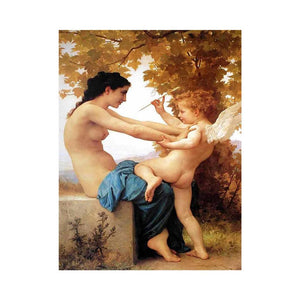


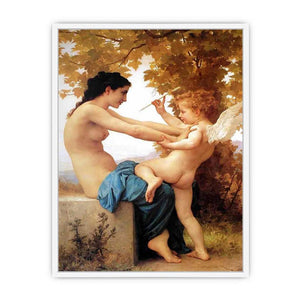




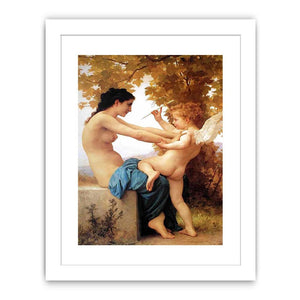


Young Girl Defending Herself against Eros 1880
Go kalles this summer with this vintage navy and white striped v-neck t-shirt from the Nike. Perfect for pairing with denim and white kicks for a stylish kalles vibe.

Young Girl Defending Herself against Eros 1880
Young Girl Defending Herself against Eros 1880 Painting by William Adolphe Bouguereau
Young Girl Defending Herself against Eros stands as one of William Adolphe Bouguereau’s most psychologically nuanced and intellectually subtle mythological works, a painting in which academic perfection, classical narrative, and moral ambiguity are held in deliberate balance. Painted in 1880, during Bouguereau’s mature period, the work reflects an artist fully confident in his technical authority and increasingly interested in the complexities of human emotion rather than overt theatricality. Rather than presenting myth as spectacle or allegory, Bouguereau transforms it into a quiet confrontation between innocence and awakening desire, rendered with restraint that deepens its meaning.
Bouguereau’s engagement with classical mythology was always shaped by his conviction that ancient stories could illuminate timeless human experiences. In Young Girl Defending Herself against Eros, he turns to the figure of Eros not as a triumphant god of love, but as a gentle yet persistent presence testing the boundaries of youth and self-awareness. The painting does not depict conquest or surrender. Instead, it focuses on resistance itself, elevating a fleeting psychological moment into a subject of lasting contemplation.
The composition is carefully calibrated to convey intimacy without intrusion. The young girl occupies the central space, her body angled slightly away from Eros, her posture poised between defensiveness and curiosity. Bouguereau avoids exaggerated gesture. Her resistance is expressed through subtle tension rather than force, through the positioning of limbs and the inclination of her torso. This restraint reinforces the painting’s emotional intelligence. The moment is not dramatic; it is internal.
Eros is rendered with characteristic softness and control. Bouguereau avoids portraying him as domineering or threatening. His wings, delicately modelled, suggest lightness rather than power. His expression and movement convey insistence without aggression. By softening Eros’s presence, Bouguereau complicates the narrative. Desire is not depicted as violence or domination, but as an inevitable and gentle pressure, testing resolve rather than overwhelming it.
The young girl’s figure is idealised with Bouguereau’s renowned anatomical precision. Her form is rendered with luminous smoothness, yet her youth is conveyed through softness rather than eroticisation. Bouguereau walks a careful line, presenting beauty without indulgence. Innocence here is not naïve fragility, but self-possession. The girl’s resistance carries moral weight precisely because it is calm and deliberate.
Light plays a crucial role in shaping the painting’s tone. Bouguereau employs a soft, diffused illumination that caresses the figures without theatrical contrast. There are no harsh shadows, no dramatic chiaroscuro. Light unifies the scene, allowing flesh, wing, and surrounding space to exist within the same gentle atmosphere. This treatment removes any sense of conflict or urgency, reinforcing the painting’s contemplative nature.
Colour is restrained and harmonised with exceptional care. Bouguereau relies on warm flesh tones, muted whites, and subtle earth hues, avoiding strong saturation. The palette supports the painting’s psychological balance. Nothing distracts from the central exchange between the figures. Colour functions not to excite, but to clarify, guiding the viewer toward emotional nuance rather than visual drama.
Bouguereau’s surface treatment is characteristically smooth, with brushwork virtually invisible. This polished finish was central to his artistic philosophy. By eliminating signs of process, he allowed form and meaning to appear inevitable rather than constructed. In Young Girl Defending Herself against Eros, this smoothness enhances the sense of timelessness, removing the scene from any specific historical moment and placing it within a universal psychological space.
Symbolically, the painting operates with great subtlety. Eros represents desire, awakening emotion, and the inevitability of change, while the girl embodies self-awareness and moral restraint. Yet Bouguereau avoids heavy-handed allegory. There are no overt attributes, no narrative resolution. The painting captures a moment of tension rather than outcome, inviting the viewer to reflect on the nature of innocence not as ignorance, but as conscious choice.
Emotionally, the work is composed and reflective. There is no triumph, no defeat. Bouguereau presents resistance itself as meaningful, suggesting that moral and emotional development unfolds through moments of quiet decision rather than dramatic transformation. This emotional restraint distinguishes the painting from more sensational mythological works of the period and underscores Bouguereau’s intellectual seriousness.
Within Bouguereau’s broader oeuvre, Young Girl Defending Herself against Eros occupies an important position among his mythological subjects. Unlike grand scenes drawn from epic or divine judgment, this work turns inward, focusing on private experience. It demonstrates Bouguereau’s belief that classical myth could serve as a mirror for inner life rather than as distant narrative.
The painting’s relevance today remains pronounced. Contemporary viewers across the United States, the United Kingdom, Canada, Australia, and Europe continue to respond to its nuanced exploration of agency, innocence, and desire. In an age often inclined toward extremes of representation, the painting’s restraint feels especially resonant. It respects complexity without forcing conclusion.
In interior settings, Young Girl Defending Herself against Eros introduces quiet tension and intellectual depth. In living rooms, it invites conversation grounded in reflection rather than spectacle. In studies and offices, it reinforces themes of self-awareness, discipline, and moral clarity. In galleries and luxury residences, it signals refined engagement with classical art interpreted through psychological subtlety.
The painting integrates seamlessly into traditional, modern, minimalist, and eclectic décor. Traditional interiors resonate with its academic finish and mythological subject. Modern spaces benefit from its compositional clarity and emotional restraint. Minimalist environments find contrast in its figurative presence without visual excess, while eclectic interiors draw cohesion from its balanced structure.
The enduring importance of Young Girl Defending Herself against Eros lies in its refusal to resolve the tension it presents. Bouguereau does not tell the viewer what happens next. He honours the moment of resistance itself, recognising it as a formative human experience. The painting endures because it acknowledges desire without surrendering to it, innocence without idealising it into fragility.
To live with Young Girl Defending Herself against Eros is to engage daily with one of Bouguereau’s most thoughtful and psychologically refined works. Through its flawless technique, balanced composition, and emotional intelligence, the painting continues to affirm that classical art can address modern concerns with clarity and grace. It stands as a testament to Bouguereau’s belief that beauty, when guided by restraint and insight, remains endlessly relevant.
Buy museum qulaity 400- 450 canvas prints, framed prints, and 100% oil paintings of Young Girl Defending Herself against Eros by William Adolphe Bouguereau at Alpha Art Gallery, where world-famous masterpieces are recreated with museum-quality detail, refined craftsmanship, and premium materials.
FAQS
What mythological theme does Young Girl Defending Herself against Eros explore?
It explores the tension between innocence and desire, using Eros as a symbol of awakening emotion rather than domination.
Why is the girl’s resistance central to the painting’s meaning?
Bouguereau presents resistance as conscious self-awareness, emphasising moral choice rather than conflict or submission.
How does Bouguereau avoid sensationalism in this work?
Through restrained gesture, softened light, and a calm emotional register that prioritises psychology over drama.
What role does Eros play in the composition?
Eros functions as a gentle, persistent presence, symbolising desire as an inevitable yet negotiable force.
Is this painting suitable for contemporary interiors?
Yes. Its balanced composition and intellectual subtlety integrate beautifully into both traditional and modern spaces.
What emotional atmosphere does the painting convey?
It conveys quiet tension, reflection, and self-possession rather than excitement or conflict.
Does this artwork have lasting cultural significance?
As a psychologically refined mythological work, it holds enduring artistic and philosophical value.
Where is the best place to display this painting?
It is especially well suited to living rooms, studies, galleries, and spaces intended for thoughtful engagement.
| 1. Select Type |
Canvas Print, Unframed Paper Print, Hand-Painted Oil Painting, Framed Paper Print |
|---|---|
| 2. Select Finish Option |
Rolled Canvas, Rolled- No Frame, Streched Canvas, Black Floating Frame, White Floating Frame, Brown Floating Frame, Black Frame with Matt, White Frame with Matt, Black Frame No Matt, White Frame No Matt, Streched, Natural Floating Frame, Champagne Floating Frame, Gold Floating Frame |
| 3. Select Size |
60cm X 90cm [24" x 36"], 76cm X 114cm [30" x 45"], 90cm X 120cm [36" x 48"], 100cm X 150cm [40" x 60"], 16.54 x 11.69"(A3), 23.39 x 16.54"(A2), 33.11 x 23.39"(A1), 46.81 x 31.11"(A0), 54" X 36", 50cm X 60cm [16" x 24"], 121cm X 182cm [48" x 72"], 135cm X 200cm [54" x 79"], 165cm x 205cm [65" x 81"], 183cm x 228cm [72" x 90"], 22cm X 30cm [9" x 12"], 30cm x 45Cm [12" x 18"], 45cm x60cm [16" x 24'], 75cm X 100cm [30" x 40"], 121cm x 193cm [48" x 76"], 45cm x 60cm [16" x 24'], 20cm x 25Cm [8" x 10"], 35cm x 50Cm [14" x 20"], 45cm x 60 cm [18" x 24"], 35cm x 53Cm [14" x 21"], 66cm X 101cm[26" x 40"], 76cm x 116cm [30"x 46"], 50cm X 60cm 16" x 24"] |