







Wild flower - By Van Gogh
Go kalles this summer with this vintage navy and white striped v-neck t-shirt from the Nike. Perfect for pairing with denim and white kicks for a stylish kalles vibe.

Wild flower - By Van Gogh
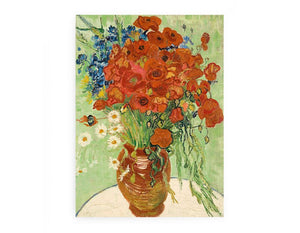
Wild Flower by Van Gogh reproduces Vincent van Gogh’s 1890 floral still life commonly titled Still Life: Vase with Daisies and Poppies. Van Gogh painted the work in June 1890 at Auvers-sur-Oise, France, during the final weeks of his career. The historic oil-on-canvas painting, catalogued as F 280, is privately owned rather than held by a public museum. Alpha Art Gallery offers reproductions as museum-quality canvas prints, fine art prints, framed prints and 100% hand-painted oil painting reproductions.
About Wild Flower by Vincent van Gogh
The artwork sold by Alpha Art Gallery under the title Wild Flower corresponds to Vincent van Gogh’s Still Life: Vase with Daisies and Poppies, also described historically under titles including Flowers of the Fields, Poppies and Still Life: Red Poppies and Daisies. These changing titles reflect the painting’s long exhibition and publication history rather than different paintings. Its catalogue number, F 280, provides a particularly useful way to distinguish it from other Van Gogh flower still lifes with similar names.
Van Gogh painted the composition in June 1890 at Auvers-sur-Oise, a village north-west of Paris where he spent the final months of his life. Van Gogh Worldwide records the work as an oil painting measuring approximately 65 × 50 cm and lists it as privately owned. The painting therefore cannot currently be visited as part of a permanent public museum collection.
The still life presents a generous bouquet dominated by vivid poppies and pale daisies, joined by other field flowers and vegetation. They emerge from a substantial earthenware vase set near the curved edge of a tabletop. Rather than arranging the bouquet into a perfectly symmetrical decorative pattern, Van Gogh allows stems, blossoms and leaves to push outward in different directions, giving the composition a feeling of abundance and movement.
A Flower Painting From Van Gogh’s Final Months
Van Gogh arrived in Auvers-sur-Oise in May 1890 after leaving Saint-Rémy-de-Provence. He rented a room at the Auberge Ravoux and worked with extraordinary intensity in the surrounding village and countryside. During this short period he painted landscapes, gardens, portraits and still lifes, including some of the works now most closely associated with the closing chapter of his career.
Still Life: Vase with Daisies and Poppies was painted in mid-June, only weeks after his arrival. Research associated with the painting places its creation at the home of Dr Paul Gachet, the physician who treated Van Gogh at Auvers and who was himself interested in art. Gachet’s home contained paintings, antiques and objects that could be used for still-life arrangements, giving Van Gogh another place to work when he was not painting outdoors.
This setting is important because the vase is not simply a neutral container. The rounded earthenware vessel and the curved tabletop help structure the entire composition. The compact solidity of the vase anchors an arrangement that becomes progressively freer and more energetic as the eye moves upward through the flowers.
What Flowers Appear in the Painting?
The bouquet is principally recognized for its brilliant poppies and white daisies. Contemporary catalogue research also identifies cornflowers and other plants gathered from the fields around Auvers. Van Gogh was surrounded by the vegetation of the northern French countryside, and wild plants repeatedly entered both his landscapes and still lifes during this period.
The flower types also create strong contrasts in shape. Broad poppy petals provide dramatic masses within the bouquet, while the smaller daisies form lighter clusters. Slender stems and irregular foliage link the blossoms to the vase, creating a composition that rewards close viewing rather than reading simply as one block of flowers.
Composition, Brushwork and Visual Energy
One of the most distinctive features of this Van Gogh flower painting is the relationship between stability and movement. The vase sits firmly near the lower centre of the composition, but the bouquet above it expands outward. Flowers overlap one another, stems bend, and smaller blossoms appear around the edges. The arrangement feels full without becoming rigid.
Van Gogh’s visible brushwork is equally important to the effect. The painting does not attempt to conceal the physical application of oil paint. Marks describing petals, foliage, vase and background remain perceptible, allowing the surface itself to contribute to the visual experience. This quality is characteristic of the increasingly direct and expressive handling associated with his mature work.
The background is comparatively simple, helping the bouquet carry most of the visual activity. The table’s curved boundary then introduces another strong shape near the bottom of the canvas. As an interior artwork, this combination of a concentrated central bouquet and vertical format makes the image visually effective even when viewed from across a room.
Post-Impressionism and Van Gogh’s Mature Style
Vincent van Gogh is one of the central artists associated with Post-Impressionism. The term describes artists who developed ideas arising from Impressionism while moving toward more individual approaches to colour, structure, brushwork and expression.
In this still life, Van Gogh remains attentive to recognizable flowers and objects, yet natural description is only part of the experience. Brushmarks, contours, contrasts and the compressed arrangement of the bouquet make the painting distinctly personal. The result is neither a conventional botanical illustration nor an academically polished flower arrangement. It is a still life in which the act of painting remains visibly present.
Visitors interested in comparing this work with other celebrated artworks from art history can see how Van Gogh transformed familiar nineteenth-century subjects through a highly individual approach to paint and composition.
The Connection to Dr Paul Gachet
Research into the painting’s provenance gives it an especially interesting relationship with Dr Paul Gachet. Sotheby’s documented Gachet as its probable earliest owner and identified his house as the location where Van Gogh painted the composition.
Van Gogh’s correspondence from this period also shows that he considered making paintings for Gachet in recognition of the physician’s assistance. The precise circumstances by which this particular still life entered Gachet’s possession are not completely certain, so it is more accurate to describe the painting as possibly given or exchanged rather than claiming a documented conventional sale.
This early history makes Vase with Daisies and Poppies unusual within Van Gogh’s career. It appears to have passed from the artist into private ownership during his lifetime before eventually moving through a succession of European and American collections.
A Remarkable Exhibition and Collecting History
The painting later developed an important public history despite remaining largely a privately owned work. During the twentieth century it appeared in major exhibitions and was shown for decades at the Albright-Knox Art Gallery in Buffalo. It was also included in significant Van Gogh exhibitions and early presentations of modern European art in the United States.
In November 2014, Still Life: Vase with Daisies and Poppies appeared at Sotheby’s New York and sold for approximately US$61.8 million. The result brought renewed international attention to a flower painting that had historically been less universally recognized than Sunflowers, Irises or The Starry Night.
The original artwork remains privately held rather than belonging to a museum. Alpha Art Gallery’s product is a reproduction of the historical painting and should not be confused with the privately owned original.
Historical Artwork Details
| Artist | Vincent van Gogh |
|---|---|
| Common title | Still Life: Vase with Daisies and Poppies |
| Alpha Art Gallery title | Wild Flower by Van Gogh |
| Catalogue number | F 280 |
| Date | June 1890 |
| Created in | Auvers-sur-Oise, France |
| Original medium | Oil on canvas |
| Original dimensions | Approximately 65 × 50 cm |
| Genre | Floral still life |
| Movement | Post-Impressionism |
| Current status | Private collection |
Choose Your Wild Flower by Van Gogh Reproduction
The upright composition and dense arrangement of flowers make this painting particularly adaptable to wall display. Alpha Art Gallery offers several reproduction formats so buyers can choose between a printed interpretation and an individually painted version with physical brushwork.
| Format | Visual Character | Ideal For |
|---|---|---|
| Canvas Print | Textured canvas presentation with strong decorative presence | Statement wall art and buyers who like the appearance of artwork on canvas |
| Fine Art Print | Detailed traditional printed presentation | Collectors who prefer an art-print format |
| Framed Print | A finished presentation with a defined border around the composition | Living rooms, bedrooms, offices and formal interiors |
| Hand-Painted Oil Reproduction | Real oil paint, visible brushwork and individually created surface variation | Buyers who value the physical character of a painted artwork |
Museum-Quality Canvas Print
Alpha Art Gallery uses 400–450 GSM museum-quality canvas for its canvas prints. For this particular artwork, canvas helps give the large bouquet a substantial visual presence while preserving the painting’s tall proportions. Multiple sizes make it possible to use the composition as either focused wall art or a larger decorative feature.
Fine Art and Framed Prints
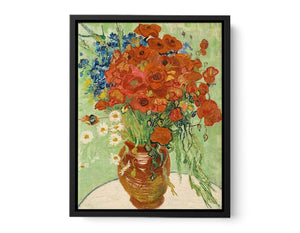
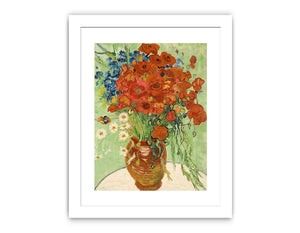
A fine art print emphasizes the complete image in a refined printed format. A framed print adds a clear visual boundary around the energetic bouquet, which can be particularly effective with this composition because the flowers already extend vigorously toward the edges of the image. Frame options are available where applicable.
100% Hand-Painted Oil Painting Reproduction
A hand-painted version offers a fundamentally different surface experience. Alpha Art Gallery’s hand-painted oil painting reproductions are individually painted by professional artists using oil on canvas. Real brushwork, painted texture and subtle variations are therefore inherent in each piece.
This format is particularly relevant to Van Gogh because the visible application of paint is such an important part of his visual language. A hand-painted reproduction cannot become the historical original, but it can introduce actual painted texture and handmade character that a printed surface does not reproduce physically.
Where Does This Van Gogh Flower Painting Work as Wall Art?
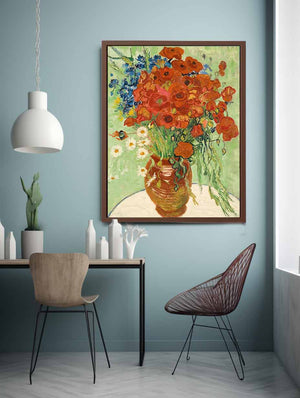
The painting’s vertical orientation makes it useful for spaces where a tall composition fits better than a wide landscape. It can work above a console, between windows, beside shelving, over a smaller piece of furniture or as part of a larger art arrangement.
In a living room, a larger canvas or hand-painted reproduction can turn the concentrated bouquet into a strong focal point. In a bedroom, study or home office, a framed or fine art print offers a more contained presentation. The recognisable flower subject also allows the work to sit comfortably in traditional interiors, while Van Gogh’s vigorous surface and unconventional handling can provide contrast in contemporary spaces.
When choosing a size, measure the actual wall and consider nearby furniture. A larger reproduction reveals more of the relationship among individual flowers, stems and brushmarks, while a smaller format emphasizes the bouquet as a single decorative form.
Where Can I Buy a Reproduction of Van Gogh’s Vase with Daisies and Poppies?
Alpha Art Gallery offers reproductions of Still Life: Vase with Daisies and Poppies, sold here as Wild Flower by Van Gogh, in canvas, fine art print, framed print and 100% hand-painted oil painting formats. Multiple sizes and framing choices are available where applicable.
Orders are securely packaged, and Alpha Art Gallery provides free worldwide shipping on all orders. Production facilities in the USA, Australia, United Kingdom and Canada support worldwide fulfilment.
Why Choose Alpha Art Gallery?
- Choice of reproduction formats: select canvas, fine art, framed or individually hand-painted artwork.
- 400–450 GSM canvas: available for a substantial canvas presentation.
- Hand-painted option: professional artists individually paint oil reproductions on canvas.
- Multiple sizes: choose a scale suited to your available wall space.
- Frame options: multiple presentation choices are available where applicable.
- Secure packaging: artwork is prepared carefully for delivery.
- Free worldwide shipping: included with every order.
Frequently Asked Questions
What is the real title of Wild Flower by Van Gogh?
The artwork is commonly identified as Still Life: Vase with Daisies and Poppies. It has appeared under several historical titles, including Poppies, Flowers of the Fields and Still Life: Red Poppies and Daisies. The catalogue number F 280 helps identify the specific painting regardless of title variation.
When did Van Gogh paint Vase with Daisies and Poppies?
Vincent van Gogh painted the work in June 1890 at Auvers-sur-Oise, France. It belongs to the extraordinarily productive final period of his career, after he had left Saint-Rémy and moved north to be closer to his brother Theo and to receive care from Dr Paul Gachet.
What does the painting depict?
The painting depicts an abundant arrangement of field flowers in an earthenware vase. Red poppies and pale daisies dominate the bouquet, with cornflowers and other vegetation adding variety. The flowers rise above a rounded tabletop, producing a dense vertical composition filled with overlapping stems, blossoms and foliage.
Where is the original Wild Flower painting by Van Gogh?
The original is in a private collection rather than a public museum. Van Gogh Worldwide currently categorizes the owner as private collections. Because it is privately held, visitors should not expect the historic painting to be permanently accessible in a museum. Alpha Art Gallery sells reproductions, not the original artwork.
Did Dr Paul Gachet own this Van Gogh painting?
Dr Paul Gachet is recorded as the probable earliest owner. Sotheby’s research places the painting’s creation at Gachet’s home and suggests that Van Gogh may have given or exchanged the work in connection with Gachet’s assistance. The exact circumstances are not fully documented, so this should not be described as a certain conventional sale.
How much did Vase with Daisies and Poppies sell for?
The painting sold at Sotheby’s New York in November 2014 for approximately US$61.8 million. The auction brought considerable international attention to the work and highlighted its importance within the market for Van Gogh’s paintings. The artwork remains privately owned rather than part of Alpha Art Gallery’s inventory as an original.
Can I buy Wild Flower by Van Gogh as a canvas print?
Yes. Alpha Art Gallery offers this Van Gogh floral still life as a canvas print using 400–450 GSM museum-quality canvas. Multiple sizes are available, allowing the upright flower composition to work as either compact decorative art or a larger feature piece.
Can I order a framed version?
Yes. Framed print options are available where applicable. Framing works particularly well with this composition because a defined outer boundary visually contains the energetic bouquet and gives the artwork a finished presentation suitable for living rooms, bedrooms, studies and offices.
Is a hand-painted oil reproduction available?
Yes. Alpha Art Gallery offers a 100% hand-painted oil painting reproduction on canvas. Professional artists paint each piece individually, producing real brushwork, physical texture and subtle handmade variations. The result is a reproduction and is never represented as Van Gogh’s historical original.
Which reproduction format is best for this painting?
Canvas is a strong choice for decorative wall presence, while a fine art print offers a more traditional printed format. A framed print provides a finished architectural presentation. Buyers most interested in the physical brushwork associated with Van Gogh’s art may prefer a hand-painted oil reproduction because actual paint and individually created texture become part of the surface.
Does Alpha Art Gallery provide worldwide shipping?
Yes. Alpha Art Gallery provides free worldwide shipping on all orders. Artwork is securely packaged for delivery, and regional production facilities in the USA, Australia, United Kingdom and Canada support customers in major markets and worldwide.
Bring Van Gogh’s Wildflowers Into Your Space
Still Life: Vase with Daisies and Poppies captures Van Gogh’s ability to transform an everyday bouquet into an intensely animated work of art. Its poppies, daisies, wild plants, visible brushwork and commanding vertical arrangement make it both an important work from his final Auvers period and an expressive choice for wall display. Select a canvas print, fine art print, framed version or individually hand-painted oil reproduction in the size that best suits your space.
| 1. Select Type |
Museum Canvas, Fine Art Paper, Hand-Painted Oil Painting, Satin Photo Paper |
|---|---|
| 2. Select Finish Option |
Rolled Canvas, Rolled- No Frame, Black Frame with Matt, White Frame with Matt, Black Frame No Matt, White Frame No Matt, Streched Canvas, Black Floating Frame, White Floating Frame, Brown Floating Frame, Rolled No Framed, Streched, Natural Floating Frame, Champagne Floating Frame, Gold Floating Frame |
| 3. Select Size |
60cm X 90cm [24" x 36"], 76cm X 114cm [30" x 45"], 82cm X 120cm [32" x 48"], 100cm X 150cm [40" x 60"], 22cm X 30cm [9" x 12"], 16.54 x 11.69"(A3), 25cm x 76cm [10" x 30"], 41cm x 61cm [16" x 24"], 20cm x 25Cm [8" x 10"], 30cm x 45Cm [12" x 18"], 35cm x 50Cm [14" x 20"], 45cm x 60 cm [18" x 24"], 35cm x 53Cm [14" x 21"], 66cm X 101cm[26" x 40"], 76cm x 116cm [30"x 46"], 50cm X 60cm [16" x 24"], 121cm X 182cm [48" x 72"], 135cm X 200cm [54" x 79"], 165cm x 205cm [65" x 81"], 183cm x 228cm [72" x 90"], 45cm x60cm [16" x 24'], 75cm X 100cm [30" x 40"], 121cm x 193cm [48" x 76"], 45cm x 60cm [16" x 24'], 50cm X 60cm 16" x 24"] |