


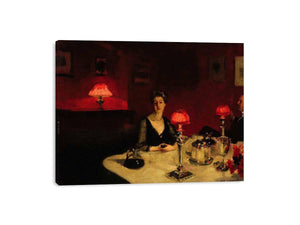


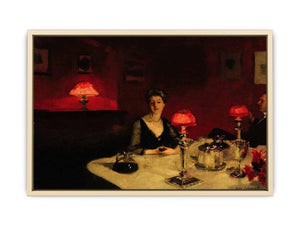


A Dinner Table At Night
Go kalles this summer with this vintage navy and white striped v-neck t-shirt from the Nike. Perfect for pairing with denim and white kicks for a stylish kalles vibe.

A Dinner Table At Night
A Dinner Table At Night Painting by John Singer Sargent
A Dinner Table At Night Painting by John Singer Sargent is one of the most psychologically nuanced and atmospherically refined interiors in the artist’s body of work, a painting in which light, silence, and social proximity replace narrative drama. Created during Sargent’s mature period, the work captures a moment of evening stillness shaped not by conversation or spectacle, but by reflection, restraint, and the subtle tensions that inhabit shared space. Rather than depicting dining as ceremony or sociability, Sargent presents it as a condition—quiet, inward, and suspended in time.
By this point in his career, John Singer Sargent had already mastered the language of society portraiture and public display. Yet increasingly, he turned away from outward performance toward moments of privacy and psychological ambiguity. A Dinner Table At Night belongs to this introspective strand of his work. It is not concerned with status, elegance, or anecdote. Instead, it examines what remains when the outward rituals of social life recede and interior states come forward.
The historical context of the painting reflects a broader late nineteenth-century shift toward interiority in art. As modern life accelerated and public visibility increased, artists grew more attentive to moments of withdrawal, contemplation, and emotional distance. Sargent’s dinner table is not animated by conversation or conviviality. It is hushed, almost austere. The scene suggests the aftermath of activity rather than its height—a pause in which thought replaces action.
Compositionally, the painting is tightly controlled and deliberately enclosed. The table anchors the scene as both physical object and psychological boundary, separating figures from one another even as it unites them within the same space. Figures are arranged with restraint, their gestures minimal, their bodies contained. Sargent avoids dramatic diagonals or expressive movement. The composition’s stability reinforces the emotional stillness of the moment.
Perspective places the viewer close to the table, yet not fully included. This proximity heightens awareness of silence and distance. One feels present, but not invited. The viewer becomes a witness to an inward moment, aware of the unspoken thoughts that circulate around the table without ever being voiced. Sargent uses spatial positioning to evoke psychological tension without overt expression.
Light is the dominant expressive force in the painting. Artificial illumination—likely candlelight or lamplight—casts a limited, focused glow across the table surface and the surrounding figures. This light does not flood the room. It isolates. Faces, hands, and objects emerge selectively from shadow, creating a rhythm of presence and withdrawal. Darkness occupies as much visual space as light, reinforcing the painting’s contemplative mood.
The color palette is restrained and tonal. Deep browns, blacks, and muted neutrals dominate the background, while the table and illuminated surfaces introduce warmer hues. Whites and pale reflections catch the light briefly, then recede. Color here is not decorative. It serves atmosphere, reinforcing the sense of enclosure and inwardness. The palette supports the painting’s emotional gravity without heaviness.
Sargent’s technique is precise yet understated. Brushwork is controlled, with surfaces rendered smoothly to avoid distraction. Details are present but never assertive. Objects on the table—plates, glassware, linens—are described with clarity, yet they do not become focal points. Everything in the painting is subordinated to mood. Technique serves silence rather than display.
Psychologically, A Dinner Table At Night is remarkable for its restraint. The figures do not interact overtly. Their expressions, if visible at all, are neutral, absorbed, or distant. There is no clear narrative tension, yet the painting feels charged. Sargent captures the complexity of shared space, where individuals coexist physically while remaining emotionally separate. This subtle dissonance is the painting’s core.
Within Sargent’s broader oeuvre, the work stands apart from his more animated group scenes and luminous outdoor paintings. It aligns instead with his quieter interiors and psychologically introspective studies. These works reveal an artist acutely aware that modern experience is often defined not by action, but by reflection—by what is withheld rather than expressed.
Culturally, the painting resonates with late nineteenth-century concerns about modern social life and emotional isolation. The dinner table, traditionally a site of connection and ritual, becomes here a space of inwardness. Sargent does not critique this condition explicitly. He observes it with clarity and empathy, allowing ambiguity to remain unresolved.
In contemporary interiors across the United States, the United Kingdom, Canada, Australia, and Europe, A Dinner Table At Night integrates with exceptional subtlety and sophistication. In dining rooms and studies, it introduces depth, introspection, and quiet authority. In offices and libraries, it conveys seriousness and psychological intelligence. In galleries and luxury residences, it anchors interiors with restraint, harmonizing seamlessly with traditional, modern, minimalist, and eclectic décor.
The painting remains meaningful today because it speaks to enduring human experience: the complexity of shared silence, the emotional texture of proximity without intimacy. In an age of constant communication and display, Sargent’s attention to stillness feels especially relevant. A Dinner Table At Night does not dramatize. It observes—and in doing so, it understands.
A Dinner Table At Night Painting by John Singer Sargent endures as a profound meditation on interior life and modern social space. Through controlled composition, subdued light, and psychological restraint, Sargent transformed an ordinary evening setting into a timeless exploration of presence, distance, and silence. The painting does not speak loudly. It listens.
Buy museum qulaity 400- 450 canvas prints, framed prints, and 100% oil paintings of A Dinner Table At Night by John Singer Sargent at Alpha Art Gallery, where world-famous masterpieces are recreated with museum-quality detail, refined craftsmanship, and premium materials.
FAQs
What does A Dinner Table At Night depict?
It depicts a quiet evening dining scene focused on atmosphere and psychological stillness rather than social interaction.
Is this painting a social or narrative scene?
No, it avoids narrative and instead explores shared space and interior states.
Why is the lighting so restrained?
The limited light reinforces intimacy, silence, and emotional inwardness.
How does this work differ from Sargent’s society portraits?
It abandons performance and status in favor of introspection and ambiguity.
What role does the table play symbolically?
The table acts as both a point of connection and a boundary between individuals.
Why does the painting feel emotionally tense despite its calm?
Because Sargent captures unspoken distance and psychological separation within shared space.
Why does this artwork remain relevant today?
Its exploration of silence and emotional complexity resonates in modern life.
Where does this artwork work best in interiors?
It is ideal for dining rooms, studies, libraries, offices, galleries, and refined private residences.
| 1. Select Type |
Canvas Print, Unframed Paper Print, Hand-Painted Oil Painting, Framed Paper Print |
|---|---|
| 2. Select Finish Option |
Rolled Canvas, Rolled- No Frame, Streched Canvas, Black Floating Frame, White Floating Frame, Brown Floating Frame, Black Frame with Matt, White Frame with Matt, Black Frame No Matt, White Frame No Matt, Streched, Natural Floating Frame, Champagne Floating Frame, Gold Floating Frame |
| 3. Select Size |
60cm X 90cm [24" x 36"], 76cm X 114cm [30" x 45"], 90cm X 120cm [36" x 48"], 100cm X 150cm [40" x 60"], 16.54 x 11.69"(A3), 23.39 x 16.54"(A2), 33.11 x 23.39"(A1), 46.81 x 31.11"(A0), 54" X 36", 50cm X 60cm [16" x 24"], 121cm X 182cm [48" x 72"], 135cm X 200cm [54" x 79"], 165cm x 205cm [65" x 81"], 183cm x 228cm [72" x 90"], 22cm X 30cm [9" x 12"], 30cm x 45Cm [12" x 18"], 45cm x60cm [16" x 24'], 75cm X 100cm [30" x 40"], 121cm x 193cm [48" x 76"], 45cm x 60cm [16" x 24'], 20cm x 25Cm [8" x 10"], 35cm x 50Cm [14" x 20"], 45cm x 60 cm [18" x 24"], 35cm x 53Cm [14" x 21"], 66cm X 101cm[26" x 40"], 76cm x 116cm [30"x 46"], 50cm X 60cm 16" x 24"] |