






The Milkmaid Painting by Jan Vermeer
Go kalles this summer with this vintage navy and white striped v-neck t-shirt from the Nike. Perfect for pairing with denim and white kicks for a stylish kalles vibe.

The Milkmaid Painting by Jan Vermeer
The Milkmaid Painting by Jan Vermeer Van Delft
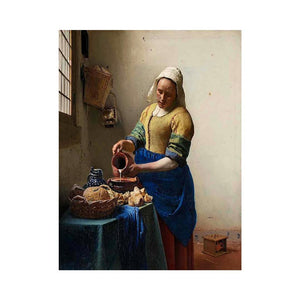
The Milkmaid stands as one of the most quietly monumental achievements of seventeenth-century painting, a work in which Jan Vermeer Van Delft transformed an ordinary domestic task into an image of enduring dignity, concentration, and inner stillness. Painted around 1657–1658, the work belongs to Vermeer’s mature period and exemplifies his unique ability to elevate everyday life through light, structure, and sustained attention. Far removed from grand historical narrative or theatrical gesture, The Milkmaid reveals how meaning can reside in restraint, and how the most modest actions can carry profound presence.
Vermeer worked in Delft at a time when Dutch art was deeply engaged with scenes of daily life. Yet his approach differed markedly from many of his contemporaries. Where others often infused genre scenes with anecdote, moralising detail, or narrative intrigue, Vermeer stripped the scene to its essentials. In The Milkmaid, there is no overt story unfolding, no secondary action to distract the eye. A single woman pours milk from a jug into a vessel, absorbed fully in her task. This concentration is the painting’s subject as much as the figure herself.
The composition is remarkably controlled. The figure is placed solidly within a shallow interior, framed by a bare wall and a sturdy table. The spatial arrangement is simple yet exacting. Vertical and horizontal elements—wall, table, window, and figure—create a stable architectural structure that anchors the scene. This geometry reinforces the sense of order and calm. Nothing feels incidental. Every element exists in measured relationship to the whole, guiding the viewer’s attention toward the act of pouring milk, which becomes the painting’s quiet centre.
Light is the defining force of the work. It enters from a window on the left, falling gently across the woman’s face, hands, and clothing. This light is neither dramatic nor symbolic in a conventional sense. It does not create theatrical contrast or emotional excess. Instead, it clarifies. It reveals texture, weight, and form with extraordinary sensitivity. Bread crusts, ceramic surfaces, fabric folds, and skin all respond differently to the same light, demonstrating Vermeer’s unmatched ability to observe and translate visual truth.
Colour in The Milkmaid is restrained yet luminous. Vermeer employs a limited palette of blues, yellows, ochres, and soft earth tones, allowing subtle relationships to emerge through balance rather than contrast. The blue of the apron and the warm yellow of the bodice are particularly striking, not because they are vivid, but because they are perfectly attuned to the surrounding tones. Colour here is not decorative; it is structural. It stabilises the composition and reinforces the painting’s sense of grounded calm.
The handling of paint is deliberate and precise. Vermeer’s surface is neither loose nor heavily worked. Instead, it is built through careful layering, allowing forms to emerge with clarity and solidity. Textures are suggested rather than exaggerated. The bread appears rough and weighty, the jug smooth and cool, the wall subtly mottled with age and use. These details are not included for narrative effect, but to affirm the physical reality of the space and the act taking place within it.
Symbolically, The Milkmaid has often been interpreted through the lens of domestic virtue, diligence, and restraint. Yet Vermeer avoids overt allegory. The woman is not idealised as a moral emblem, nor is she eroticised or sentimentalised. She is presented with dignity and autonomy, defined by her attention rather than her role. The act of pouring milk becomes an image of care and continuity, suggesting that meaning can arise through sustained presence rather than dramatic action.
Emotionally, the painting conveys stillness without emptiness. There is no sense of isolation or melancholy, but neither is there overt warmth or narrative intimacy. The emotional tone is one of equilibrium. The viewer is invited to slow down, to match the pace of the figure’s attention. This quiet absorption is central to the painting’s enduring power. It does not demand reaction; it invites contemplation.
Within Vermeer’s body of work, The Milkmaid occupies a singular position. It is one of his earliest and most forceful genre scenes, demonstrating his move toward greater simplicity and focus. The painting reveals his commitment to reducing narrative in favour of visual and psychological clarity. In doing so, it anticipates modern concerns with perception, presence, and the act of seeing itself.
Culturally, The Milkmaid has come to represent a broader ideal of attentiveness and respect for ordinary life. In an era increasingly defined by speed and distraction, the painting offers a counter-image of patience and care. Its relevance extends far beyond its historical context, speaking to universal experiences of work, concentration, and quiet responsibility.
In contemporary interiors, The Milkmaid integrates with exceptional elegance. In living rooms, it introduces calm authority and visual balance without overwhelming the space. In kitchens and dining areas, its subject matter resonates naturally, reinforcing themes of nourishment and continuity. In studies and offices, it fosters focus and reflection. Within galleries and refined residences across the United States, United Kingdom, Canada, Australia, and Europe, the painting complements traditional, modern, minimalist, and eclectic décor alike. Its muted palette and strong composition allow it to anchor a space with understated confidence.
The enduring relevance of The Milkmaid lies in its affirmation of presence as value. Vermeer demonstrates that greatness in art does not require grandeur, and that meaning can be found in the careful observation of a single, unremarkable moment. By honouring attention, labour, and stillness, The Milkmaid continues to speak with quiet authority across centuries, reminding viewers that depth often resides where one is willing to look most closely.
Buy museum qulaity 400- 450 canvas prints, framed prints, and 100% oil paintings of The Milkmaid by Jan Vermeer Van Delft at Alpha Art Gallery, where world-famous masterpieces are recreated with museum-quality detail, refined craftsmanship, and premium materials.
FAQS
What does The Milkmaid by Jan Vermeer Van Delft depict?
It depicts a woman pouring milk in a simple interior, focusing on concentration and presence rather than narrative action.
Why is The Milkmaid considered such an important painting?
It elevates everyday labour through light, composition, and restraint, demonstrating Vermeer’s mastery of visual clarity and attention.
What role does light play in the painting?
Light clarifies form and texture, guiding the viewer’s eye and creating calm balance rather than dramatic effect.
Is The Milkmaid a symbolic or moralising work?
While often associated with domestic virtue, the painting avoids overt allegory, presenting the figure with dignity and autonomy.
How does Vermeer use colour in this work?
He employs a restrained palette in which blues and yellows are carefully balanced to create harmony and structure.
Does the painting tell a story?
No, it focuses on a single moment without narrative development, inviting contemplation rather than interpretation.
Is The Milkmaid suitable for contemporary interiors?
Yes, its calm composition and timeless subject make it ideal for both modern and traditional spaces.
Why does The Milkmaid remain relevant today?
Its emphasis on attentiveness, care, and the value of ordinary moments continues to resonate across cultures and generations.
| 1. Select Type |
Canvas Print, Unframed Paper Print, Hand-Painted Oil Painting, Framed Paper Print |
|---|---|
| 2. Select Finish Option |
Rolled Canvas, Rolled- No Frame, Streched Canvas, Black Floating Frame, White Floating Frame, Brown Floating Frame, Black Frame with Matt, White Frame with Matt, Black Frame No Matt, White Frame No Matt, Streched, Natural Floating Frame, Champagne Floating Frame, Gold Floating Frame |
| 3. Select Size |
60cm X 90cm [24" x 36"], 76cm X 114cm [30" x 45"], 90cm X 120cm [36" x 48"], 100cm X 150cm [40" x 60"], 16.54 x 11.69"(A3), 23.39 x 16.54"(A2), 33.11 x 23.39"(A1), 46.81 x 31.11"(A0), 54" X 36", 50cm X 60cm [16" x 24"], 121cm X 182cm [48" x 72"], 135cm X 200cm [54" x 79"], 165cm x 205cm [65" x 81"], 183cm x 228cm [72" x 90"], 22cm X 30cm [9" x 12"], 30cm x 45Cm [12" x 18"], 45cm x60cm [16" x 24'], 75cm X 100cm [30" x 40"], 121cm x 193cm [48" x 76"], 45cm x 60cm [16" x 24'], 20cm x 25Cm [8" x 10"], 35cm x 50Cm [14" x 20"], 45cm x 60 cm [18" x 24"], 35cm x 53Cm [14" x 21"], 66cm X 101cm[26" x 40"], 76cm x 116cm [30"x 46"], 50cm X 60cm 16" x 24"] |