


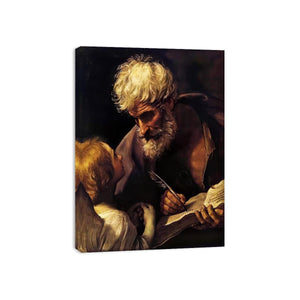





St Matthew and the Angel 1635-40
Go kalles this summer with this vintage navy and white striped v-neck t-shirt from the Nike. Perfect for pairing with denim and white kicks for a stylish kalles vibe.

St Matthew and the Angel 1635-40
St Matthew and the Angel 1635–40 Painting by Guido Reni
St Matthew and the Angel 1635–40 Painting by Guido Reni is one of the most refined and spiritually poised interpretations of divine inspiration in seventeenth-century Italian art, a painting in which grace, restraint, and intellectual clarity converge with rare harmony. Created during Reni’s mature period, the work exemplifies a vision of sacred art that rejects theatrical excess in favor of luminous calm and moral intelligibility. Rather than dramatizing revelation as ecstatic rupture, Reni presents it as an intimate act of guidance—quiet, attentive, and profoundly human.
The artist responsible for this distilled elegance, Guido Reni, was among the most admired painters of his generation, often described by contemporaries as the “divine” Reni for the purity of his style. Trained in Bologna and deeply influenced by classical ideals, Reni developed a Baroque language distinct from the emotional turbulence of Caravaggio and his followers. His art sought balance, serenity, and ethical beauty, drawing on Raphael and antiquity while remaining responsive to Counter-Reformation aims. St Matthew and the Angel stands as a consummate expression of this synthesis.
The subject derives from the Gospel tradition in which the evangelist Matthew composes his account under divine guidance. Earlier depictions often emphasized dramatic possession or ecstatic fervor. Reni, by contrast, chooses a moment of calm collaboration. The angel does not overwhelm Matthew; it inclines gently toward him, offering counsel rather than command. Inspiration here is portrayed as intelligible and orderly, aligning with the Counter-Reformation emphasis on clarity and doctrinal accessibility.
Compositionally, the painting is intimate and focused. Matthew is seated, his body inclined toward the page, his attention absorbed by the act of writing. The angel occupies a close but non-invasive proximity, creating a diagonal exchange that guides the viewer’s eye between heaven and earth. The spatial arrangement is shallow, eliminating distractions and centering the encounter. Reni’s economy of means—few figures, limited setting—heightens the painting’s contemplative intensity.
Perspective reinforces the intimacy of revelation. The viewer is placed at a respectful distance, close enough to observe expression and gesture, yet not so close as to intrude. This balance mirrors the painting’s theological message: divine truth is accessible but not coercive. The scene unfolds as a conversation rather than a spectacle, inviting reflection rather than astonishment.
Light plays a decisive role in shaping meaning. Reni employs a soft, enveloping illumination that caresses forms without sharp contrast. Matthew’s face and hands are gently lit, emphasizing cognition and labor, while the angel’s presence is marked by a subtle luminosity that distinguishes without dazzling. Light here signifies understanding rather than miracle—an inward clarity that accompanies faithful attention.
The color palette is restrained and harmonious. Warm flesh tones, subdued reds, and cool whites create a balanced chromatic field that supports the painting’s mood of serenity. The angel’s garments, rendered in luminous whites and pale hues, suggest purity and transcendence without ostentation. Color functions not to excite, but to stabilize, reinforcing the painting’s ethical calm.
Reni’s technique is exemplary in its refinement. Brushwork is smooth and controlled, contours precise yet supple. Anatomical forms are idealized without rigidity, recalling classical sculpture while retaining lifelike presence. The surfaces are polished, suppressing painterly bravura in favor of clarity. This technical restraint aligns with the painting’s spiritual ethos: truth revealed through order and measure.
Symbolically, St Matthew and the Angel articulates a theology of inspiration grounded in cooperation. Matthew is not passive; he listens, thinks, and writes. The angel’s gesture—often interpreted as counting or indicating points—suggests instruction and structure. Divine revelation is thus portrayed as compatible with human reason and discipline. The image affirms the dignity of intellectual labor within faith.
Psychologically, the painting is notable for its calm attentiveness. Matthew’s expression conveys concentration rather than ecstasy. The angel’s demeanor is gentle and composed. There is no urgency, no fear, no dramatic rupture. Reni presents holiness as a state of alignment rather than exaltation, a vision that resonated deeply with audiences seeking stability amid the upheavals of the seventeenth century.
Within Reni’s broader oeuvre, this work exemplifies his late style, in which spiritual subjects are treated with increasing purity and restraint. Compared with his earlier, more dynamic compositions, St Matthew and the Angel reveals an artist committed to distillation—paring away excess to reveal essence. It stands alongside his finest saints and Madonnas as a testament to his belief that beauty and virtue are inseparable.
Culturally, the painting reflects the Counter-Reformation’s call for intelligible, edifying imagery. Reni answers this call not through didactic symbolism, but through emotional and visual clarity. The work communicates sanctity through balance and grace, making sacred history feel immediate and humane. Its influence extended widely, shaping devotional painting across Italy and beyond.
In contemporary interiors across the United States, the United Kingdom, Canada, Australia, and Europe, St Matthew and the Angel brings a sense of calm authority and contemplative depth. In living rooms, it introduces serenity and classical refinement. In studies and offices, it conveys focus, wisdom, and ethical purpose. In galleries and luxury residences, it anchors space with luminous restraint, integrating seamlessly into traditional, neoclassical, modern, and minimalist décor through its balanced composition and gentle palette.
The painting remains meaningful today because it proposes a vision of inspiration grounded in attentiveness rather than spectacle. In a culture often drawn to immediacy and excess, Reni’s work offers an alternative: truth revealed through patience, dialogue, and disciplined thought. St Matthew and the Angel reminds the viewer that insight is cultivated, not seized.
St Matthew and the Angel 1635–40 Painting by Guido Reni endures as one of the most eloquent expressions of sacred calm in Baroque art. Through compositional economy, luminous restraint, and psychological clarity, Reni transformed a biblical episode into a timeless meditation on guidance, intellect, and grace. The painting does not shout revelation. It listens.
Buy museum qulaity 400- 450 canvas prints, framed prints, and 100% oil paintings of St Matthew and the Angel by Guido Reni at Alpha Art Gallery, where world-famous masterpieces are recreated with museum-quality detail, refined craftsmanship, and premium materials.
FAQs
What moment does St Matthew and the Angel depict?
It depicts the evangelist Matthew composing his Gospel under gentle divine guidance rather than ecstatic possession.
How does Guido Reni’s interpretation differ from other Baroque versions?
Reni emphasizes calm instruction and clarity instead of dramatic intensity or emotional excess.
What is the role of the angel in the composition?
The angel acts as a guide and instructor, suggesting order and intelligibility in divine inspiration.
Why is the lighting so soft and even?
Soft light reinforces contemplation and understanding rather than spectacle or miracle.
How does this painting reflect Counter-Reformation ideals?
It prioritizes clarity, accessibility, and moral edification through balanced composition.
Is the work more classical or Baroque in style?
It blends Baroque spirituality with classical restraint and idealized form.
Why does the painting remain relevant today?
Its vision of inspiration grounded in patience and dialogue resonates across faith and culture.
Where does this artwork work best in interiors?
It is ideal for living rooms, studies, offices, galleries, and spaces seeking serenity and intellectual depth.
| 1. Select Type |
Canvas Print, Unframed Paper Print, Hand-Painted Oil Painting, Framed Paper Print |
|---|---|
| 2. Select Finish Option |
Rolled Canvas, Rolled- No Frame, Streched Canvas, Black Floating Frame, White Floating Frame, Brown Floating Frame, Black Frame with Matt, White Frame with Matt, Black Frame No Matt, White Frame No Matt, Streched, Natural Floating Frame, Champagne Floating Frame, Gold Floating Frame |
| 3. Select Size |
60cm X 90cm [24" x 36"], 76cm X 114cm [30" x 45"], 90cm X 120cm [36" x 48"], 100cm X 150cm [40" x 60"], 16.54 x 11.69"(A3), 23.39 x 16.54"(A2), 33.11 x 23.39"(A1), 46.81 x 31.11"(A0), 54" X 36", 50cm X 60cm [16" x 24"], 121cm X 182cm [48" x 72"], 135cm X 200cm [54" x 79"], 165cm x 205cm [65" x 81"], 183cm x 228cm [72" x 90"], 22cm X 30cm [9" x 12"], 30cm x 45Cm [12" x 18"], 45cm x60cm [16" x 24'], 75cm X 100cm [30" x 40"], 121cm x 193cm [48" x 76"], 45cm x 60cm [16" x 24'], 20cm x 25Cm [8" x 10"], 35cm x 50Cm [14" x 20"], 45cm x 60 cm [18" x 24"], 35cm x 53Cm [14" x 21"], 66cm X 101cm[26" x 40"], 76cm x 116cm [30"x 46"], 50cm X 60cm 16" x 24"] |