


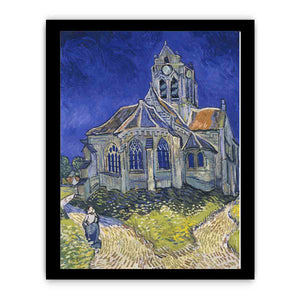

The Church At Auvers By Van Gogh
Go kalles this summer with this vintage navy and white striped v-neck t-shirt from the Nike. Perfect for pairing with denim and white kicks for a stylish kalles vibe.

The Church At Auvers By Van Gogh
The Church at Auvers by Vincent van Gogh is one of the defining paintings from the artist’s final months at Auvers-sur-Oise. Painted between approximately 4 and 8 June 1890, the composition transforms the village church into a dramatically wavering structure surrounded by curving paths and an intensely painted sky. The historic oil-on-canvas work, catalogued as F 789 / JH 2006, is held by the Musée d’Orsay in Paris. Alpha Art Gallery offers reproductions as canvas prints, fine art prints, framed prints and 100% hand-painted oil paintings.
About The Church at Auvers
Van Gogh arrived at Auvers-sur-Oise on 20 May 1890 after leaving Saint-Rémy. Within weeks he painted the village church from behind, looking toward its apse and surrounding paths.
The Musée d’Orsay dates the painting specifically to between 4 and 8 June 1890. The original measures approximately 93 × 74.5 cm and is painted in oil on canvas.
Van Gogh’s surviving correspondence identifies the work as F 789 / JH 2006. It is the only painting in which he represented the Auvers church in full as the principal subject, although the building appears more distantly in other village views.
The Real Church at Auvers-sur-Oise
The church itself is a historic building rather than an invented structure. Musée d’Orsay describes it as a thirteenth-century early Gothic church with Romanesque chapels.
Van Gogh nevertheless did not approach it like an architectural surveyor. The church remains recognizable, but walls, rooflines and paths appear to bend and shift. The painting communicates Van Gogh’s experience of the building rather than giving the viewer a mechanically precise record.
Why the Building Appears to Move
The church seems almost unstable because Van Gogh avoids rigid architectural geometry. Lines that might normally be straight become irregular, roof edges tilt and the surrounding paths curve dramatically around the structure.
Musée d’Orsay emphasizes how different this approach is from Impressionist studies of architecture such as Monet’s later Rouen Cathedral series. Van Gogh was less concerned with recording temporary light falling on the façade than with transforming the entire structure through line, colour and expressive rhythm.
This is one reason the painting has often been discussed as anticipating later Fauvist and Expressionist approaches.
The Two Paths
Two paths divide and move around the church. Their exaggerated curves lead the viewer into the foreground before turning toward either side of the building.
The paths create both depth and visual tension. Instead of providing one calm route toward the church entrance, they pull the eye in different directions and reinforce the painting’s restless structure.
The effect is compositional rather than a documented religious symbol, so interpretations of the paths as representing specific spiritual choices should be treated as interpretation rather than established fact.
Architecture, Landscape and Post-Impressionism
The Church at Auvers is both an architectural subject and a landscape. The building dominates the centre, but the paths, grass, sky and surrounding environment remain essential to the image.
Van Gogh’s Post-Impressionist approach allows these elements to interact through strong contours and visible paint. Architecture no longer provides a stable geometric centre; it participates in the same expressive rhythm as the landscape around it.
Visitors exploring other iconic works of art can compare this painting with Van Gogh’s Arles and Saint-Rémy landscapes to see how his style continued to evolve at Auvers.
Historical Artwork Details
| Artist | Vincent van Gogh |
|---|---|
| Title | The Church at Auvers-sur-Oise, View from the Chevet |
| Common title | The Church at Auvers |
| Catalogue references | F 789 / JH 2006 |
| Date | Approximately 4–8 June 1890 |
| Created at | Auvers-sur-Oise, France |
| Original medium | Oil on canvas |
| Dimensions | Approximately 93 × 74.5 cm |
| Subjects | Church, architecture and landscape |
| Movement | Post-Impressionism |
| Current collection | Musée d’Orsay, Paris |
| Accession number | RF 1951 42 |
The historic original belongs to the Musée d’Orsay. Alpha Art Gallery offers reproductions rather than Van Gogh’s original and is not affiliated with or endorsed by the museum.
Choose Your Church at Auvers Reproduction
| Format | Presentation | Ideal For |
|---|---|---|
| Canvas Print | Strong vertical canvas presentation emphasizing the church and paths | Feature walls and statement displays |
| Fine Art Print | Refined traditional printed interpretation | Collectors and smaller spaces |
| Framed Print | Architectural outer boundary around Van Gogh’s distorted building | Living rooms, studies and offices |
| Hand-Painted Oil Reproduction | Real paint with individually recreated brushwork | Buyers who value physical texture |
Museum-Quality Canvas Print
Alpha Art Gallery uses 400–450 GSM museum-quality canvas for its canvas prints. Because the original is taller than it is wide, this artwork can create substantial presence without requiring an exceptionally broad wall.
100% Hand-Painted Oil Reproduction
A hand-painted oil reproduction can emphasize the directional marks that make the paths, rooflines and sky appear so active. Each is individually painted by professional artists using oil on canvas.
Frequently Asked Questions
When did Van Gogh paint The Church at Auvers?
Musée d’Orsay dates the work to approximately 4–8 June 1890.
Where is the original?
The historical painting is held by the Musée d’Orsay in Paris.
How large is it?
The original measures approximately 93 × 74.5 cm.
Is the church a real building?
Yes. Van Gogh depicted the historic church at Auvers-sur-Oise, although he transformed its architecture through expressive line and colour.
Is this a religious painting?
The principal subject is a church, so religious-art discovery is relevant, but the painting is primarily an architectural landscape rather than a traditional biblical or devotional scene.
Can I order a canvas print?
Yes. Multiple canvas sizes are available on 400–450 GSM museum-quality canvas.
Can I buy a hand-painted reproduction?
Yes. Alpha Art Gallery offers individually painted 100% oil-on-canvas reproductions.
Is worldwide shipping free?
Yes. Alpha Art Gallery provides free worldwide shipping on all orders.
Bring Van Gogh’s Auvers Church Into Your Space
With its tilting architecture, dramatic paths and expressive late-period brushwork, The Church at Auvers turns a familiar village building into one of Van Gogh’s most distinctive final landscapes. Choose canvas, fine art, framed or hand-painted oil presentation in a size suited to your wall.
| 1. Select Type |
Museum Canvas, Fine Art Paper, Hand-Painted Oil Painting, Satin Photo Paper |
|---|---|
| 2. Select Finish Option |
Rolled Canvas, Rolled- No Frame, Black Frame with Matt, White Frame with Matt, Black Frame No Matt, White Frame No Matt, Streched Canvas, Black Floating Frame, White Floating Frame, Brown Floating Frame, Rolled No Framed, Streched, Natural Floating Frame, Champagne Floating Frame, Gold Floating Frame |
| 3. Select Size |
60cm X 90cm [24" x 36"], 76cm X 114cm [30" x 45"], 82cm X 120cm [32" x 48"], 100cm X 150cm [40" x 60"], 22cm X 30cm [9" x 12"], 16.54 x 11.69"(A3), 25cm x 76cm [10" x 30"], 41cm x 61cm [16" x 24"], 20cm x 25Cm [8" x 10"], 30cm x 45Cm [12" x 18"], 35cm x 50Cm [14" x 20"], 45cm x 60 cm [18" x 24"], 35cm x 53Cm [14" x 21"], 66cm X 101cm[26" x 40"], 76cm x 116cm [30"x 46"], 50cm X 60cm [16" x 24"], 121cm X 182cm [48" x 72"], 135cm X 200cm [54" x 79"], 165cm x 205cm [65" x 81"], 183cm x 228cm [72" x 90"], 45cm x60cm [16" x 24'], 75cm X 100cm [30" x 40"], 121cm x 193cm [48" x 76"], 45cm x 60cm [16" x 24'], 50cm X 60cm 16" x 24"] |