


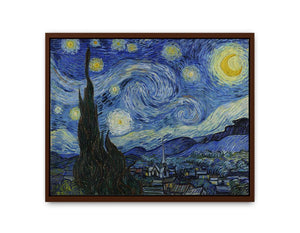
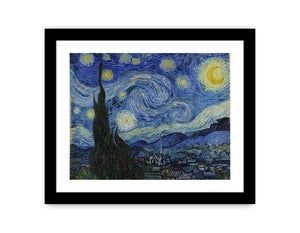


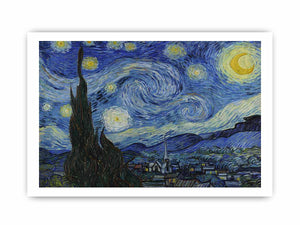
Starry Night Painting By Vincent Van Gogh
Go kalles this summer with this vintage navy and white striped v-neck t-shirt from the Nike. Perfect for pairing with denim and white kicks for a stylish kalles vibe.

Starry Night Painting By Vincent Van Gogh
The Starry Night by Vincent van Gogh
The Starry Night is Vincent van Gogh’s celebrated 1889 painting of a dramatically transformed night sky above a quiet village and rolling landscape. Created during Van Gogh’s stay at Saint-Paul-de-Mausole in Saint-Rémy-de-Provence, France, the oil painting is one of the defining works associated with Post-Impressionism. The historical original is held by The Museum of Modern Art (MoMA) in New York. Alpha Art Gallery offers reproductions as canvas prints, fine art prints, framed prints and 100% hand-painted oil painting reproductions.
Van Gogh painted The Starry Night in June 1889. The original oil-on-canvas work measures approximately 73.7 × 92.1 cm. Its swirling sky, luminous celestial forms, dark cypress and compact village have made it one of the most recognizable images in modern art.
About The Starry Night
The Starry Night presents a nocturnal landscape that feels simultaneously familiar and extraordinary. A village rests beneath an enormous sky filled with stars, a crescent moon and sweeping bands of movement. A tall cypress rises in the foreground, linking the earth visually with the animated heavens above.
Rather than describing the night sky with photographic realism, Van Gogh transformed what he observed and remembered into a highly expressive composition. Curving lines, rhythmic brushwork and exaggerated celestial forms create a sensation of movement across the entire upper half of the painting.
The result is a landscape in which the sky becomes the dominant event. Buildings, hills and trees establish the setting, but the viewer's attention repeatedly returns to the great spiraling forms above them. This relationship between quiet architecture and an intensely active sky gives the painting much of its distinctive emotional power.
When and Where Did Van Gogh Paint The Starry Night?
Vincent van Gogh painted The Starry Night in June 1889 while staying at Saint-Paul-de-Mausole, a former monastery and psychiatric hospital at Saint-Rémy-de-Provence in southern France. He had voluntarily entered the institution in May 1889 and continued working intensively during his stay.
The landscape around Saint-Rémy became an important source of subjects. Van Gogh painted wheat fields, olive groves, cypresses, hills and views associated with the surrounding Provençal countryside. In The Starry Night, however, observation is combined with artistic invention rather than presented as a straightforward transcription of a single view.
This makes the painting particularly important for understanding Van Gogh's mature approach. He could begin with recognizable elements of the landscape and reorganize them through memory, imagination, line and colour to create an image with its own independent visual logic.
The Composition: Earth Beneath an Expansive Sky
The composition is organized around a powerful contrast between the lower landscape and the enormous sky above. The village occupies a relatively narrow band across the lower portion of the canvas. Its roofs and buildings create angular forms that feel comparatively stable and quiet.
Above them, the sky is dominated by broad curves, circles and spiraling rhythms. Stars appear as glowing discs surrounded by halos, while the crescent moon occupies the upper right portion of the composition. Long bands of paint sweep across the sky, creating a strong directional flow from one side of the painting to the other.
The cypress at the left is crucial to the structure. Its tall, flame-like form rises dramatically from the foreground and visually connects the lower landscape with the sky. Without it, the village and heavens could feel like separate horizontal zones; the cypress ties them together.
The horizontal proportions of The Starry Night make the image especially effective as large wall art. A wider Starry Night canvas print can create a strong focal point above sofas, sideboards, beds or other substantial pieces of furniture.
Van Gogh's Famous Swirling Sky
The sky is the feature most immediately associated with The Starry Night. Van Gogh built its movement through repeated curved marks and directional brushstrokes rather than through smooth atmospheric blending. Individual strokes remain visually active and contribute to the sensation that the entire sky is circulating.
A large swirling form stretches through the center of the heavens, while smaller circular movements surround stars. These shapes do not need to be interpreted as literal astronomical structures to be appreciated. Their visual purpose is clear: they make the sky feel energetic, expansive and alive.
This quality is one reason reproduction format matters. A printed canvas can emphasize the scale and overall movement of the image, while a hand-painted oil reproduction is better suited to buyers who particularly value the physical presence of individually painted brushwork.
Brushwork and Technique
The historical original is painted in oil on canvas. Van Gogh used highly visible brushstrokes throughout the composition, allowing the direction of his marks to help define clouds, hills, vegetation, architecture and celestial forms.
Instead of hiding the physical process of painting, Van Gogh made the marks themselves part of the image. Curved strokes generate movement in the sky, shorter marks articulate buildings and landscape forms, and the cypress is constructed through energetic upward movements.
This approach contributes to the painting's unity. Although the village, hills, tree and sky represent different types of objects, the visible rhythm of the paint connects them into a single expressive surface.
The Starry Night and Post-Impressionism
The Starry Night is closely associated with Post-Impressionism, a broad term used for several artists who developed highly individual approaches beyond Impressionism during the late nineteenth century. Van Gogh retained an interest in observed nature but used line, colour and brushwork increasingly for expressive purposes.
In this painting, a landscape does not simply record what the eye sees. The visual world is reorganized through the artist's distinctive language. Hills become sweeping rhythms, the cypress rises like a dark flame and stars expand into radiant circular forms.
This transformation is central to Van Gogh's importance in art history. His work demonstrated how recognizably observed subjects could carry emotional and expressive intensity through the physical handling of paint.
What Does The Starry Night Mean?
There is no single universally accepted interpretation of The Starry Night. Viewers and scholars have proposed readings involving spirituality, nature, emotional experience, infinity and the relationship between earthly life and the heavens, but the painting should not be reduced to one fixed symbolic formula.
Some visual relationships naturally invite interpretation. The village appears quiet beneath an extraordinarily active sky, while the cypress extends upward between earth and heaven. These contrasts can encourage reflections on scale, isolation, nature or spirituality, but such responses should be distinguished from documented statements of Van Gogh's intent.
What can be stated confidently is that Van Gogh was deeply engaged with nocturnal subjects and with the expressive potential of painting the night. The Starry Night became the most famous example of that interest.
The Village in The Starry Night
The small settlement beneath the sky gives the painting an essential sense of human scale. Houses cluster around a prominent church spire, while the surrounding hills establish the wider landscape.
The village is not simply a precise documentary record of the view around Saint-Rémy. Van Gogh combined observed landscape elements with imaginative transformation. That distinction is important because The Starry Night is better understood as a constructed artistic vision than as an exact topographical panorama.
The relative stillness of the village also strengthens the effect of the sky. Straight rooflines, compact buildings and the vertical church spire contrast sharply with the flowing curves overhead.
Why Is The Starry Night So Famous?
The Starry Night became famous because it combines immediate visual recognition with extraordinary expressive individuality. Even viewers unfamiliar with its history can recognize the swirling sky, brilliant stars and towering cypress almost instantly.
The painting also represents many qualities now strongly associated with Van Gogh: visible brushwork, intense transformation of nature, rhythmic line and a highly personal approach to landscape. Rather than resembling a generic nineteenth-century night scene, it looks unmistakably like a Van Gogh.
Its influence extends far beyond specialist art history. The image has become deeply embedded in popular visual culture while the original remains a major work in the collection of The Museum of Modern Art.
Explore more iconic works of art available as reproductions from Alpha Art Gallery.
Where Is the Original The Starry Night?
The historical original of The Starry Night is held by The Museum of Modern Art (MoMA) in New York City. MoMA acquired the painting in 1941, and it has become one of the most widely recognized works in the museum's collection.
Alpha Art Gallery sells reproductions of The Starry Night, not Vincent van Gogh's historical 1889 painting. Alpha Art Gallery does not imply authorization, certification, endorsement, partnership or affiliation with The Museum of Modern Art.
Choose Your Starry Night Reproduction
The painting's energetic surface and broad horizontal composition translate effectively into several reproduction formats. The right choice depends on whether you prioritize scale, a finished frame, a traditional printed presentation or genuine hand-painted texture.
Museum-Quality Canvas Print
A Starry Night canvas print is well suited to the painting because its strong directional movement can create substantial visual presence across a wide wall. Alpha Art Gallery uses 400–450 GSM museum-quality canvas and offers multiple sizes, allowing the artwork to function as either a compact decorative feature or a large statement piece.
A larger canvas can give the sweeping sky more room to command attention, making this format particularly effective for living rooms, bedrooms, offices and feature walls. Explore additional museum-quality canvas prints for related wall-art options.
Museum-Quality Fine Art Print
A fine art print provides a refined traditional printed presentation. This format can suit buyers who want the detailed composition of The Starry Night without the stronger physical character of canvas. It is also a practical option for incorporating the artwork into an existing framing or gallery-wall arrangement.
Museum-Quality Framed Print
A framed print provides a finished visual boundary around Van Gogh's dynamic composition. Because the painting contains so much movement, framing can create a useful structural contrast and help define the artwork clearly against the surrounding wall.
Framed presentation can work particularly well in living areas, studies, offices and interiors where a more complete, formal presentation is preferred.
100% Hand-Painted Oil Painting Reproduction
For buyers who particularly value the physical character of Van Gogh's medium, Alpha Art Gallery offers a 100% hand-painted Starry Night oil painting reproduction. Professional artists individually recreate the composition using oil on canvas.
The hand-painted format provides real brushwork, physical texture and visual depth. Because every reproduction is painted individually rather than mechanically printed, subtle differences are inherent in its handmade character. Explore additional hand-painted oil painting reproductions if this tactile presentation appeals to you.
Which Starry Night Format Should You Choose?
| Format | Presentation | Ideal For |
|---|---|---|
| Canvas Print | Substantial canvas presence and strong visual scale | Feature walls and larger contemporary displays |
| Fine Art Print | Refined printed presentation | Gallery walls and traditional print collectors |
| Framed Print | Finished, structured appearance | Living rooms, offices and coordinated interiors |
| Hand-Painted Oil Reproduction | Real brushwork and individually painted texture | Buyers who value the tactile character of an oil painting |
Displaying The Starry Night as Wall Art
The horizontal orientation of The Starry Night makes it particularly adaptable to wide wall spaces. It can sit naturally above a sofa, console, sideboard, bed or office credenza where the artwork's width can relate visually to the furniture below.
A large reproduction emphasizes the sweep of the sky and allows Van Gogh's rhythmic composition to operate as a major focal point. Smaller formats are useful where the painting will form part of a gallery wall or where available wall space is limited.
Because the composition contains both dark landscape forms and luminous celestial elements, it has enough visual contrast to hold attention from across a room. A canvas presentation can emphasize scale, while a framed print can give the energetic image a stronger structural boundary.
Choosing the Right Starry Night Size
Choose size according to the wall and the role you want the painting to play. If The Starry Night will be the principal artwork in a living room or bedroom, a larger reproduction gives the expansive sky greater visual impact. For smaller walls or multi-artwork arrangements, a more compact size may be preferable.
The original composition is landscape-oriented, so preserving a broad horizontal presentation allows the relationship between the cypress, village, hills and sweeping sky to remain visually balanced.
Where Can I Buy a Reproduction of The Starry Night?
Alpha Art Gallery offers reproductions of Vincent van Gogh's The Starry Night as canvas prints, fine art prints, framed prints and 100% hand-painted oil painting reproductions. Multiple sizes are available, with framing options where offered.
Customers can choose the format according to the presentation they prefer: canvas for strong wall presence, fine art print for a traditional printed look, framing for a finished display or hand-painted oil for genuine brushwork and texture.
Why Choose Alpha Art Gallery for The Starry Night?
- Multiple formats: canvas, fine art print, framed print and hand-painted oil reproduction options.
- 400–450 GSM canvas: a substantial canvas choice designed for wall display.
- 100% hand-painted option: professional artists recreate the composition individually using oil on canvas.
- Real painted texture: the hand-painted format provides genuine brushwork and handmade character.
- Multiple sizes: choose a scale suited to your available wall space.
- Frame options: multiple choices are available where offered.
- Secure packaging: artwork is packaged for delivery.
- Worldwide fulfilment: Alpha Art Gallery has production facilities in the USA, Australia, United Kingdom and Canada.
- Free worldwide shipping: included on all orders.
Frequently Asked Questions About The Starry Night
Who painted The Starry Night?
Vincent van Gogh painted The Starry Night in 1889. The Dutch artist created the work while living at Saint-Paul-de-Mausole in Saint-Rémy-de-Provence, France. It is now among the paintings most strongly associated with Van Gogh and with the broader Post-Impressionist movement.
When was The Starry Night painted?
The Starry Night was painted in June 1889. Van Gogh had entered Saint-Paul-de-Mausole at Saint-Rémy the previous month and continued producing landscapes and other works inspired by his surroundings throughout his stay.
What does The Starry Night depict?
The painting shows a village and rolling landscape beneath an expansive night sky filled with radiant stars, a crescent moon and sweeping bands of movement. A tall cypress dominates the foreground at the left and visually connects the terrestrial landscape with the sky.
Is the village in The Starry Night a real place?
The painting draws on the landscape around Saint-Rémy but should not be understood as an exact documentary view. Van Gogh combined observed motifs with imaginative transformation, producing a constructed composition rather than a precise topographical record of one village scene.
Why does The Starry Night have a swirling sky?
The swirling appearance comes from Van Gogh's use of rhythmic curved brushstrokes and large flowing forms. These marks give the sky extraordinary visual movement and help distinguish the painting from a conventionally realistic nocturnal landscape.
What art movement is The Starry Night associated with?
The Starry Night is associated with Post-Impressionism. Van Gogh used observed nature as a starting point but transformed it through highly individual colour, line, brushwork and composition, qualities central to his mature artistic language.
Where is the original The Starry Night painting?
The historical 1889 painting is held by The Museum of Modern Art in New York City. MoMA acquired The Starry Night in 1941. Alpha Art Gallery offers reproductions and does not sell or claim ownership of Van Gogh's historical canvas.
How large is the original The Starry Night?
The original oil painting measures approximately 73.7 × 92.1 cm. Its horizontal proportions contribute to the broad sweep of the landscape and sky and make the composition naturally suited to landscape-format reproduction sizes.
Can I buy a Starry Night canvas print?
Yes. Alpha Art Gallery offers The Starry Night as a museum-quality canvas print using 400–450 GSM canvas. Multiple sizes are available, so you can choose between a smaller decorative reproduction and larger statement wall art.
Can I buy a hand-painted Starry Night reproduction?
Yes. Alpha Art Gallery offers a 100% hand-painted oil reproduction created individually by professional artists using oil on canvas. This option provides genuine painted brushwork, physical texture and subtle handmade variations rather than a printed surface.
Which reproduction format is best for The Starry Night?
The best format depends on the presentation you want. Canvas works particularly well when scale and visual impact are priorities; framed prints provide a finished appearance; fine art prints suit buyers preferring traditional printed artwork; and hand-painted oil reproductions are ideal when real brushwork and texture matter most.
Does Alpha Art Gallery ship The Starry Night worldwide?
Yes. Alpha Art Gallery provides worldwide delivery and free worldwide shipping on all orders. Production facilities are located in the USA, Australia, United Kingdom and Canada, and artwork is securely packaged for delivery.
Bring Van Gogh's Night Sky Into Your Space
The Starry Night remains compelling because Van Gogh transformed a night landscape into an extraordinary rhythm of sky, stars, earth and paint. Its sweeping horizontal composition can become a striking focal point in both traditional and contemporary interiors. Choose a museum-quality canvas, fine art print, framed print or individually hand-painted oil reproduction in a size suited to your wall and bring one of Van Gogh's most celebrated compositions into your space.
| 1. Select Type |
Museum Canvas, Fine Art Paper, Hand-Painted Oil Painting, Satin Photo Paper |
|---|---|
| 2. Select Finish Option |
Rolled Canvas, Rolled- No Frame, Black Frame with Matt, White Frame with Matt, Black Frame No Matt, White Frame No Matt, Streched Canvas, Black Floating Frame, White Floating Frame, Brown Floating Frame, Rolled No Framed, Streched, Natural Floating Frame, Champagne Floating Frame, Gold Floating Frame |
| 3. Select Size |
60cm X 90cm [24" x 36"], 76cm X 114cm [30" x 45"], 82cm X 120cm [32" x 48"], 100cm X 150cm [40" x 60"], 22cm X 30cm [9" x 12"], 16.54 x 11.69"(A3), 25cm x 76cm [10" x 30"], 41cm x 61cm [16" x 24"], 20cm x 25Cm [8" x 10"], 30cm x 45Cm [12" x 18"], 35cm x 50Cm [14" x 20"], 45cm x 60 cm [18" x 24"], 35cm x 53Cm [14" x 21"], 66cm X 101cm[26" x 40"], 76cm x 116cm [30"x 46"], 50cm X 60cm [16" x 24"], 121cm X 182cm [48" x 72"], 135cm X 200cm [54" x 79"], 165cm x 205cm [65" x 81"], 183cm x 228cm [72" x 90"], 45cm x60cm [16" x 24'], 75cm X 100cm [30" x 40"], 121cm x 193cm [48" x 76"], 45cm x 60cm [16" x 24'], 50cm X 60cm 16" x 24"] |