





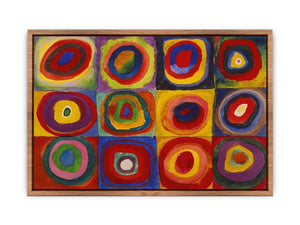


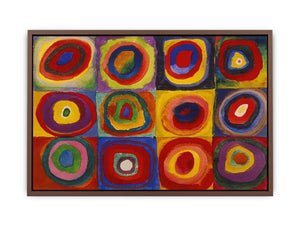

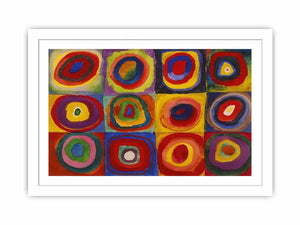


Squares with Concentric Rings
Go kalles this summer with this vintage navy and white striped v-neck t-shirt from the Nike. Perfect for pairing with denim and white kicks for a stylish kalles vibe.

Squares with Concentric Rings
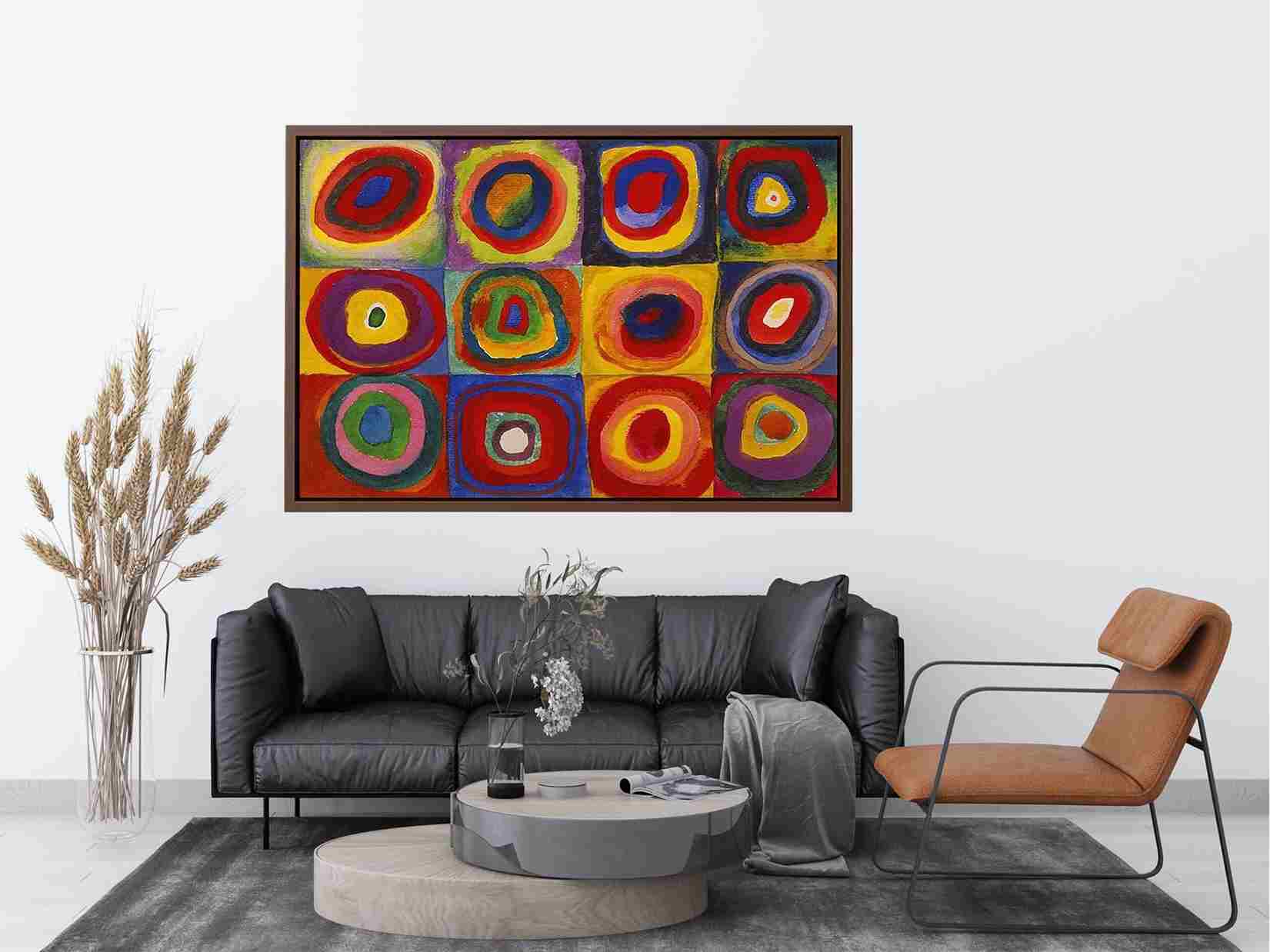
Squares with Concentric Rings Painting by Wassily Kandinsky
Squares with Concentric Rings occupies a singular position within Wassily Kandinsky’s artistic legacy, standing as one of his most direct and pedagogical explorations of colour as an autonomous force. Created in 1913, the work does not function as a traditional painting in the narrative or pictorial sense. Instead, it operates as a visual experiment of exceptional intellectual clarity, revealing Kandinsky’s belief that colour possesses its own inner life, capable of generating emotional and psychological response independent of form, symbolism, or representation. In this work, painting becomes inquiry, and vision becomes a disciplined act of perception.
At the time of its creation, Kandinsky was deeply engaged in developing a new visual language that could articulate spiritual and emotional realities without reference to the visible world. His theoretical writings from this period reveal a conviction that colour alone could function as a direct communicator, much like sound in music. Squares with Concentric Rings emerges from this conviction with unusual purity. Unlike his more complex compositions, which balance colour with dynamic geometry and line, this work isolates colour relationships within a rigid, neutral framework. The square grid serves not as an expressive device, but as a stabilising constant against which colour can be experienced without distraction.
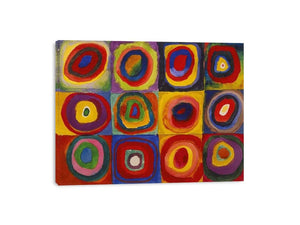
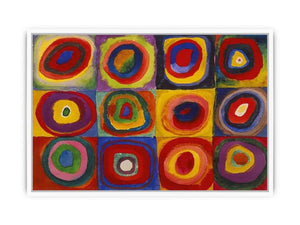
The composition consists of a systematic arrangement of squares, each containing concentric rings of varying colours. The repetition of form is deliberate and absolute. Every square is equal in proportion, eliminating hierarchy, perspective, or focal emphasis. This uniformity is essential to the painting’s meaning. By removing compositional dominance, Kandinsky ensures that attention is directed entirely toward chromatic interaction. The viewer is not guided by narrative or structure, but by sensation.
Colour in Squares with Concentric Rings is the sole protagonist. Kandinsky deploys a broad range of hues, from luminous primaries to subdued secondary and tertiary tones, arranging them so that each square functions as a self-contained chromatic event. The concentric rings generate inward and outward movement, producing a pulsation that is felt rather than seen. Colours advance, retreat, vibrate, and settle depending on their placement and relationship to neighbouring tones. The experience is cumulative. As the eye moves across the grid, perception shifts continuously, revealing how colour alters meaning through proximity and contrast.
The concentric structure intensifies this effect. Rings draw the eye toward a centre while simultaneously pushing outward, creating tension between containment and expansion. Kandinsky understood this dual movement as psychologically potent. The square, traditionally associated with stability and order, becomes a vessel for dynamic sensation. The result is a paradox central to Kandinsky’s thinking: discipline does not suppress emotion; it clarifies it.
Light in this work is not representational. There is no illusion of illumination or shadow. Brightness and depth emerge solely through chromatic relationships. Certain colour combinations appear to glow, while others recede or flatten. Kandinsky exploits these optical effects with precision, allowing the viewer to experience how colour alone can generate spatial sensation. The painting thus functions as both artwork and visual lesson, demonstrating principles that Kandinsky believed were universal and reproducible.
Texture is minimal and controlled. Brushwork does not assert itself. The surface is smooth, reinforcing the neutrality of the framework and preventing materiality from interfering with perception. This restraint underscores the work’s conceptual rigor. Kandinsky did not intend this painting to be admired for technique or expressiveness in the traditional sense. Its value lies in clarity of intention and execution.
Emotionally, Squares with Concentric Rings produces a surprisingly rich range of responses. Despite its apparent austerity, the work is far from cold. Some squares radiate warmth and vitality, others convey calm, tension, or introspection. The absence of narrative allows the viewer’s emotional response to arise directly from perception. Kandinsky believed that this immediacy was essential to spiritual experience in art. The painting does not tell the viewer what to feel; it creates conditions in which feeling emerges naturally.
Within Kandinsky’s artistic evolution, this work occupies a critical role. It is not a culmination, but a foundation. Many of his later, more complex abstractions rely on principles tested here. By isolating colour from expressive gesture and symbolic form, Kandinsky was able to study its effects with scientific seriousness. Squares with Concentric Rings thus bridges art and theory, intuition and analysis, positioning Kandinsky not only as a painter, but as one of the great thinkers of modern visual culture.
The cultural importance of this work extends well beyond its modest scale. It has influenced generations of artists, designers, educators, and architects who recognised in it a method for understanding colour as structure rather than ornament. Its relevance persists across the United States, the United Kingdom, Canada, Australia, and Europe, where contemporary audiences continue to engage with its clarity and intellectual honesty. In an age saturated with imagery, its disciplined reduction feels increasingly radical.
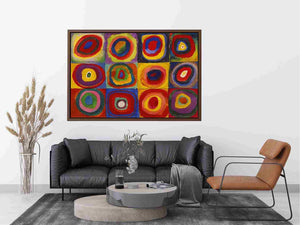
In interior settings, Squares with Concentric Rings introduces intellectual energy and visual rhythm. In living rooms, it functions as a point of contemplation, inviting sustained looking rather than passive consumption. In studies and offices, it reinforces clarity of thought, creativity, and analytical focus. In galleries and luxury residences, it signals refined engagement with one of the most foundational investigations of modern abstraction.
The work integrates seamlessly into traditional, modern, minimalist, and eclectic interiors. In traditional spaces, it provides a striking contrast that enlivens classical surroundings. In modern interiors, it aligns naturally with architectural clarity and design-conscious aesthetics. Minimalist environments benefit from its structural discipline, while eclectic spaces draw coherence from its ordered diversity of colour.
The enduring importance of Squares with Concentric Rings lies in its refusal to disguise complexity behind expression. Kandinsky presents colour as it is: powerful, unstable, and deeply affecting. The painting remains meaningful because it teaches the viewer how to see, not what to see. It affirms that perception itself can be a source of depth and meaning.
To live with Squares with Concentric Rings is to engage daily with one of Kandinsky’s most lucid and intellectually generous works. Through its disciplined structure, chromatic intensity, and philosophical clarity, the painting continues to affirm the possibility of art as a universal language—one that speaks directly to perception, bypassing representation and reaching toward something essential and enduring.
Buy museum qulaity 400- 450 canvas prints, framed prints, and 100% oil paintings of Squares with Concentric Rings by Wassily Kandinsky at Alpha Art Gallery, where world-famous masterpieces are recreated with museum-quality detail, refined craftsmanship, and premium materials.
FAQS
What is the purpose of Squares with Concentric Rings?
The work explores how colour alone can create emotional and spatial effects without reliance on representation or narrative.
Why does Kandinsky use a grid of identical squares?
The uniform structure removes hierarchy and distraction, allowing pure colour relationships to become the focus.
Are the concentric rings symbolic?
They are not symbolic in a narrative sense but serve to intensify inward and outward movement of colour perception.
Is this painting meant to be decorative or instructional?
It is both an artwork and a visual study, demonstrating Kandinsky’s theories of colour perception.
How does this work differ from Kandinsky’s later abstractions?
It isolates colour more rigorously, while later works integrate colour with complex geometry and line.
Is Squares with Concentric Rings suitable for contemporary interiors?
Yes. Its clarity, rhythm, and intellectual presence integrate seamlessly into modern and minimalist spaces.
What emotional response does the painting evoke?
Responses vary by viewer, ranging from calm and harmony to energy and tension, depending on colour interaction.
Does this artwork have lasting artistic significance?
As a foundational study in abstract colour theory, it holds enduring importance in modern art history.
| 1. Select Type |
Canvas Print, Unframed Paper Print, Hand-Painted Oil Painting, Framed Paper Print |
|---|---|
| 2. Select Finish Option |
Rolled Canvas, Rolled- No Frame, Streched Canvas, Black Floating Frame, White Floating Frame, Brown Floating Frame, Black Frame with Matt, White Frame with Matt, Black Frame No Matt, White Frame No Matt, Streched, Natural Floating Frame, Champagne Floating Frame, Gold Floating Frame |
| 3. Select Size |
60cm X 90cm [24" x 36"], 76cm X 114cm [30" x 45"], 90cm X 120cm [36" x 48"], 100cm X 150cm [40" x 60"], 16.54 x 11.69"(A3), 23.39 x 16.54"(A2), 33.11 x 23.39"(A1), 46.81 x 31.11"(A0), 54" X 36", 50cm X 60cm [16" x 24"], 121cm X 182cm [48" x 72"], 135cm X 200cm [54" x 79"], 165cm x 205cm [65" x 81"], 183cm x 228cm [72" x 90"], 22cm X 30cm [9" x 12"], 30cm x 45Cm [12" x 18"], 45cm x60cm [16" x 24'], 75cm X 100cm [30" x 40"], 121cm x 193cm [48" x 76"], 45cm x 60cm [16" x 24'], 20cm x 25Cm [8" x 10"], 35cm x 50Cm [14" x 20"], 45cm x 60 cm [18" x 24"], 35cm x 53Cm [14" x 21"], 66cm X 101cm[26" x 40"], 76cm x 116cm [30"x 46"], 50cm X 60cm 16" x 24"] |