


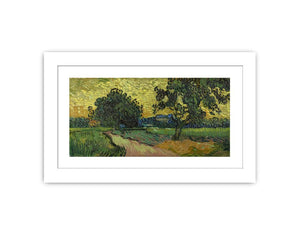
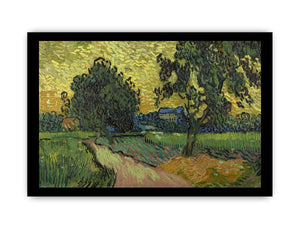

Landscape At Twilight By Van Gogh
Go kalles this summer with this vintage navy and white striped v-neck t-shirt from the Nike. Perfect for pairing with denim and white kicks for a stylish kalles vibe.

Landscape At Twilight By Van Gogh
Landscape at Twilight by Vincent van Gogh is a panoramic landscape painted at Auvers-sur-Oise in June 1890, during the final weeks of the artist’s life. Two dark pear trees rise against a glowing evening sky, with wheat fields stretching toward the distant castle of Auvers. The unusually wide oil-on-canvas painting belongs to Van Gogh’s remarkable final series of double-square landscapes and is now held by the Van Gogh Museum in Amsterdam. Alpha Art Gallery offers reproductions as canvas prints, fine art prints, framed prints and 100% hand-painted oil paintings.
About Landscape at Twilight by Vincent van Gogh
Vincent van Gogh painted Landscape at Twilight at Auvers-sur-Oise, France, in June 1890. Catalogued as F 770 / JH 2040, the work belongs to the extraordinary final phase of his career, when he was exploring the countryside around Auvers through landscapes of wheat fields, gardens, cottages, trees and dramatically changing skies.
The original painting is approximately 50 cm high and just over one metre wide. This unusually elongated format gives the scene the appearance of a panorama. Instead of concentrating attention on one central object, Van Gogh spreads the landscape laterally across the canvas, allowing trees, wheat fields, distant architecture and sky to participate in a single expansive view.
The historic oil painting is today in the Van Gogh Museum in Amsterdam. The painting offered by Alpha Art Gallery is a reproduction of that artwork rather than the museum’s original.
Van Gogh’s Description of the Painting
Landscape at Twilight is particularly valuable because Van Gogh himself described the composition in a letter to his brother Theo dated 24 June 1890. He referred to a night or evening effect with two very dark pear trees set against a yellowing sky, wheat fields beyond them and a castle surrounded by dark greenery in the violet distance.
That contemporary description provides an unusually direct guide to what Van Gogh considered important in the painting. The contrast between the dark foreground trees and the luminous sky is not an accidental feature noticed only by later viewers; it was one of the visual relationships he specifically drew attention to while the work was still newly painted.
The description also helps identify the landscape as a particular place rather than an invented fantasy. Van Gogh was looking at the countryside around Auvers and reorganizing its recognizable features through his increasingly expressive use of colour, contour and brushwork.
Auvers-sur-Oise and Van Gogh’s Final Period
Van Gogh arrived in Auvers-sur-Oise in May 1890 after leaving the Saint-Paul-de-Mausole hospital at Saint-Rémy-de-Provence. The village north of Paris offered open fields, gardens, thatched houses and rolling countryside while allowing him to live closer to his brother Theo and Theo’s family.
His stay at Auvers lasted only a little more than two months, but his output was remarkable. He worked rapidly across landscapes, portraits, gardens and village views, producing some of the most distinctive paintings of his career.
Landscape at Twilight belongs to this intense final campaign. Rather than suggesting that Van Gogh’s late work can be explained solely through biography or psychological interpretation, the painting demonstrates his continuing formal experimentation. Even at this late stage, he was trying new canvas proportions and reconsidering how landscape could be organized.
The Double-Square Format
One of the most distinctive facts about Landscape at Twilight is its shape. Near the end of June 1890, Van Gogh began using canvases approximately twice as wide as they were high. The format is often called a double square because its proportions resemble two squares placed side by side.
Van Gogh created thirteen works in this elongated format during June and July 1890, with landscapes making up almost the entire group. Subjects included wheat fields, gardens, woodland, cottages and other views of rural Auvers.
The format fundamentally changes the viewer’s experience. In a conventional landscape, the eye may be guided toward a dominant central feature or deep perspective. Here, the unusually broad surface encourages the viewer to scan across the image. Dark trees at the front, open fields, distant buildings and sky unfold almost cinematically from side to side.
This panoramic character also makes Landscape at Twilight particularly distinctive as wall art. A reproduction naturally suits broad horizontal spaces where a more conventional rectangular painting might appear comparatively compact.
What Does Landscape at Twilight Depict?
The scene shows the countryside around Auvers as evening approaches. Two prominent pear trees form dark silhouettes in the foreground. Behind them lie cultivated wheat fields, while a distant castle appears enclosed within darker vegetation. Above the land, the sky retains a luminous yellow quality associated with the fading daylight.
The foreground trees immediately establish depth because their dark trunks and branches stand strongly against the brighter sky. Instead of forming a perfectly symmetrical pair, their irregular silhouettes create an organic frame through which the viewer looks toward the fields and distant architecture.
The landscape does not depend on intricate architectural description. The distant castle is absorbed into the broader arrangement of fields, vegetation and evening light. Nature remains the dominant presence.
The Contrast Between Darkness and Light
The strongest visual relationship in the painting is the opposition between the nearly black pear trees and the illuminated sky. The trees occupy the foreground as dense, branching forms, while the yellowing atmosphere behind them produces a striking silhouette effect.
Van Gogh reinforces this contrast through surrounding colours. The distant landscape moves through wheat-field tones, greens and violet passages, preventing the composition from becoming a simple division between black foreground and yellow sky.
Twilight is an especially useful subject for such experimentation because daylight and darkness are simultaneously present. Forms can remain recognizable while their colours and tonal relationships shift rapidly. Van Gogh uses that transitional moment to create a landscape that feels both observed and strongly interpreted.
Brushwork and the Dark Pear Trees
The branches of the foreground trees are rendered through numerous vigorous dark marks. Their irregular network contrasts strongly with the more open sky behind them and gives the upper portion of the composition substantial visual energy.
Van Gogh’s brushwork does not disappear into a smooth illusion. Individual marks remain part of the visual structure, continuing the increasingly expressive handling that characterizes his mature work. The viewer can experience the scene both as a representation of the Auvers countryside and as a surface deliberately built from oil paint.
This quality becomes particularly relevant when choosing between reproduction formats. A printed canvas can reproduce the visual pattern of Van Gogh’s marks, while a hand-painted oil reproduction introduces actual physical brushwork and surface variation.
Wheat Fields in Van Gogh’s Auvers Landscapes
Wheat fields became one of Van Gogh’s most persistent subjects during his time at Auvers. Their broad horizontal structure suited the open countryside surrounding the village and gave him opportunities to explore changing weather, seasonal colour and expansive skies.
In Landscape at Twilight, the wheat fields sit between the dark foreground trees and the more distant castle. This middle ground is crucial because it prevents the large trees from overwhelming the entire scene. The viewer’s eye can move past them and outward across the land.
The horizontal movement of the fields is also perfectly suited to Van Gogh’s new panoramic canvas proportions. The landscape can spread across the picture rather than being compressed into a narrow central perspective.
Is Landscape at Twilight a Post-Impressionist Painting?
Yes. Vincent van Gogh is one of the major artists associated with Post-Impressionism, although the term encompasses painters with very different techniques and artistic aims.
In Landscape at Twilight, the observed countryside remains recognizable, but Van Gogh does not simply reproduce natural appearances. Colour relationships are intensified, outlines become expressive, and visible brushwork contributes to the emotional and structural character of the scene.
This approach illustrates one of the important developments beyond Impressionism: landscape could become not only a record of changing light but also a vehicle for highly individual composition, colour and expression.
What Does Landscape at Twilight Mean?
The painting naturally invites interpretations concerning transition because twilight itself marks the passage between day and night. Dark trees against a fading sky may evoke stillness, uncertainty or contemplation for modern viewers.
However, there is no need to impose a fixed symbolic meaning on every element. Van Gogh’s own surviving description focuses primarily on the visual scene: the dark pear trees, yellowing sky, wheat fields, violet distance and castle enclosed in vegetation.
Interpretations involving mortality or the end of Van Gogh’s life should therefore be treated cautiously. The painting was made shortly before his death, but chronological proximity does not prove that every feature was deliberately conceived as autobiographical symbolism. What can be stated confidently is that Van Gogh was deeply engaged with the visual effects of evening in the Auvers landscape.
Why Landscape at Twilight Is Important
The painting is important for both its imagery and its format. It belongs to Van Gogh’s final experimental group of elongated canvases and shows that he continued reconsidering fundamental questions of scale and composition during the last weeks of his career.
It also documents the relationship between an actual Auvers landscape and Van Gogh’s mature style. Familiar elements—trees, crops, distant architecture and sky—are transformed through strong silhouettes, expressive colour and active brushwork.
Among Van Gogh’s late landscapes, the enormous width creates a particularly immersive experience. Collectors exploring other masterpieces from art history can use this painting to see how radically an artist can alter the emotional character of a conventional countryside view through format alone.
Historical Artwork Details
| Artist | Vincent van Gogh |
|---|---|
| Title | Landscape at Twilight |
| Catalogue references | F 770 / JH 2040 |
| Date | June 1890 |
| Place created | Auvers-sur-Oise, France |
| Original medium | Oil on canvas |
| Original size | Approximately 50 × 101 cm |
| Orientation | Extra-wide horizontal / double-square format |
| Movement | Post-Impressionism |
| Current collection | Van Gogh Museum, Amsterdam |
Alpha Art Gallery offers reproductions of this historical artwork rather than the Van Gogh Museum’s original painting. Alpha Art Gallery is not affiliated with or endorsed by the Van Gogh Museum, and “museum-quality” describes Alpha Art Gallery’s reproduction format rather than museum certification.
Choose Your Landscape at Twilight Reproduction
The unusually panoramic proportions make this painting different from many other Van Gogh works. Choosing the right reproduction format can emphasize either its scale, printed detail, framed presentation or expressive painted surface.
| Format | How It Presents the Artwork | Best Suited To |
|---|---|---|
| Canvas Print | Emphasizes the panoramic sweep with a textured canvas presentation | Wide feature walls and statement artwork |
| Fine Art Print | Refined traditional printed presentation | Collectors wanting clearly defined detail and colour |
| Framed Print | Adds a structured boundary around the extremely wide landscape | Finished residential or professional interiors |
| Hand-Painted Oil Reproduction | Real oil paint with individually created brushwork and physical texture | Buyers who value Van Gogh’s painterly surface |
Museum-Quality Canvas Print
Alpha Art Gallery’s canvas prints use substantial 400–450 GSM museum-quality canvas. This format is particularly effective for Landscape at Twilight because the painting’s exceptional width gives it natural presence when reproduced at larger scale.
A canvas print allows the panoramic image itself to dominate. The dark trees can anchor the wall while the lighter sky and fields extend across the available space, creating a strong horizontal visual line.
Fine Art and Framed Prints
A fine art print offers a more traditional printed presentation and can be useful when precise definition of the branching silhouettes, distant fields and castle is the priority.
A framed print adds an external boundary around Van Gogh’s elongated composition. Because the original has such unusual proportions, framing can emphasize its panoramic character and make the piece appear intentionally architectural within a room.
100% Hand-Painted Oil Painting Reproduction
Alpha Art Gallery also offers 100% hand-painted oil painting reproductions, individually painted by professional artists using oil on canvas.
For Landscape at Twilight, this option can be especially appealing around the dark pear trees, where energetic brushmarks form a dense network of branches against the luminous sky. Actual oil paint provides real texture and handmade variation rather than merely reproducing the appearance of brushwork through printing.
Each hand-painted version is a reproduction and is not represented as Van Gogh’s original painting.
Which Format Is Best for Landscape at Twilight?
Canvas is particularly well matched to this composition if your goal is dramatic wall presence because the extraordinary horizontal proportions benefit from substantial scale. A fine art print is appropriate when you prefer a conventional printed artwork presentation.
A framed print can make the panoramic shape feel more architectural, while a hand-painted oil reproduction is most relevant when physical brushwork and handmade character are important to the purchase decision.
There is no universally superior format. The most suitable option depends on whether your priority is scale, printed refinement, framing or real painted texture.
How to Display Landscape at Twilight as Wall Art
The approximately two-to-one proportions make this one of Van Gogh’s most naturally panoramic compositions. It is particularly well suited to broad walls above sofas, beds, sideboards, dining furniture, reception consoles or long office credenzas.
Unlike a square or vertical painting, the artwork needs enough lateral space for its format to feel intentional. When displayed at a generous size, the long sequence of dark trees, fields and evening sky can create an immersive visual horizon across the room.
The scene also offers an unusual balance between drama and restraint. The dark silhouettes create strong contrast, while the agricultural landscape and fading sky keep the subject grounded in nature. This combination can work in both traditional and contemporary interiors.
Choosing the Right Size
Measure the usable wall width before selecting a reproduction. Because this painting is exceptionally wide relative to its height, wall width is more important than simply choosing a size according to room type.
On a large wall, increasing the scale strengthens the panoramic effect and allows the pear-tree branches and distant landscape to remain legible. In a smaller space, a framed fine art print may preserve the complete composition without requiring the visual dominance of a very large canvas.
If standard dimensions do not suit a particular interior project, Alpha Art Gallery also offers custom artwork and commission services where applicable.
Where Can I Buy Landscape at Twilight by Van Gogh?
Alpha Art Gallery offers Vincent van Gogh’s Landscape at Twilight as a museum-quality canvas print, fine art print, framed print and 100% hand-painted oil painting reproduction. Multiple sizes and frame choices are available where applicable.
Artwork is securely packaged for delivery, and Alpha Art Gallery provides free worldwide shipping on all orders. Production facilities in the USA, Australia, United Kingdom and Canada support worldwide fulfilment.
Why Choose Alpha Art Gallery?
- Multiple reproduction formats: choose canvas, fine art, framed or individually hand-painted oil.
- 400–450 GSM canvas: particularly suitable for this wide panoramic landscape.
- Hand-painted option: professional artists individually create oil reproductions on canvas.
- Multiple sizes: select a scale appropriate for your available wall width.
- Frame options: available where applicable for a finished presentation.
- Secure packaging: artwork is prepared carefully for international delivery.
- Free worldwide shipping: included on all Alpha Art Gallery orders.
Frequently Asked Questions About Landscape at Twilight
Who painted Landscape at Twilight?
Vincent van Gogh painted Landscape at Twilight in June 1890. The Dutch Post-Impressionist created it during his short final stay at Auvers-sur-Oise, where he produced an exceptional group of landscapes depicting fields, houses, gardens and the surrounding countryside.
When was Landscape at Twilight painted?
Van Gogh painted the work in June 1890, approximately one month before his death. His letter to Theo dated 24 June specifically describes the painting, providing strong documentary evidence for both its date and its subject.
Where did Van Gogh paint Landscape at Twilight?
The painting was created at Auvers-sur-Oise, France. Van Gogh spent his final months in the village and worked extensively in the surrounding countryside. The distant architecture in this scene includes the castle at Auvers surrounded by dark vegetation.
What does Landscape at Twilight depict?
The painting depicts two dark pear trees silhouetted against a yellowing twilight sky, with wheat fields beyond and the castle of Auvers visible amid dark greenery in the distance. Van Gogh himself described these principal elements in his June 1890 correspondence with his brother Theo.
Where is the original Landscape at Twilight?
The historic original is held by the Van Gogh Museum in Amsterdam, Netherlands. Alpha Art Gallery offers reproductions of the artwork and does not sell or claim ownership of the museum’s original painting.
How large is the original painting?
Landscape at Twilight measures approximately 50 × 101 cm. Its unusual proportions belong to the elongated double-square canvas format Van Gogh began using during his final weeks at Auvers.
Why is Landscape at Twilight so wide?
Van Gogh deliberately experimented with a new panoramic canvas format near the end of June 1890. He produced thirteen works using approximately these proportions, almost all landscapes. The width allowed him to develop broad views of fields, gardens, woodland and rural Auvers that unfold laterally across the canvas.
What art movement is Landscape at Twilight?
The painting is associated with Post-Impressionism. Van Gogh used recognizable landscape elements but transformed them through expressive colour, strong silhouettes and visible brushwork rather than limiting himself to literal naturalistic representation.
Does Landscape at Twilight symbolize Van Gogh’s death?
No single interpretation of that kind can be stated as documented fact. Because the painting was created shortly before Van Gogh’s death, viewers sometimes read the twilight setting symbolically. Van Gogh’s own description, however, concentrates on the visual landscape—the pear trees, evening sky, wheat fields and distant castle—so broader symbolic readings should remain interpretations.
Can I buy Landscape at Twilight as a canvas print?
Yes. Alpha Art Gallery offers the painting on 400–450 GSM museum-quality canvas in multiple sizes. Its unusually wide composition makes canvas particularly effective for broad feature walls where the panoramic proportions can be appreciated fully.
Can I order a framed Landscape at Twilight print?
Yes. Framed print options are available where applicable. The defined outer border can emphasize the painting’s unusual elongated shape while providing a finished presentation for living rooms, bedrooms, offices and commercial interiors.
Can I buy a hand-painted Van Gogh reproduction?
Yes. Alpha Art Gallery offers a 100% hand-painted oil reproduction of Landscape at Twilight. Professional artists individually paint each reproduction on canvas, creating actual brushwork, physical texture and subtle handmade variation. It remains a reproduction rather than Van Gogh’s historical original.
Does Alpha Art Gallery ship Landscape at Twilight worldwide?
Yes. Alpha Art Gallery provides free worldwide shipping on all orders. Reproductions are securely packaged and available internationally in several formats and sizes.
Bring Van Gogh’s Auvers Twilight Into Your Space
Landscape at Twilight captures the moment when daylight fades across the fields of Auvers, turning two pear trees into dramatic silhouettes against a luminous sky. Its extraordinary panoramic format, documented connection to Van Gogh’s final weeks and distinctive balance of darkness and evening light make it one of his most compelling late landscapes. Choose a canvas print, fine art print, framed version or individually hand-painted oil reproduction in a size that gives this unusually wide composition the space it deserves.
| 1. Select Type |
Museum Canvas, Fine Art Paper, Hand-Painted Oil Painting, Satin Photo Paper |
|---|---|
| 2. Select Finish Option |
Rolled Canvas, Rolled- No Frame, Black Frame with Matt, White Frame with Matt, Black Frame No Matt, White Frame No Matt, Streched Canvas, Black Floating Frame, White Floating Frame, Brown Floating Frame, Rolled No Framed, Streched, Natural Floating Frame, Champagne Floating Frame, Gold Floating Frame |
| 3. Select Size |
60cm X 90cm [24" x 36"], 76cm X 114cm [30" x 45"], 82cm X 120cm [32" x 48"], 100cm X 150cm [40" x 60"], 22cm X 30cm [9" x 12"], 16.54 x 11.69"(A3), 25cm x 76cm [10" x 30"], 41cm x 61cm [16" x 24"], 20cm x 25Cm [8" x 10"], 30cm x 45Cm [12" x 18"], 35cm x 50Cm [14" x 20"], 45cm x 60 cm [18" x 24"], 35cm x 53Cm [14" x 21"], 66cm X 101cm[26" x 40"], 76cm x 116cm [30"x 46"], 50cm X 60cm [16" x 24"], 121cm X 182cm [48" x 72"], 135cm X 200cm [54" x 79"], 165cm x 205cm [65" x 81"], 183cm x 228cm [72" x 90"], 45cm x60cm [16" x 24'], 75cm X 100cm [30" x 40"], 121cm x 193cm [48" x 76"], 45cm x 60cm [16" x 24'], 50cm X 60cm 16" x 24"] |