





At The Moulin Rouge
Go kalles this summer with this vintage navy and white striped v-neck t-shirt from the Nike. Perfect for pairing with denim and white kicks for a stylish kalles vibe.

At The Moulin Rouge
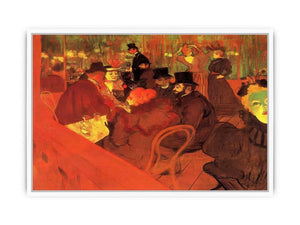
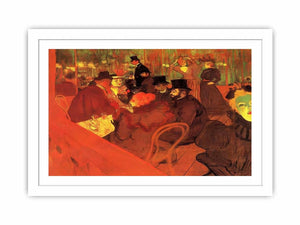
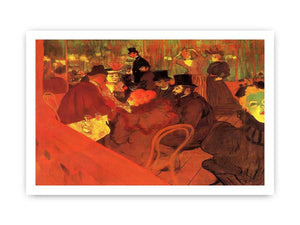
At The Moulin Rouge Painting by Henri de Toulouse-Lautrec
At The Moulin Rouge stands as one of the most penetrating and psychologically complex works of late nineteenth-century modern art, a painting in which Henri de Toulouse-Lautrec transformed Parisian nightlife into an unvarnished study of presence, alienation, and spectacle. Painted in 1892–1895, the work is neither a celebratory scene nor a moral critique. Instead, it functions as an unflinching observation of modern life, capturing the tension between public performance and private isolation within one of Paris’s most famous entertainment venues.
By the early 1890s, Toulouse-Lautrec had become an essential chronicler of Montmartre’s nightlife. He moved easily among dancers, singers, patrons, and proprietors, not as a detached observer but as a familiar presence. His physical condition and social position placed him simultaneously inside and outside the world he depicted. At The Moulin Rouge emerges directly from this lived proximity. The painting is not imagined or theatricalised; it is constructed from memory, experience, and acute psychological insight.
The composition is strikingly unconventional. Figures are cropped abruptly, compressed into a shallow interior space that feels crowded yet emotionally distant. The table in the foreground cuts across the scene, anchoring the viewer within the space rather than offering a comfortable vantage point. This compositional choice dissolves the separation between observer and subject. The viewer does not watch the scene unfold from afar; they are placed among the figures, subject to the same disorientation and visual overload.
Perspective is deliberately destabilised. Traditional depth is flattened, and spatial logic is subordinated to perception. Faces appear at different scales, some looming close, others receding abruptly. This distortion mirrors the psychological environment of the nightclub itself—a place of artificial light, constant motion, and fractured attention. Toulouse-Lautrec does not attempt to correct or smooth these effects. He embraces them, using visual imbalance to communicate emotional truth.
Colour plays a decisive role in shaping the painting’s unsettling atmosphere. The palette is dominated by acidic greens, harsh yellows, and bruised reds that resist harmony. These colours are not decorative. They evoke the glare of gaslight, the fatigue of late hours, and the estrangement produced by constant exposure to spectacle. Skin tones appear pallid or distorted, reinforcing the sense that the figures are illuminated rather than warmed by their environment. Colour here functions psychologically, not descriptively.
Light is artificial and unforgiving. Faces are lit from below or the side, exaggerating features and flattening expressions. This lighting denies romantic glamour, replacing it with exposure. Toulouse-Lautrec reveals his subjects without sentimentality, allowing neither idealisation nor condemnation. The result is a vision of nightlife stripped of illusion, where entertainment is inseparable from exhaustion.
Gesture and expression are rendered with ruthless precision. Figures sit, lean, or turn toward one another, yet rarely connect. Conversations seem suspended rather than engaged. Eyes drift, faces harden, mouths tighten. Even where familiarity exists, intimacy does not. Toulouse-Lautrec captures the peculiar loneliness of crowded spaces, where proximity does not guarantee connection. This psychological insight is central to the painting’s enduring power.
The presence of the artist himself within the composition adds another layer of complexity. Toulouse-Lautrec includes his own likeness among the figures, reinforcing the painting’s reflexive quality. He is both participant and witness, implicated in the scene yet conscious of its artifice. This dual position allows the painting to operate as both documentation and self-examination, blurring the boundary between subject and observer.
Symbolically, At The Moulin Rouge resists allegory. Its meaning arises through accumulation rather than metaphor. The nightclub becomes a microcosm of modern urban life, defined by speed, performance, and emotional distance. The painting does not moralise this condition, nor does it offer resolution. It simply presents it, insisting on attention rather than interpretation. In this refusal to explain, Toulouse-Lautrec aligns himself with modernity’s ambiguity.
Emotionally, the painting is tense and unresolved. There is energy in the scene, but it is brittle rather than exuberant. Viewers often experience discomfort alongside fascination, drawn in by the immediacy of the setting yet unsettled by its emotional vacancy. This response is deliberate. Toulouse-Lautrec does not seek to please. He seeks to reveal.
Within the artist’s career, At The Moulin Rouge represents a culmination of his artistic philosophy. It unites his interest in contemporary life, his mastery of composition, and his acute psychological perception. Unlike his posters, which distilled movement into graphic clarity, this painting embraces complexity and contradiction. It demonstrates that Toulouse-Lautrec was not merely an illustrator of nightlife, but one of its most profound interpreters.
Culturally, the painting occupies a critical position in the transition toward modern art. It rejects narrative closure, ideal beauty, and moral certainty. Instead, it embraces fragmentation, subjectivity, and psychological depth. These qualities would become central to twentieth-century artistic practice. At The Moulin Rouge anticipates the modern understanding of the city as a space of performance and alienation, making it as relevant now as it was at the end of the nineteenth century.
In contemporary interiors, At The Moulin Rouge commands attention through intellect rather than ornament. In living rooms, it functions as a provocative focal point that invites conversation and sustained looking. In studies and offices, it communicates cultural sophistication and psychological depth. In galleries and curated residences across the United States, United Kingdom, Canada, Australia, and Europe, the painting integrates powerfully with modern, minimalist, and eclectic décor. Its muted yet confrontational palette complements contemporary interiors while asserting unmistakable historical authority.
The enduring relevance of At The Moulin Rouge lies in its honesty. Toulouse-Lautrec reveals modern life not as spectacle alone, but as experience—fractured, luminous, and emotionally complex. The painting reminds viewers that behind every performance lies fatigue, behind every crowd lies isolation, and behind every illuminated surface lies shadow. In capturing this truth without judgment, Toulouse-Lautrec created a work that continues to speak with clarity and force to the modern condition.
Buy museum qulaity 400- 450 canvas prints, framed prints, and 100% oil paintings of At The Moulin Rouge by Henri de Toulouse-Lautrec at Alpha Art Gallery, where world-famous masterpieces are recreated with museum-quality detail, refined craftsmanship, and premium materials.
FAQS
What does At The Moulin Rouge depict?
It depicts patrons and performers inside the Moulin Rouge nightclub, capturing the psychological atmosphere rather than a specific event.
Why is the painting considered psychologically intense?
Toulouse-Lautrec emphasises alienation, fatigue, and emotional distance within a crowded social setting.
How does colour contribute to the painting’s mood?
Harsh greens and yellows evoke artificial light and discomfort, reinforcing the scene’s unsettling tone.
Why does the composition feel disorienting?
Flattened space, abrupt cropping, and distorted perspective mirror the sensory overload of nightlife.
Is the artist present in the painting?
Yes, Toulouse-Lautrec includes himself, reinforcing his role as both participant and observer.
Does the painting criticise Parisian nightlife?
It neither condemns nor celebrates it, presenting nightlife as lived experience rather than moral statement.
Is At The Moulin Rouge suitable for contemporary interiors?
Yes, its intellectual depth and modern sensibility make it well suited to refined and contemporary spaces.
Why does At The Moulin Rouge remain important today?
Its exploration of performance, isolation, and modern urban life continues to resonate strongly in contemporary culture.
| 1. Select Type |
Canvas Print, Unframed Paper Print, Hand-Painted Oil Painting, Framed Paper Print |
|---|---|
| 2. Select Finish Option |
Rolled Canvas, Rolled- No Frame, Streched Canvas, Black Floating Frame, White Floating Frame, Brown Floating Frame, Black Frame with Matt, White Frame with Matt, Black Frame No Matt, White Frame No Matt, Streched, Natural Floating Frame, Champagne Floating Frame, Gold Floating Frame |
| 3. Select Size |
60cm X 90cm [24" x 36"], 76cm X 114cm [30" x 45"], 90cm X 120cm [36" x 48"], 100cm X 150cm [40" x 60"], 16.54 x 11.69"(A3), 23.39 x 16.54"(A2), 33.11 x 23.39"(A1), 46.81 x 31.11"(A0), 54" X 36", 50cm X 60cm [16" x 24"], 121cm X 182cm [48" x 72"], 135cm X 200cm [54" x 79"], 165cm x 205cm [65" x 81"], 183cm x 228cm [72" x 90"], 22cm X 30cm [9" x 12"], 30cm x 45Cm [12" x 18"], 45cm x60cm [16" x 24'], 75cm X 100cm [30" x 40"], 121cm x 193cm [48" x 76"], 45cm x 60cm [16" x 24'], 20cm x 25Cm [8" x 10"], 35cm x 50Cm [14" x 20"], 45cm x 60 cm [18" x 24"], 35cm x 53Cm [14" x 21"], 66cm X 101cm[26" x 40"], 76cm x 116cm [30"x 46"], 50cm X 60cm 16" x 24"] |