








A Rustic Mill
Go kalles this summer with this vintage navy and white striped v-neck t-shirt from the Nike. Perfect for pairing with denim and white kicks for a stylish kalles vibe.

A Rustic Mill
A Rustic Mill Painting by Albert Bierstadt
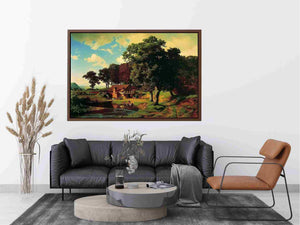
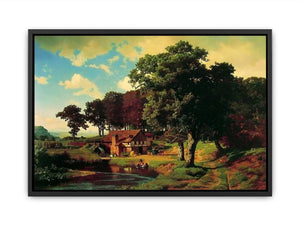
A Rustic Mill stands apart within Albert Bierstadt’s body of work as a quietly contemplative meditation on human presence within nature, offering an intimate counterpoint to the vast western panoramas for which the artist is most widely known. Painted during the mid-nineteenth century, the work reveals Bierstadt’s sensitivity to scale not as spectacle alone, but as relationship. Here, the grandeur of the natural world does not overwhelm the scene; instead, it shelters and contextualises a modest human structure, presenting coexistence rather than conquest as the central theme.
Albert Bierstadt’s artistic reputation was shaped by monumental landscapes that articulated the American sublime through sweeping vistas and luminous light. Yet his training in Europe and his grounding in the traditions of Romantic landscape painting also fostered an appreciation for pastoral intimacy and narrative restraint. A Rustic Mill emerges from this lineage. Rather than positioning the viewer at a commanding height, Bierstadt draws attention inward, toward a secluded environment shaped by water, wood, and time. The painting does not proclaim; it invites.
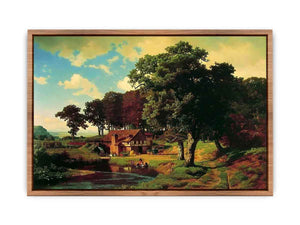
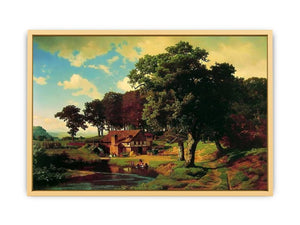
The composition is structured around balance and enclosure. A small mill, constructed of timber and stone, occupies a natural clearing beside a gently flowing stream. Trees frame the scene, their foliage forming a visual canopy that encloses the space and softens the transition between foreground and background. The mill is neither dominant nor obscured. It exists in measured proportion to its surroundings, suggesting harmony rather than intrusion. Bierstadt carefully arranges natural forms so that the eye moves fluidly through the scene, guided by the stream’s course and the gentle recession of space.
Perspective is intimate and grounded. The viewer stands at a human scale, close enough to sense the texture of wood, water, and earth, yet distant enough to absorb the scene as a unified whole. This vantage point encourages contemplation rather than awe. Unlike Bierstadt’s alpine landscapes, which often place the viewer before vast, uninhabitable space, A Rustic Mill situates the observer within an environment shaped by daily life. The painting feels inhabitable, lived-in, and continuous.
Light plays a central role in shaping the painting’s atmosphere. Bierstadt employs a soft, diffused illumination that filters through foliage and reflects gently off water and stone. This light does not dramatise the scene through sharp contrast. Instead, it enhances form and texture with subtle clarity. Shadows are present but restrained, contributing depth without obscuring detail. The effect is one of calm visibility, as though the scene exists in a perpetual state of quiet daylight.
Colour is handled with naturalistic restraint. Earthy browns, muted greens, and cool greys dominate the palette, reinforcing the painting’s pastoral character. Bierstadt avoids chromatic drama, allowing tonal harmony to establish mood. The water reflects surrounding colours rather than asserting its own, further integrating all elements into a cohesive visual system. Colour here serves atmosphere rather than emphasis, supporting the painting’s sense of continuity and repose.
Bierstadt’s technique remains polished and controlled, reflecting his academic discipline. Surfaces are smooth, transitions are seamless, and detail is present without excess. The mill’s structure is rendered with care, its weathered surfaces suggesting age and use rather than neglect. Trees and foliage are described with clarity but not fussiness, ensuring that no single element disrupts the painting’s equilibrium. Brushwork remains largely invisible, reinforcing the illusion of permanence and stillness.
Symbolically, A Rustic Mill functions as an image of equilibrium between human labour and natural rhythm. The mill represents industry on a modest scale—productive yet unobtrusive, reliant on natural forces rather than domination over them. Water flows steadily, trees stand firm, and the structure endures through adaptation rather than resistance. Bierstadt does not depict progress as expansion or transformation, but as continuity. The painting suggests a world in which human activity aligns with environmental order rather than displacing it.
Emotionally, the work evokes quiet reassurance. There is no urgency, no narrative tension, no impending change. Viewers often experience a sense of withdrawal from noise and speed, as though the painting offers a refuge from intensity. This emotional tone distinguishes the work within Bierstadt’s oeuvre. While his grand landscapes inspire awe, A Rustic Mill cultivates calm. It affirms that significance can reside in stillness and that beauty may be found in modest, enduring relationships between people and place.
Within Bierstadt’s career, this painting reveals the breadth of his artistic vision. It demonstrates that his engagement with landscape was not limited to the heroic or monumental. He was equally capable of finding meaning in scenes shaped by daily life and quiet labour. A Rustic Mill aligns Bierstadt with Romantic traditions that valued the pastoral as a site of moral and emotional clarity, bridging European influences with American subject matter.
Culturally, the painting reflects nineteenth-century ideals that associated rural life with balance, virtue, and continuity. At a time of rapid industrialisation and territorial expansion, such images offered reassurance that harmony between humanity and nature remained possible. While modern perspectives recognise the idealisation inherent in such visions, A Rustic Mill remains a revealing artifact of how landscape painting articulated cultural values alongside aesthetic ones.
In contemporary interiors, A Rustic Mill offers exceptional versatility and warmth. In living rooms, it introduces calm narrative presence without visual dominance. In studies and offices, it encourages reflection and focus, providing a counterpoint to abstraction and intensity. In galleries and luxury residences across the United States, United Kingdom, Canada, Australia, and Europe, the painting integrates seamlessly with traditional, rustic, modern, and transitional décor. Its natural palette complements wood, stone, and neutral interiors, while its subject matter grounds spaces with a sense of continuity and care.
The enduring relevance of A Rustic Mill lies in its affirmation of proportion and patience. Bierstadt presents a vision of the world in which human structures do not overwhelm their surroundings, and where progress is measured through coexistence rather than scale. The painting reminds viewers that meaning can be sustained through balance, that labour can be gentle, and that beauty often emerges where attention is quiet and sustained. In offering this vision, Bierstadt expands the language of American landscape painting, leaving behind not only images of grandeur, but also images of belonging.
Buy museum qulaity 400- 450 canvas prints, framed prints, and 100% oil paintings of A Rustic Mill by Albert Bierstadt at Alpha Art Gallery, where world-famous masterpieces are recreated with museum-quality detail, refined craftsmanship, and premium materials.
FAQS
What does A Rustic Mill by Albert Bierstadt depict?
It depicts a small mill set within a natural landscape, emphasising harmony between human activity and the surrounding environment.
How does this painting differ from Bierstadt’s monumental landscapes?
It focuses on intimacy and balance rather than vast scale and dramatic spectacle.
What role does light play in the painting?
Soft, diffused light enhances calm, texture, and visibility without theatrical contrast.
Is the mill symbolic within the composition?
Yes, it symbolises modest human industry existing in alignment with natural rhythms.
Does the painting reflect a real location?
It is inspired by observation but composed as an idealised pastoral vision rather than a specific site.
What emotional tone does the painting convey?
It conveys serenity, reassurance, and quiet continuity.
Is A Rustic Mill suitable for contemporary interiors?
Yes, its calm palette and narrative warmth suit both modern and traditional spaces.
Why does A Rustic Mill remain relevant today?
Its vision of balance between humanity and nature resonates strongly in a world seeking sustainability and calm.
| 1. Select Type |
Canvas Print, Unframed Paper Print, Hand-Painted Oil Painting, Framed Paper Print |
|---|---|
| 2. Select Finish Option |
Rolled Canvas, Rolled- No Frame, Streched Canvas, Black Floating Frame, White Floating Frame, Brown Floating Frame, Black Frame with Matt, White Frame with Matt, Black Frame No Matt, White Frame No Matt, Streched, Natural Floating Frame, Champagne Floating Frame, Gold Floating Frame |
| 3. Select Size |
60cm X 90cm [24" x 36"], 76cm X 114cm [30" x 45"], 90cm X 120cm [36" x 48"], 100cm X 150cm [40" x 60"], 16.54 x 11.69"(A3), 23.39 x 16.54"(A2), 33.11 x 23.39"(A1), 46.81 x 31.11"(A0), 54" X 36", 50cm X 60cm [16" x 24"], 121cm X 182cm [48" x 72"], 135cm X 200cm [54" x 79"], 165cm x 205cm [65" x 81"], 183cm x 228cm [72" x 90"], 22cm X 30cm [9" x 12"], 30cm x 45Cm [12" x 18"], 45cm x60cm [16" x 24'], 75cm X 100cm [30" x 40"], 121cm x 193cm [48" x 76"], 45cm x 60cm [16" x 24'], 20cm x 25Cm [8" x 10"], 35cm x 50Cm [14" x 20"], 45cm x 60 cm [18" x 24"], 35cm x 53Cm [14" x 21"], 66cm X 101cm[26" x 40"], 76cm x 116cm [30"x 46"], 50cm X 60cm 16" x 24"] |